Last updated: August 13, 2026
Lettuce is the crop hydroponics was practically designed for. It roots shallowly, finishes in weeks rather than months, needs no pollination, and responds to a well managed nutrient solution with a speed that surprises people used to soil. Knowing how to grow hydroponic lettuce at home comes down to four controllable variables: solution strength, pH, water temperature, and light.
This guide walks the full cycle, from a seed in a plug to a head on a plate, with the numbers stated as ranges rather than laws. If you would rather compare hydroponics against pots of potting mix on a windowsill first, start with our broader guide on how to grow lettuce indoors.
This article contains affiliate links. If you buy through them, we may earn a commission at no extra cost to you. Learn more.
Quick Answer
How do you grow hydroponic lettuce at home?
- Germinate seed in rockwool cubes or peat plugs, then move the seedling into a net pot once roots poke through, usually after around 10 to 14 days.
- Run a nutrient solution most growers keep near a pH of 5.5 to 6.5, at a fairly low strength, and keep the water below roughly 72 F so oxygen stays available.
- Give 12 to 16 hours of light a day and expect a harvestable head in roughly 4 to 6 weeks from transplant, sooner if you cut baby leaves.
The Hydroponic Lettuce Timeline at a Glance
The crop moves through four clear stages, and each one wants slightly different handling. Solution strength climbs as the plant grows, light stays constant, and your attention shifts from moisture to oxygen. Print this table and you have the whole cycle.
| Stage | Roughly | Solution | What to watch |
|---|---|---|---|
| Germination | Days 1 to 10 | Plain pH adjusted water, no nutrients yet | Even moisture, gentle light once sprouts appear, temperatures around 60 to 70 F |
| Seedling | Days 7 to 14 | Quarter to half strength feed, commonly around 0.4 to 0.8 EC | Roots emerging from the plug, short sturdy stems rather than stretching |
| Transplant and establish | Days 12 to 21 | Around half to three quarter strength | Water level touching the plug base, roots reaching down within a few days |
| Grow out | Weeks 3 to 6 | Full leafy green strength, commonly around 0.8 to 1.2 EC | Water temperature, root color, tip damage on new leaves |
| Harvest | Weeks 4 to 6 onward | Unchanged until the reservoir is emptied | Firm heart, no upward stretching, cut before the plant bolts |
Treat those EC figures as a commonly cited working range rather than a law. Meters, water sources, and nutrient lines all read differently, and the plant in front of you is the better instrument.
Pick a System That Matches Your Appetite
Any of the four common home systems grows excellent lettuce, so choose on effort and volume rather than results. Passive systems need no electricity, active systems grow slightly faster, and countertop units trade capacity for convenience.
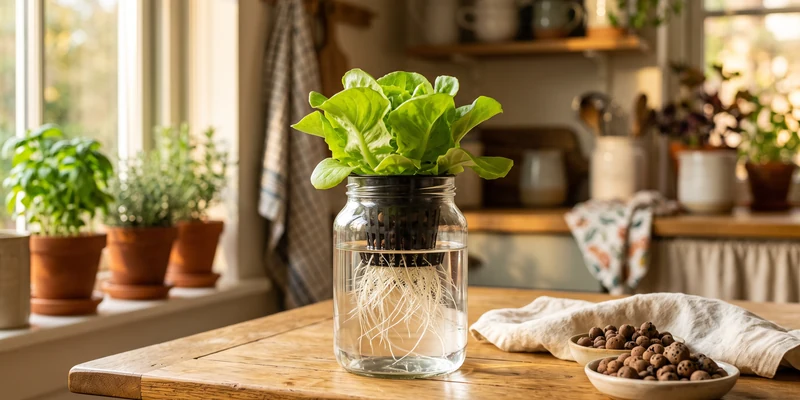
The Kratky method is the cheapest entry: one fill of solution, an air gap that grows as the level drops, and no pump, which suits a crop that finishes before the reservoir runs dry. Deep water culture adds an air pump and airstone. NFT channels suit anyone who wants a dozen or more heads in a small footprint, and a countertop smart garden hides all of it behind a lid. Our roundup of hydroponic systems for lettuce compares them, and the passive route is covered in the Kratky method guide.
Germinating in Plugs, Not in the System
Start seed in a medium, never directly in the reservoir. Rockwool cubes and peat or coco plugs both work, because they hold the seed at the right moisture and drop straight into a net pot later. Sow two or three seeds per plug and thin to the strongest seedling.
Rockwool arrives alkaline out of the bag, so most growers soak cubes in water adjusted to around a pH of 5.5 before sowing. Keep plugs covered until sprouts show, typically within 2 to 10 days, then get the lid off and the light on. Leaving a dome on after germination produces the long, floppy stems that never recover. A sheet of 1.5 inch rockwool starter cubes is the standard buy here, and one sheet covers several sowings.

Light the seedlings from day one
Seedlings need less intensity than mature plants but the same long hours. Keep a small LED at the distance the manufacturer recommends, often around 12 to 24 inches for panels, and raise the tray if stems stretch. Our guide to the best grow light for seedlings covers this stage.
Transplanting Without Stalling Growth
Move a seedling when roots poke out of the plug and it has one or two sets of true leaves, usually around 10 to 14 days. Set the whole plug into a net pot, pack clay pebbles around it for support, and never bury the crown.
Water level at transplant decides the next week. The solution should just touch the base of the plug or sit a fraction below, so capillary action keeps it damp while young roots grow down. Too low and the plug dries out before roots find water; too high and the stem sits wet. In a passive system the level then falls on purpose, leaving the air gap that keeps roots breathing. Our net pots guide covers sizing and the clay pebbles explainer the medium. Lettuce sits comfortably in 2 to 3 inch net pots, and a multi pack costs little enough that having spares is the sensible default.

Mixing the Solution: pH, Strength, and Order
Lettuce is a light feeder, and overfeeding is far more common than underfeeding. Most growers run leafy greens at a low strength, commonly cited around 0.8 to 1.2 EC once established, and hold pH in the 5.5 to 6.5 band where the full range of nutrients stays available.
Mix in the right order: water first, each nutrient part added separately and stirred before the next, and pH adjusted only once everything is in. Concentrated A and B parts poured together lock out calcium as a solid, which is the most common mixing error. Powdered blends are popular for cost, with a widely used starting ratio of roughly two parts MasterBlend to two parts calcium nitrate to one part Epsom salt by weight, always following the label for quantities. The three components are usually sold together as one combo kit, which saves sourcing them separately.

Test, do not guess
A cheap pH pen that drifts is worse than no pen, because it makes you confident about a wrong number. Calibrate before a new crop and keep the probe wet. Deeper detail lives in how to mix hydroponic nutrients and pH for hydroponic lettuce.
Water Temperature and Oxygen: The Quiet Failures
Warm water is the most underestimated risk in home hydroponics. As solution temperature climbs it holds less dissolved oxygen exactly when roots need more, and pathogens move faster. Most growers aim for a reservoir somewhere around 65 to 72 F and treat anything sustained above roughly 75 F as a warning.
The fixes are simple: keep reservoirs out of direct sun, use opaque containers, and run an airstone in active systems. Root rot is not bad luck, it is oxygen starvation plus pathogens, and it shows as brown, slimy roots and a sour smell instead of firm white ones. The full routine is in our guide to DWC root rot. Any pump or light near water belongs on a GFCI protected outlet with a drip loop in the cord.
Light Schedule for Fast, Sweet Heads
Lettuce does well on roughly 12 to 16 hours of light a day, and it is a low intensity crop compared to fruiting plants, so a modest LED is enough. A timer matters more than raw power, because day to day consistency produces even heads rather than a tray of mismatched plants. Pale leaves and long stems mean the fixture is too far or too weak; bleaching under the center of a panel means it is too close. Our guide on how many hours of grow light plants need covers scheduling.
Reservoir Care From Transplant to Harvest
In an active system, top up with plain pH adjusted water as the level drops, because plants drink faster than they eat and full strength top ups slowly concentrate salts. Check pH every few days and plan a full change every one to three weeks; passive Kratky setups instead fill once and let the level fall. Keep light off the water in every system, since exposed solution grows algae fast, and how often to change hydroponic water covers the schedule.
Harvesting and Restarting the Cycle
You can cut outer leaves from around three weeks after transplant and keep the plant producing, or take whole heads at roughly 4 to 6 weeks. Loose leaf and butterhead types tolerate repeated cutting best; romaine and crisphead types reward a single clean harvest at the base.
Between crops, empty and scrub the reservoir, rinse net pots, and sanitize reusable pebbles, since a clean start prevents most root problems in the next run. Starting a new plug tray every two weeks keeps a rolling supply.
Common Mistakes to Avoid
- Feeding seedlings at full strength. Young plants want a fraction of mature strength. Strong solution early stunts more crops than weak solution does.
- Chasing exact numbers. pH drifting within a reasonable band is normal. Constantly correcting it with acid and base swings the solution more than leaving it alone.
- Letting the reservoir get warm. Warm water plus low oxygen is the standard route to brown, slimy roots.
- Growing it in a warm room. Hydroponics does not change the biology. Heat still makes lettuce bolt and turn bitter.
Where to Go From Here
Once the first head comes out clean, better seed pays off fastest, because variety choice changes bolt resistance and time to harvest more than any nutrient tweak will. Our guide to hydroponic lettuce types covers which varieties behave in a container, nutrients for hydroponic lettuce covers feeding, and Kratky lettuce shows the same crop with no pump at all.
Frequently Asked Questions
How long does hydroponic lettuce take to grow? Roughly 4 to 6 weeks from transplant to a full head, plus around 10 to 14 days in the plug beforehand. Baby leaf harvests start earlier, often from about three weeks after transplant.
What pH should hydroponic lettuce run at? Most growers hold leafy greens somewhere around 5.5 to 6.5. Slow drift inside that band is normal and better tolerated than constant corrections in both directions.
Do you need an air pump for hydroponic lettuce? Not always. Deep water culture and NFT benefit from active aeration, while the Kratky method relies on a growing air gap instead. Warm reservoirs make aeration more valuable in any system.
Why are my hydroponic lettuce leaf tips brown? Brown, crisped tips on new growth usually point to tipburn, which is linked to fast growth, low airflow, and swings in humidity rather than to a disease. Steadier conditions and moving air usually reduce it.
Can you grow hydroponic lettuce without a grow light? Only in a very bright window during the brighter half of the year. For year round results indoors, an LED on a timer is what makes the schedule predictable.
The Bottom Line
Hydroponic lettuce is a four variable crop: light hours, solution strength, pH, and water temperature. Start seed in plugs, transplant when roots show, feed lightly, keep the reservoir cool and dark, and cut before plants stretch. Get those right and a head takes roughly 4 to 6 weeks from transplant, in any system from a mason jar to an NFT channel.
See the stage by stage timeline