Last updated: August 13, 2026
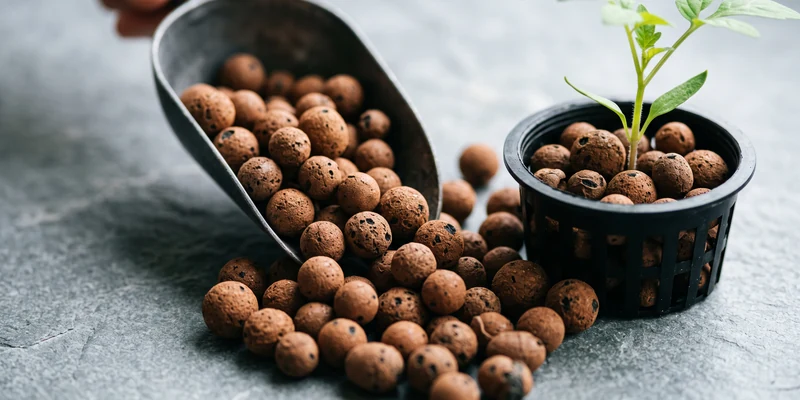
Open almost any photo of a home hydroponic setup and you will see the same reddish-brown balls filling every net pot. Hydroponics clay pebbles, sold as LECA, hydroton, or expanded clay aggregate, are the default growing medium of the entire hobby, and for once the default earned its position. They anchor plants, breathe, drain instantly, and can be washed and reused for years.
This guide explains what clay pebbles actually are, why they behave so well in water-based systems, where they fit in each type of setup, and where they fall short, so you know when to reach for them and when another medium serves better.
This article contains affiliate links. If you buy through them, we may earn a commission at no extra cost to you. Learn more.
Quick Answer
Why do hydroponic growers use clay pebbles?
- They are inert: baked clay adds no nutrients and barely shifts pH, so you stay in control of the solution.
- Their round, porous shape leaves air gaps everywhere, which roots in water-based systems depend on.
- They are reusable almost indefinitely: rinse, sanitize, and refill, which makes them cheap over time.
Clay Pebbles at a Glance
Clay pebbles are small balls of clay fired in a rotary kiln until they puff up like popcorn, leaving a hard ceramic shell around a honeycomb of air pockets. Everything useful about them follows from that structure, summarized here.
| Property | What it means in practice |
|---|---|
| Inert and pH stable | No nutrients, no decomposition, minimal pH drift once rinsed; your nutrient mix stays predictable |
| Free draining | Water runs straight through, so roots never sit soggy in the pot itself |
| Air holding | Gaps between round pebbles keep oxygen at the root zone at all times |
| Light wicking | The porous shell pulls some moisture upward, enough to keep a root zone humid |
| Heavy enough to anchor | Unlike perlite, pebbles hold plants upright and do not float away in moving water |
| Reusable | Wash, sanitize, reuse, season after season |
| Dusty out of the bag | New pebbles carry red clay dust that must be rinsed off before use |
What Clay Pebbles Actually Do in a Hydroponic System
In hydroponics the pebbles are not the plant’s food source, they are its scaffolding. The nutrient solution feeds the plant; the pebbles hold the stem upright in the net pot, shade the root crown, and keep an air-rich buffer zone between the plant and the water below. That division of labor is the whole design.
The wicking effect does quiet, important work in young systems. Before roots reach the reservoir, moisture creeping up through damp pebbles keeps a seedling’s starter plug from drying out. Once roots hang into the solution, the pebbles’ job shifts to structure and airflow, and their free drainage means the pot never becomes the waterlogged zone where trouble starts.
Why inert matters
Soil and compost feed plants but also feed guesswork: you never quite know what is breaking down in there. Baked clay contributes nothing and takes nothing. When you mix a nutrient solution to a target strength and a pH around 5.5 to 6.5, that is what the roots actually receive, which makes diagnosing problems far simpler.
Where Clay Pebbles Fit in Each System
Clay pebbles appear in nearly every system type, but their role changes with the design. In net pot systems they are a collar; in Dutch buckets they are the entire root zone.
In Kratky jars and totes, and in DWC buckets, a few handfuls fill each net pot around the seedling. In Dutch buckets and many drip systems, whole buckets of pebbles hold the full root mass while drip lines feed from above. Flood and drain tables use deep beds of pebbles that flood and empty on a cycle, and semi-hydro houseplant growers use them in cache pots with a standing water reserve at the bottom. The net pot pairing is the one most beginners meet first; our net pots guide covers how pot size and pebble volume work together, and the deep water culture guide shows the geometry in a bucket.
Where Clay Pebbles Fall Short
No medium wins everywhere, and clay pebbles have three honest limits worth knowing before you commit a whole system to them.
First, they hold little water compared to coco coir or rockwool, so in any setup where the pump or reservoir fails, pebbles alone dry out fast. Second, they are poor at starting seeds: small seeds fall between pebbles, which is why most growers germinate in a plug or cube and transplant into the pebbles later. Third, weight cuts both ways: a Dutch bucket full of wet pebbles anchors a tomato beautifully and is also genuinely heavy to move. Growers who scale up often mix pebbles with perlite or coco in media beds to balance drainage against water holding.
Buying, Preparing, and Reusing Them
Clay pebbles are sold in bags by liter or pound under names like hydroton, LECA, and expanded clay, with GROW!T and Mother Earth among the familiar brands on the shelf. Size grades around 8 to 16 mm suit most net pots; very small grades pour through wide-slotted pots.
For most home systems a single bag in that mid size grade covers every net pot you are likely to fill.

Preparation is one job: rinse until the water runs clear, because kiln dust will otherwise cloud your reservoir and coat pump parts. Some growers also soak pebbles overnight so they enter the system pre-wetted and wick immediately. At the end of a run, strip old roots, wash, and sanitize in diluted peroxide or bleach, rinse well, and they are ready again. The full hands-on routine, from first rinse to replanting, is in our step by step on how to use clay pebbles.
Common Mistakes to Avoid
- Skipping the first rinse. Red dust in the reservoir is the classic new-grower reservoir cloud. Rinse until clear, every new bag.
- Starting seeds directly in pebbles. Germinate in a plug or cube, then transplant. Loose pebbles swallow small seeds and dry out seedlings.
- Using pebbles as the only medium in outage-prone setups. They barely buffer water. If the power is flaky, pair them with a system that holds a reserve.
- Buying the wrong size grade. Tiny pebbles fall through wide net pot slots. Match grade to pot before ordering.
- Tossing them after one season. Cleaned and sanitized, the same bag serves for years, which is most of their economic argument.
Frequently Asked Questions
Are clay pebbles and LECA the same thing? Yes. LECA stands for lightweight expanded clay aggregate; hydroton and clay pebbles are trade and common names for the same kiln-fired material.
Do clay pebbles change pH? Rinsed pebbles are close to neutral and shift solution pH very little. Unrinsed dust can nudge readings, one more reason the first wash matters.
Can you mix clay pebbles with soil? They are sometimes blended into potting mixes for drainage or used as a base layer, but their real strengths show in soilless systems where they stay clean and reusable.
How long do clay pebbles last? Effectively indefinitely. The ceramic does not decompose; you retire pebbles only when they are too root-clogged or contaminated to clean.
Do clay pebbles float? Some do at first, especially very porous ones, because of trapped air. After soaking, most sink or sit low, and inside a filled net pot floating stops being an issue.
The Bottom Line
Clay pebbles earned their default status honestly: inert, free draining, air holding, and reusable, they do exactly what a water-based system needs from a medium and nothing it does not. Rinse them before first use, pair them with a plug for seed starting, and clean them between runs. Their weaknesses, low water holding and poor seed starting, are easy to work around once you know them.