Last updated: August 15, 2026
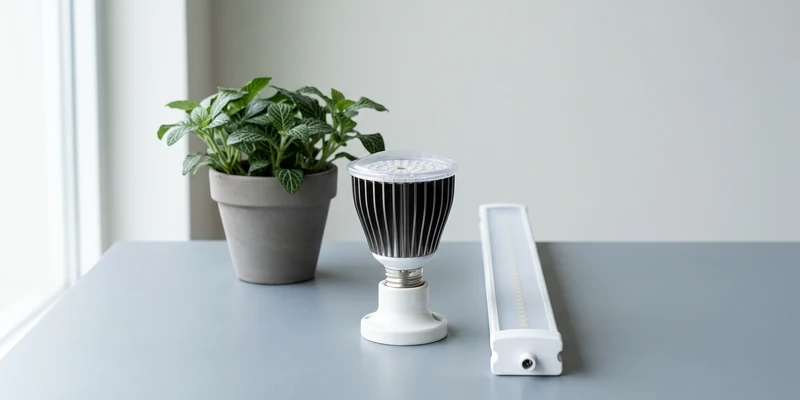
Search for grow light bulbs and you land in two very different worlds. One is a screw-in LED that goes into the desk lamp you already own and looks like an ordinary bulb. The other is a fixture: a strip, a bar, or a panel that comes with its own housing, hangers, and coverage chart. Both grow plants perfectly well, and choosing between them is the single decision that makes an indoor setup either tidy and effective or awkward and disappointing.
The difference is not quality, it is shape. A bulb concentrates light in a cone under one lamp; a fixture spreads it across an area. This guide explains what each format is actually good at, where each one fails, and how to match the format to the space you are lighting.
This article contains affiliate links. If you buy through them, we may earn a commission at no extra cost to you. Learn more.
Quick Answer
Should you buy a grow light bulb or a fixture?
- Choose a screw-in bulb when you are lighting one or two plants, already own a suitable lamp, and want the setup to blend into a living room.
- Choose a strip or bar fixture when you are lighting a row or a shelf, because even coverage matters more than a single bright spot.
- Choose a panel when you have a dedicated growing area, seed trays, or fruiting crops that want real intensity across a defined footprint.
Bulbs, Strips and Panels Compared
The three common formats differ mainly in how their light is distributed and how they mount. Everything else, spectrum, efficiency, running cost, has largely converged on modern LEDs, so distribution is what you are really buying.
| Format | Best at | Weak at | Mounting |
|---|---|---|---|
| Screw-in grow bulb | One plant or a tight group; using lamps you already own | Covering a wide area evenly; the edges fall off quickly | Any standard E26 socket: desk lamp, floor lamp, pendant, clamp light |
| Clip-on gooseneck lamp | Small plants on a shelf or desk; aiming light exactly where you want it | Anything larger than a couple of pots | Clamps onto a shelf edge, table, or headboard; usually has a timer built in |
| Linkable strip lights | Rows, shelves, and under-cabinet runs; even light along a line | Tall or fruiting plants that want high intensity | Screws, clips, or adhesive; chained end to end from one outlet |
| LED panel or quantum board | Defined growing areas; seedlings, greens, and fruiting crops | Living room decor; it looks like equipment | Hangs from ratchet ropes above the plants, usually dimmable |
| Bar style fixture | Very even coverage across a tent or rack shelf | Small setups where it is more light than you need | Multiple bars spread across the footprint |
Notice that none of the weaknesses are about growing power. A good bulb over one basil plant and a good panel over a tray of seedlings both work; using either in the other role is what disappoints people.
What a Grow Bulb Really Is
A grow bulb is an LED lamp with a standard base, tuned to put out light plants can use and often built with a heavier heat sink than a household bulb. The useful part is the base: an E26 socket is the most common fitting in American homes, so a grow bulb turns almost any lamp into a plant light without new hardware.
The label to ignore is lumens, which measures brightness as human eyes perceive it. Plants respond to photon count in the growing range, described by PAR and PPFD figures, and a bulb tuned for plants can look less bright than a household bulb of the same wattage while doing more for a plant. Where a maker publishes PPFD at a stated distance, that is the number worth comparing; the background is in our explainer on full spectrum grow lights.
Three fixture cautions
Check the lamp’s maximum wattage rating before fitting a high-power grow bulb, keep grow bulbs out of fully enclosed fixtures unless the maker says they are rated for it, since trapped heat shortens LED life, and choose a fixture with a proper shade or reflector so light goes down toward the plant rather than into your eyes.
Which Format to Buy for Your Setup
How we chose: we compared widely available full spectrum LEDs in each format on coverage, output, mounting options, and how they behave in a normal home, based on manufacturer specifications and the patterns that repeat across owner reviews. Pick by the shape of the space you are lighting, not by the plant.
💡 Best Bulb for One or Two Plants
A full spectrum white LED with an E26 base and a ceramic or metal housing, screwed into a lamp you already own. The tidiest way to light a single houseplant without the room looking like a greenhouse; our SANSI grow light review covers the range.

📏 Best Fixture for Shelves and Rows
Linkable T5 style LED strips that chain end to end and mount under a cabinet or shelf. Even light along the whole run, low profile, and expandable one strip at a time as the collection grows.
⬆️ Best Panel for a Growing Area
A compact dimmable LED panel for a rack shelf, seed-starting station, or small tent. Real intensity across a defined footprint, with a dimmer so the same fixture suits seedlings and mature plants.

If you would rather not assemble anything, an all-in-one unit with the light built into the frame skips the whole question; see our roundup of indoor gardens with LED grow lights.
Coverage Is the Real Difference
A bulb throws a cone of light. Directly underneath it, intensity can be high; two feet to the side, it is a fraction of that. For a single plant that is exactly what you want, since all the output lands where the plant is. For a shelf of six pots it means one happy plant in the middle and five stragglers at the edges.
Fixtures solve that by spreading emitters over a length or an area. Strips give you an even line, panels an even rectangle, and both hold their intensity across the footprint far better than a point source does. This also changes hanging height: strips sit close, panels hang higher, and the ranges per format are in our guide to how far grow lights should be from plants.
Two smaller lights often beat one big one
When a space is wider than it is deep, such as a windowsill or a bookshelf, splitting the same output across two fixtures gives more even coverage than one central light hung higher. It is also easier to expand later, which is why linkable strips are so popular for growing collections.
Cost, Wiring and Practical Living
A bulb is the cheapest entry point because you supply the lamp, and it is the easiest to live with: no hanging hardware, no visible equipment, and it comes out again in seconds. Fixtures cost more up front but cover more per dollar of hardware once you are lighting several plants, and they generally include the mounting parts you need.
Wiring deserves a moment of thought wherever plants and water share a shelf. Keep power strips and plugs above the level of the pots, let cords hang in a drip loop so any water runs off before reaching a connection, and use a GFCI protected outlet where one is available. For schedules, both formats behave the same: a plug-in timer runs either one, and many clip-on lamps have a timer built in. Hours by plant type are covered in how many hours of grow light plants need.
Common Mistakes to Avoid
- Buying a bulb to light a whole shelf. The center plant thrives and the rest stretch. That is a coverage problem no wattage fixes.
- Shopping by lumens. Lumens describe brightness to human eyes. For plants, compare PAR or PPFD figures at a stated distance.
- Putting a high-wattage grow bulb in an enclosed fixture. Heat has nowhere to go, and LED life suffers. Use an open shade unless the bulb is rated for enclosed use.
- Ignoring the lamp’s wattage rating. Old fixtures often carry a low maximum. Check the label before fitting anything powerful.
- Hanging a panel where you have to look at it. Panels are wonderful over a rack in a spare room and unpleasant at eye level in a living room. Match the format to where you actually live.
- Buying a fixture too small to grow into. Collections expand. Linkable strips and dimmable panels leave room for that; a single fixed lamp does not.
Frequently Asked Questions
Do grow light bulbs actually work? Yes. A quality full spectrum LED bulb at a sensible distance grows herbs and houseplants well. The limit is coverage, not capability, so it suits one plant or a tight group rather than a whole shelf.
Can I use a grow bulb in a normal lamp? Usually, as long as the base matches, which is E26 in most American homes, and the lamp’s maximum wattage rating allows it. Prefer an open shade over a fully enclosed fixture so heat can escape.
Is a regular LED bulb good enough for plants? A bright household bulb can keep a low-light plant alive, but it is not tuned for plant growth and rarely delivers useful intensity at a comfortable distance. A dedicated grow bulb is a small step up in price for a large step up in result.
What about the purple panels? Red and blue fixtures grow plants fine, they just distort how everything looks and make problems harder to spot. Most indoor growers now choose white full spectrum instead.
How many bulbs or strips do I need? Think in area rather than count: one bulb per plant group, or enough linkable strips to run the full length of the shelf. Our roundup of the best LED grow lights for indoor plants lists typical coverage per format.
The Bottom Line
Grow bulbs and grow fixtures are not competing quality levels, they are different shapes of light. A screw-in bulb is the neat answer for one or two plants in a lamp you already own; strips are the answer for shelves and rows; panels are the answer for a real growing area. Decide by the footprint you need to cover, then set distance and hours to match.
See which format fits your setup