Last updated: August 13, 2026
Most people looking for their first plant light do not want a hanging panel and a corner of the living room turned into a grow area. They want the monstera in the dim hallway to stop dropping leaves. That is the problem a SANSI grow light is built for: a screw-in full spectrum bulb that goes into a lamp you already own and looks like ordinary lighting once it is on.
The brand is unusual in a category dominated by panel makers. SANSI builds its bulbs around a ceramic heat sink rather than the aluminum housing and cooling fan most fixtures use, which is why they run silently. This review looks at what that buys you, where a bulb runs out of road, and which size fits which situation, based on published specifications and the patterns that repeat across owner feedback.
This article contains affiliate links. If you buy through them, we may earn a commission at no extra cost to you. Learn more.
Quick Answer
Is a SANSI grow light worth buying?
- Yes, if you want to light one or a few houseplants using a standard socket, without a fan, a hanging kit, or purple light in your living room.
- The ceramic-based bulbs run quietly and put out white full spectrum light, which suits rooms people actually sit in.
- Skip it if you need even coverage over a seed tray or a whole shelf, since a bulb throws a cone and strips or a panel do that job better.
SANSI Grow Lights at a Glance
SANSI sells conventional LED bulbs, security floodlights, and a grow light line built on the same ceramic platform. The grow range centers on screw-in full spectrum bulbs in several wattages, with larger flood-style fixtures at the top of the line.
| Category | What to know |
|---|---|
| Format | Screw-in full spectrum LED bulbs for standard E26 sockets, plus larger flood-style grow fixtures |
| Signature design | LEDs mounted on a ceramic heat sink instead of an aluminum body with a fan, so bulbs run without moving parts |
| Spectrum | White full spectrum output rather than red and blue peaks, so plants and rooms look normal under it |
| Sizes | Wattages commonly running from around 10 to 15 watts for one small plant up to the 30 to 40 watt class and higher output fixtures |
| Where it excels | Individual houseplants, dim corners, desk and floor lamps, clamp lights, track heads |
| Less suited to | Seed trays, wide shelves, and grow tents, where even rectangular coverage matters |
| Controls | No built-in dimmer or timer; use a plug-in timer and a fixture rated for the wattage |
What SANSI Gets Right
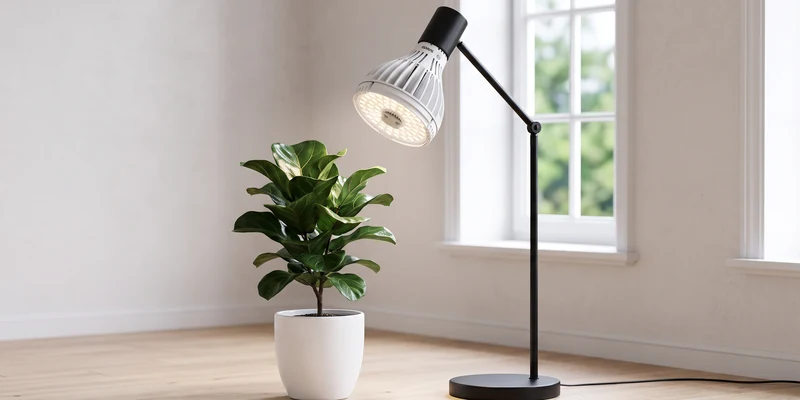
Fitting into a normal socket is the whole proposition, and it solves more than it first appears to. A panel needs somewhere to hang, a way to hang it, and a plan for the cable. A bulb needs a lamp, and most homes have spare lamps. That turns a floor lamp beside a fiddle leaf fig or a clamp light on a bookshelf into a working plant light in about a minute.
The ceramic heat sink is the second genuine differentiator. Because the LEDs sit on ceramic rather than being cooled by airflow, there is no fan, which means no noise and no dust intake, and owner feedback consistently reflects that silence as a reason for choosing the brand.
White light you can live with
SANSI’s grow bulbs put out white full spectrum light instead of the purple glow associated with red and blue fixtures. That matters practically as well as aesthetically: under white light you can see yellowing leaves, spider mite stippling, and soil moisture properly, all of which disappear under a purple wash. Our explainer on full spectrum grow lights covers why broad white output is a sensible default for home growing.
Where SANSI Falls Short
A bulb is a point source, and that is a physical limit no design can engineer away. Output falls off steeply toward the edges of the cone, so a single bulb lights one plant well, two plants acceptably, and a row of five badly. Growers who buy one bulb for a whole plant shelf usually end up disappointed with the plants at either end, and the fix is a different format rather than a bigger bulb.
No dimmer, and wattage limits to check
The bulbs have no built-in dimmer or timer, so scheduling means a plug-in timer and intensity means moving the lamp. That is less flexible than a dimmable panel, which matters when acclimating a plant from a dim store shelf. Higher-wattage grow bulbs also draw more than a typical household bulb, so check that your fixture and any dimmer switch in the circuit are rated for it. SANSI has also revised its lineup over the years, so read the specific listing rather than assuming one size matches another.
How SANSI Compares
Against clip-on gooseneck lights such as the GooingTop style, SANSI trades built-in timers and dimmers for more output per fixture, which is why it suits a large floor plant while a clip-on suits a small pot. Against Barrina-style linkable strips, the comparison is about shape: strips win over a shelf or seed tray, a bulb wins over a single tall plant in a corner. Against dimmable panels from Spider Farmer or MARS HYDRO, SANSI is the choice when you do not want a visible grow setup, while the panels are the choice when yield and control matter more. The full format comparison sits in our roundup of LED grow lights for indoor plants.
Check It Out
How we chose: the mid-size screw-in bulb is the version most owner feedback describes and the one that fits the widest range of household fixtures, from floor lamps to track heads.
🏆 The Everyday Plant Bulb
A full spectrum LED bulb in the 30 to 40 watt class for a standard socket, silent, fan free, and bright enough for a large houseplant at about 12 to 18 inches. The default choice for lighting one plant properly without building a setup.

Who It Is For, and Who Should Skip It
Buy a SANSI grow light if your problem is a specific plant in a specific dim spot, if the light has to live in a room you use, or if a fan would bother you. It suits renters who cannot drill and anyone whose ideal grow light is invisible as a grow light. Pair it with a plug-in timer and the height ranges in how far grow lights should be from plants.
Skip it if you are starting seed trays, filling a shelf, or running a grow tent, since those setups need even rectangular coverage that no bulb provides. Skip it too if you want dimming built in.
Alternatives Worth Considering
Three directions, depending on which limitation you run into first.
🌱 Smaller and Softer
A lower-wattage bulb from the same range for a single small plant, a desk lamp, or a low-light species that does not want a strong beam close by.

⬆️ More Output From One Socket
A higher-wattage flood-style SANSI grow light for a large plant or a small cluster, with more intensity and a wider cone in the same fan free format.

📚 Better Shape for Shelves
Linkable T5-style LED strips when the problem is a row of plants rather than one. Even coverage end to end is something a bulb cannot match.

Frequently Asked Questions
Do SANSI grow lights actually work for houseplants? Yes, within the format’s limits. A full spectrum bulb at the right distance delivers far more usable light than a household bulb. Coverage over a wide area is where a bulb runs out.
How far should a SANSI grow light be from plants? Commonly 12 to 18 inches for a bulb in the 30 to 40 watt class, closer for lower wattages. Bleaching on the lit side means back off; stretching means come closer.
Can I put a SANSI grow bulb in any lamp? Any standard E26 socket, provided the fixture is rated for the wattage and there is no dimmer switch in the circuit. Clamp lights, gooseneck lamps, and track heads all work.
Do SANSI grow lights have a fan? The bulbs use a ceramic heat sink instead of a fan, which is the main reason people choose them for bedrooms and offices.
How many hours should I run a SANSI grow light? Typically 10 to 14 hours a day for foliage houseplants, more for herbs and vegetables. Use a plug-in timer, since the bulbs have no scheduling built in; ranges by plant type are in how many hours of grow light plants need.
Is SANSI good for a monstera or a fiddle leaf fig? It is one of the more practical options for large foliage plants, because a floor lamp puts the light overhead without a hanging kit. See our grow light for monstera guide.
The Bottom Line
SANSI solves a narrow problem unusually well: strong, silent, white full spectrum light from a socket you already have, with no fan and no visible grow setup. Judge it as a houseplant bulb rather than a growing system and it is easy to recommend, with the mid-size bulb the sensible default. For seed trays, shelves, and tents, buy the shape that fits instead.