Last updated: August 15, 2026
A dehumidifier for a grow tent is one of those purchases that is either completely unnecessary or the single thing standing between you and a tent full of mildew. Which of the two depends on your room, your plants, and your ventilation, not on what the tent instructions say. A few gallons of water pass through a healthy tent every week, and all of it eventually leaves the leaves as vapor.
This guide sorts the decision in the right order: whether you need one at all, then what size and type fits a tent rather than a basement, then which setups growers actually keep running. Along the way you will see why an exhaust fan solves the problem more often than a dehumidifier does.
This article contains affiliate links. If you buy through them, we may earn a commission at no extra cost to you. Learn more.
Quick Answer
Do you need a dehumidifier for a grow tent, and which one?
- Only if humidity inside the tent stays above roughly 60 to 65 percent after your exhaust fan is running properly. Airflow is the cheaper fix and should always come first.
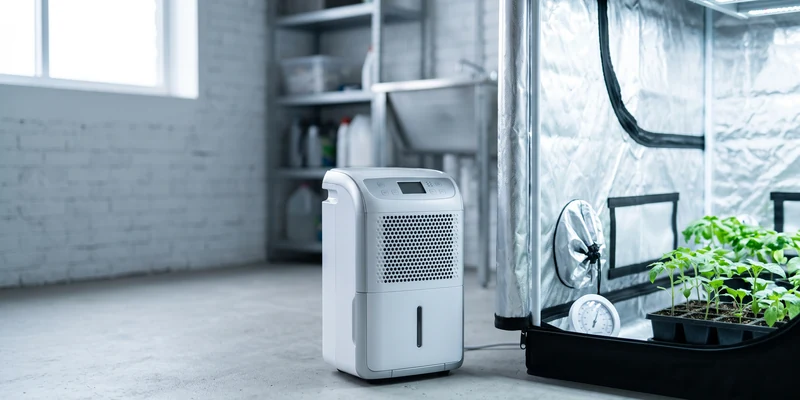
- For a tent in a small or humid room, a compact compressor dehumidifier placed outside the tent, treating the whole room, is the setup most growers end up with.
- Pair it with a humidity controller so it switches on and off by reading, not by guesswork, and run a separate hygrometer inside the tent to check the result.
Do You Actually Need a Dehumidifier in a Grow Tent?
Most home growers do not, at least not at first. A tent with a correctly sized exhaust fan pulls damp air out and drier room air in many times an hour, which handles ordinary transpiration on its own. A dehumidifier becomes worth buying when the room feeding the tent is itself humid, or when the tent is packed with mature, thirsty plants.
Work through the table below before you spend anything. Each row describes a situation, what is really going on, and the cheapest thing that fixes it.
| Situation | What is happening | First move |
|---|---|---|
| Humidity spikes only at lights-off | Cooler air holds less moisture, so relative humidity climbs | Keep the exhaust fan running at a low speed through the dark period |
| Condensation on the inside of the tent | Warm, wet air meeting a cool tent wall or a cold outside wall | Increase air exchange and move the tent off cold exterior walls |
| Room itself feels damp year round | Basement, garage, or a humid climate; the tent cannot exhaust to drier air | A room dehumidifier outside the tent |
| Big, mature plants in a small tent | Transpiration outpaces the air exchange rate | Larger or faster fan first, dehumidifier if that is maxed out |
| Mildew or fuzzy growth on leaves | Stagnant humid air sitting in the canopy | Add a clip fan for internal circulation, then address room humidity |
| Hygrometer reads high but plants look fine | Sensor placed in a dead corner or against wet media | Move the sensor to canopy height, mid-tent, out of direct light |
If the fix in the right column is airflow, start there. Our guide to the best fans for grow tents covers sizing an inline fan and why a small clip fan inside the canopy prevents more problems than any appliance.
Humidity Targets Are Ranges, Not Rules
Different stages want different air. As a widely used guideline, seedlings and fresh cuttings do well in humid air, roughly 65 to 75 percent, because their root systems cannot yet keep up with what the leaves lose. Established vegetative plants are generally happy somewhere around 55 to 65 percent, and mature fruiting plants around 45 to 55 percent.
Those bands overlap for a reason: plants tolerate a wide range, and stability matters more than hitting a number. A tent that swings from 40 percent under the lights to 80 percent overnight stresses plants more than one that sits steadily at 60. That is exactly the swing a dehumidifier on a controller is good at flattening.
Where a dehumidifier earns its place
Two moments make the strongest case: late in a fruiting crop, when a dense canopy of tomatoes or peppers moves serious volumes of water, and winter in a sealed basement, where the room outside the tent is already near saturation and there is no drier air to bring in.
Types of Dehumidifier, and Which Suits a Tent
Three technologies show up in this category, and they are not interchangeable. Compressor units chill a coil so moisture condenses out, desiccant units pass air over a moisture-absorbing wheel, and thermo-electric or Peltier units use a small cooled plate. Capacity, noise, and heat output separate them.
Compressor models remove the most water per hour and are the practical choice for a room. They also add heat and vibration, which is why they normally live outside the tent. Desiccant models work better in cool rooms where compressors lose efficiency, and they are quieter, though they warm the air noticeably. Thermo-electric units are tiny, nearly silent, and remove modest amounts of water, which suits a closet or a small tent in an already dry room.
Our Top Picks at a Glance
How we chose: we compared widely available options on extraction capacity relative to tent size, noise and heat added to the growing space, drainage options for unattended running, and how easily each one can be automated with a humidity controller. We lean on manufacturer specifications and the themes that repeat across grower feedback rather than any hands on trial of our own.
🏆 Best Overall
A compact compressor dehumidifier sized for a small room, placed just outside the tent so the exhaust fan draws already dried air in. Look for a continuous drain hose port so it can run unattended, plus an adjustable humidistat. This is the setup that solves damp basements and dense late-season canopies at the same time.

🤫 Best for Small Tents
A mini thermo-electric dehumidifier for closets and cabinets. It removes far less water than a compressor unit, but it is quiet, light, and small enough to sit in the corner of a 2 by 2 or 2 by 4 tent without stealing floor space. The sensible pick when humidity is only a little too high.

🎛️ Best for Automation
A dedicated humidity controller with outlets that switch a plugged-in appliance on and off at your set points. It turns any basic dehumidifier into a hands-off system and stops the endless cycle of noticing a problem hours after it started. Inkbird’s dual-outlet controllers are the ones growers name most often.

Sizing: Pints Per Day, Room Volume, and Drainage
Dehumidifier capacity is rated in pints of water removed per day under test conditions, and those conditions are warmer and wetter than your room. Treat the number on the box as a ceiling rather than a promise, and size for the room the tent sits in, not for the tent itself.
For a spare bedroom or a small basement corner, a unit in the 20 to 35 pint class usually has enough headroom. Larger basements and garages ask for more. The specification that matters just as much is drainage: a bucket that fills in a few hours and shuts the unit off is useless while you are at work, so a gravity drain hose to a floor drain or a sink is worth planning for from day one.
Inside the tent or outside it?
Outside is the default for compressor units. They add heat and noise, they take up scarce floor space, and treating the room means every tent in it benefits. Inside makes sense only for a small thermo-electric unit in a large tent, or when the tent is the only enclosed space you can control. Either way, keep the intake and exhaust of the unit clear of tent fabric.
Two More Picks: Measuring and Moving Air
Humidity control is a loop: measure, act, measure again. These two fill the other halves of that loop, and both are often the cheaper answer to a humidity complaint.
📡 For Knowing What Is Really Happening
A wireless hygrometer and thermometer that logs to a phone app shows you the overnight spike you would otherwise sleep through. Place the sensor at canopy height in the middle of the tent, away from the light and away from wet media, and the readings suddenly make sense.

💨 For Fixing It Without an Appliance
An inline duct fan with a proper speed controller exchanges tent air on a schedule and is the first thing to upgrade when humidity creeps up. In a lot of rooms this alone brings a tent back into range, and it improves temperature and stale air at the same time.

Setting It Up Safely and Sensibly
Water and electricity share a room in every grow tent, so a few boring habits are worth adopting on day one: plug appliances into a GFCI protected outlet, let cords hang in a drip loop so water runs off rather than down into the plug, and keep the drain hose routed away from power strips.
Placement decides how well the unit performs. Give it several inches of clearance on all sides so it is not recycling its own exhaust, set the humidistat a few points below your target, and clean the filter on a schedule. A clogged filter quietly halves output long before any warning light appears.
Common Mistakes to Avoid
- Buying a dehumidifier before fixing airflow. An undersized or throttled exhaust fan causes most tent humidity problems, and no appliance compensates for stagnant air.
- Putting a compressor unit inside the tent. It dumps heat exactly where you are trying to control the climate, and it eats floor space you need for plants.
- Trusting the built-in humidistat alone. The sensor reads the air at the unit, not at your canopy. Verify with a separate hygrometer inside the tent.
- Emptying the bucket by hand. Sooner or later you forget, the unit shuts off, and humidity climbs all weekend. Run a drain hose.
- Chasing a single number. Steady humidity in a sensible range beats a perfect reading that swings at lights-off.
- Ignoring wet media. Open reservoirs, saturated coco, and standing runoff all evaporate into the tent. Cover reservoirs and clear spills first.
Where to Go From Here
If you are still assembling the tent itself, get the ventilation right before the climate gear, because the fan choice changes whether you need a dehumidifier at all. Our roundup of the best grow tent kits covers what a complete package should include, and the AC Infinity grow tent review looks at the controller-driven approach in detail.
And if your problem turns out to be the opposite one, dry winter air and crispy seedling leaves, the mirror image of this guide is our take on choosing a humidifier for a grow tent. The same principle applies in both directions: measure first, ventilate second, and add an appliance only when those two are not enough.
Frequently Asked Questions
What humidity should a grow tent be? As a general guideline, seedlings do well around 65 to 75 percent, vegetative plants around 55 to 65 percent, and mature fruiting plants around 45 to 55 percent. Stability across the day matters more than hitting an exact figure.
Should the dehumidifier go inside or outside the grow tent? Outside for compressor units, since they add heat and take up floor space, and the tent will pull the drier room air in through its intake. Small thermo-electric units are the exception and can sit inside a larger tent.
Can a fan replace a dehumidifier? Often, yes. An exhaust fan that exchanges tent air frequently enough removes moist air continuously, which is why sizing the fan properly is the first step; see our grow tent fan guide.
Why does humidity spike when the lights go off? Cooler air holds less water vapor, so the same amount of moisture pushes relative humidity up. Running the exhaust fan at a reduced speed through the dark period usually flattens the spike.
Does high humidity hurt hydroponic plants? Persistently damp, still air encourages mildew and other fungal problems on leaves and slows transpiration, which is how plants move nutrients. The plants themselves tolerate a wide band; the air around them is the risk.
How many pints per day do I need? Size for the room rather than the tent. A unit in the 20 to 35 pint class covers most spare rooms and small basement corners, and rated capacity is measured under warm, humid test conditions, so allow headroom.
The Bottom Line
Fix airflow first, then measure honestly, then buy. If your tent still sits above roughly 60 to 65 percent with the exhaust running, a compact compressor dehumidifier outside the tent on a humidity controller is the setup that solves it and keeps solving it. Small tents in dry rooms rarely need more than a mini thermo-electric unit, and a hygrometer at canopy height is what tells you which camp you are in.