Last updated: August 15, 2026
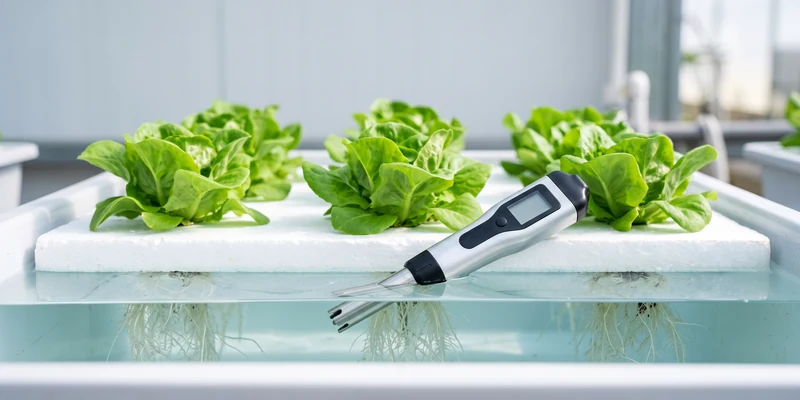
You mixed the solution correctly, the light is on the right schedule, and the lettuce still looks unhappy. Nine times out of ten the reservoir is the place to look, and the number that matters most is hydroponic lettuce pH. Nutrients can be perfectly present in the water and still be unavailable to the roots if the pH has drifted out of range.
The good news is that lettuce is forgiving about where the number sits and much fussier about how far it swings. This guide covers the range worth aiming for, why small reservoirs drift so fast, and a maintenance routine that takes a couple of minutes a week.
This article contains affiliate links. If you buy through them, we may earn a commission at no extra cost to you. Learn more.
Quick Answer
What pH should hydroponic lettuce run at?
- Aim somewhere around 5.5 to 6.5, with many growers settling near 5.8 to 6.0 as a comfortable middle.
- Stability beats precision: a reservoir sitting steadily at 6.3 outperforms one bouncing between 5.2 and 7.0.
- Check after mixing, then two or three times a week, and correct in small amounts rather than all at once.
What Happens at Each pH Level
pH does not feed the plant. It decides which of the nutrients already in your water the roots can actually absorb, and different elements have different comfort zones. This is why the same reservoir can produce two different deficiency symptoms depending on which way it drifted.
| pH reading | What is happening | What you tend to see |
|---|---|---|
| Below 5.0 | Calcium and magnesium uptake becomes harder; roots can be stressed directly | Slow growth, weak new leaves, tip burn appearing early |
| 5.0 to 5.5 | Workable, on the acidic edge of the comfortable window | Usually fine, but leaves less margin if it keeps drifting down |
| 5.5 to 6.5 | The commonly recommended range for lettuce | Broadly good availability across macro and micronutrients |
| 6.5 to 7.0 | Iron, manganese, and some other micronutrients become harder to take up | Yellowing between the veins of new leaves while veins stay green |
| Above 7.0 | Micronutrient lockout becomes pronounced; phosphates can precipitate | Pale new growth, stalled development, visible sediment in some systems |
Notice that the failures at either end look different. Yellow new growth with green veins usually means too high, while poor structure and early tip burn more often points to too low. That difference is a quick diagnostic when you have not measured recently.
Why pH Drifts, and Why Small Systems Drift Fastest
A hydroponic reservoir is a small, unbuffered pool of water with plant roots actively trading ions into and out of it. Several things push the number around at once, and they do not always push the same way.
Plants take up nutrients as charged ions and release hydrogen or hydroxide ions to keep their internal balance, so uptake itself moves pH. The direction depends partly on your nitrogen source: solutions high in nitrate tend to drive pH upward as it is absorbed, while ammonium-based nitrogen tends to push it down. Water loss adds a second effect, since evaporation and transpiration concentrate whatever is left. Algae and microbial activity add a third, especially in a warm reservoir exposed to light.
Volume is your best buffer
All of that acts on a fixed volume of water, which is why a countertop garden holding a gallon can move a full point in a day while a tote holding several gallons barely moves in a week. If your pH will not sit still, the most effective fix is often a bigger reservoir rather than more chemicals. Reverse osmosis water makes this worse, not better, since removing dissolved minerals also removes the natural alkalinity that resists change.
A Routine That Actually Holds It Steady
Consistency comes from a short, repeatable sequence rather than constant fiddling. Work through these steps and the reservoir mostly manages itself.
- Measure your source water first. Note the pH and EC of plain tap water so you know what you are starting from.
- Add nutrients, then wait. Nutrients shift pH as they dissolve, so measuring too early wastes adjustment solution.
- Adjust in small increments. A few drops of pH Down, stir, wait a minute, measure again. Overshooting is the classic beginner move.
- Record the number. A note on your phone turns single readings into a trend, which is what you actually want to see.
- Check two or three times a week. Daily in a countertop unit, less often in a large tote.
- Change the reservoir on schedule. When pH becomes hard to hold, the solution is usually exhausted and unbalanced rather than merely acidic.
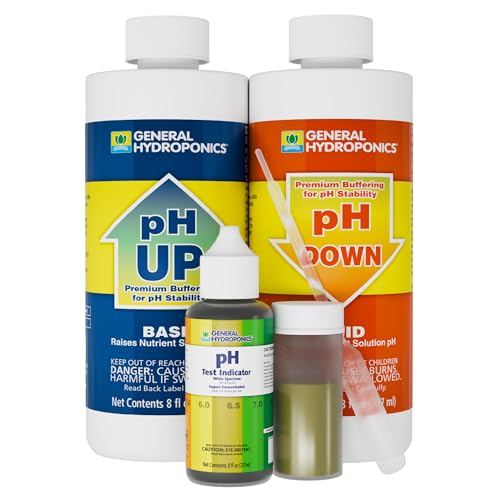
Correct in a range rather than to a point. If the reading is anywhere between 5.5 and 6.5, leaving it alone is a legitimate decision, and often a better one than chasing 5.8 with another squeeze of pH Down. Our hydroponic nutrient chart lists the equivalent windows for other crops if you share a reservoir. For the corrections themselves, a matched pH Up and pH Down pair is what makes small increments possible.
Measuring It Properly
Your routine is only as good as your reading, and this is where most lettuce troubleshooting quietly goes wrong. Paper strips and drop kits give a rough color match that is genuinely hard to read against a nutrient-tinted solution, which is fine for a sanity check and poor for tracking a trend.
A digital pen is the practical upgrade, with one condition attached: it needs calibrating. An uncalibrated meter drifts and will confidently report a number that is off by several tenths, which is worse than no meter at all because you act on it. Calibrate with fresh buffer solution on a regular schedule, rinse the probe with clean water rather than wiping it dry, and store the tip wet in storage solution. Our guide to calibrating a pH meter covers the process, and the best pH meters for hydroponics roundup compares the models growers keep recommending. Since the meter, pump, and light all live around open water, keep everything on a GFCI outlet with a drip loop in the cord. A pen that ships with buffer sachets and storage solution is the one to reach for, because it makes calibration a habit rather than a project.

Common Mistakes to Avoid
- Chasing an exact number. Correcting 6.1 to 5.9 achieves nothing except a slightly emptier bottle of pH Down.
- Adjusting before the nutrients dissolve. The reading moves again once they do, and you end up overcorrecting.
- Using an uncalibrated meter. A confident wrong number causes more damage than an honest guess.
- Reaching for household acids. Vinegar and lemon juice do move pH, briefly, then feed microbes and rebound. Use proper pH adjusters.
- Fighting a tiny reservoir. If a small tank swings daily, more volume solves the problem that more chemistry cannot.
Where to Go From Here
pH is one of two numbers worth tracking, and the other is strength. Lettuce is commonly grown around 0.8 to 1.2 EC, and an overly strong solution contributes to the same tip burn that a low pH can trigger, so it is worth understanding both together; our EC and PPM guide explains what the second number means.
If the underlying question is really which nutrient to buy, our roundup of the best nutrients for hydroponic lettuce covers the complete formulas that behave predictably in a small reservoir, and how to grow hydroponic lettuce at home puts the whole timeline together from seed to harvest.
Frequently Asked Questions
What is the ideal pH for hydroponic lettuce? Somewhere around 5.5 to 6.5, with many growers settling near 5.8 to 6.0. Holding a steady value inside that window matters more than hitting a specific decimal.
Why does my pH keep rising? Nitrate uptake tends to push pH upward as plants feed, and water loss concentrates what remains. Small reservoirs and reverse osmosis water both amplify the effect because there is little natural buffering.
How often should I check pH in a lettuce system? Two or three times a week suits most home setups, and daily is reasonable for countertop gardens holding around a gallon. Always check after mixing a fresh reservoir.
Can I use vinegar to lower pH? It works briefly, then rebounds as microbes consume it, and repeated use encourages growth you do not want in the tank. A proper pH Down solution is more stable and easier to dose.
Does high pH cause tip burn in lettuce? Tip burn is more often linked to calcium delivery, high solution strength, low airflow, and fast growth. Very low pH can contribute by hindering calcium uptake, but pH is rarely the whole story.
The Bottom Line
Aim for around 5.5 to 6.5 and treat stability as the real target, because lettuce cares far more about swings than about decimals. Measure after mixing, adjust in small steps, calibrate the meter, and give the system enough water volume to resist drift on its own. When pH stops holding at all, change the reservoir instead of adding more acid.