Last updated: August 15, 2026
Search around long enough and you will find a recipe promising DIY hydroponic nutrients from things already under your sink. Epsom salt, a spoon of this, a splash of that, and supposedly your lettuce is fed. It is an appealing idea, and it is also where a lot of first grows quietly fail, because plants need fourteen mineral elements and a kitchen cupboard reliably supplies about three of them.
There is a real DIY path, though, and experienced growers do walk it. It means buying individual mineral salts and blending a complete formula yourself, with a scale and a plan. This guide separates that legitimate route from the folk recipes, explains what a complete formula has to contain, and helps you decide whether mixing your own is worth the effort at your scale.
This article contains affiliate links. If you buy through them, we may earn a commission at no extra cost to you. Learn more.
Quick Answer
Can you make your own hydroponic nutrients?
- Yes, but only one version works: buying raw mineral salts (calcium nitrate, potassium nitrate, monopotassium phosphate, magnesium sulfate, and a micronutrient blend) and weighing them yourself.
- Household recipes built from Epsom salt, baking soda, or plant food scraps do not supply a complete mineral profile, and the gaps show up as stunted, discolored plants weeks later.
- For most home growers, a three part kit like MasterBlend is the practical middle ground: you still mix it yourself, but the hard chemistry is already balanced.
The Three Things People Mean by DIY Nutrients
“DIY nutrients” covers three very different projects, and most arguments online happen because two people are discussing different ones. Here is how they compare before you commit to any of them.
| Route | What it involves | Who it suits |
|---|---|---|
| Household recipes | Epsom salt, baking soda, ash, leftover plant food, sometimes aquarium water | Nobody growing a crop they intend to eat; incomplete and unpredictable |
| Raw salt blending | Buying six or seven individual mineral salts and weighing each per batch | Growers running several systems, or anyone who enjoys the chemistry side |
| Pre-blended components | A base blend plus calcium nitrate plus Epsom salt, mixed by you per gallon | Almost everyone: cheap per gallon, complete, and hard to get badly wrong |
| Organic brews | Compost teas, fish emulsion, worm castings steeped and aerated | Media based and aerated systems only, and a different skill set entirely |
The honest summary is that route three is where the value sits for home growers, and route two is where the fun sits for people who like spreadsheets. If you want the underlying chemistry first, our hydroponic nutrients explainer covers NPK, A and B systems, and why powders dominate.
Why Household Recipes Fall Apart
A plant grown in water gets nothing from a soil bank, so your solution has to supply everything: nitrogen, phosphorus, potassium, calcium, magnesium, and sulfur, plus iron, manganese, zinc, copper, boron, molybdenum, chlorine, and nickel in trace amounts. Miss one and growth stops at the point that element controls.
Epsom salt is a good example of the trap. It genuinely supplies magnesium and sulfur, both real plant nutrients, which makes the recipe feel scientific. It supplies no nitrogen, no phosphorus, no potassium, and no calcium at all. Baking soda is worse: sodium is not a nutrient plants need, and it accumulates in a closed reservoir. Wood ash is a lottery of potassium, calcium, and a pH swing you cannot predict from a bag.
The iron problem nobody mentions
Even growers who assemble a decent macronutrient mix often stumble on iron. In a solution around pH 5.5 to 6.5, plain iron sulfate precipitates out and becomes unavailable within days, which is why commercial formulas use chelated iron such as EDTA or DTPA forms. Yellowing between the veins on new leaves is the classic result, and it is a chemistry problem rather than a dosing one. Our guide to nutrient deficiencies in hydroponics shows what those symptoms look like in practice.
The Real DIY Route: Mixing From Raw Salts
Blending from scratch means buying each mineral separately and weighing them to a target recipe. The usual shopping list is calcium nitrate, potassium nitrate, monopotassium phosphate, magnesium sulfate, a chelated micronutrient blend, and sometimes potassium sulfate or ammonium nitrate for fine tuning.
Two constraints shape the whole process. First, you need a scale that reads to hundredths of a gram, because micronutrients are dosed in fractions of a gram per gallon and eyeballing them is how you get toxicity instead of nutrition. Second, calcium must be kept apart from sulfates and phosphates in concentrated form, since calcium sulfate and calcium phosphate are poorly soluble and will drop out as a chalky sludge. That is the entire reason commercial products split into A and B parts.
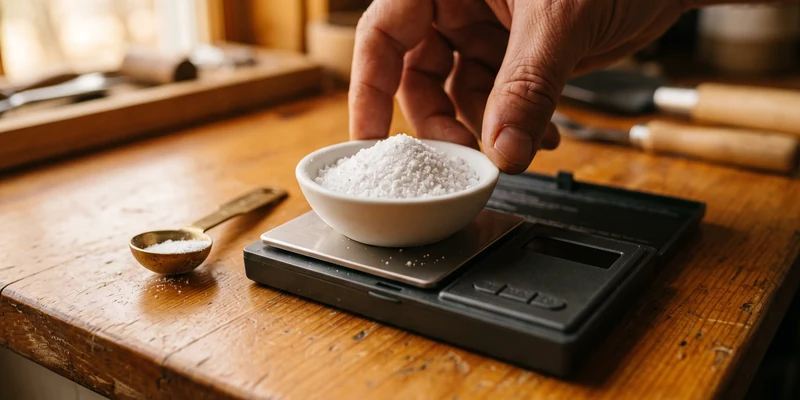
Both this route and the three part blend below rest on the same tool: a pocket scale that reads to a hundredth of a gram. Spoons cannot hold the numbers involved, so this is the one purchase to make before any bag of powder.

How growers actually run it
Most people who blend their own make two concentrated stock solutions, an A with the calcium source and a B with everything else, then dilute both into the final reservoir separately, never mixing the concentrates. It scales beautifully once set up, and it demands consistency: label everything, write down your recipe, and change one variable at a time. The mixing order and dilution logic are the same as for commercial powders, covered in how to mix hydroponic nutrients.
The Middle Path Most Growers Land On
There is a reason the three part MasterBlend approach became the community default: it is DIY with the dangerous parts already solved. You buy a 4-18-38 base blend, calcium nitrate, and magnesium sulfate, then weigh three numbers per gallon instead of seven.
A widely cited starting ratio for leafy greens is roughly two parts base blend, two parts calcium nitrate, and one part magnesium sulfate, dissolved one at a time in the full volume of water rather than combined dry. Treat it as a starting point and adjust to your crop and water, not as a law. Our MasterBlend mixing guide walks through the ratios and the order that keeps the solution clear.
The three components are commonly sold together as one bundled set, which is the least fiddly way to start on this route.

Is Mixing Your Own Actually Cheaper?
At volume, yes, and the savings are real. Buying salts in bulk bags lowers the cost per mixed gallon substantially compared with ready-made liquids, which are mostly water shipped across the country. That is the honest case for DIY.
At windowsill scale it usually is not worth it. A hobby grower with one or two jars will mix a tiny fraction of what a bulk bag holds, and salts have a practical shelf life once opened, especially calcium nitrate, which absorbs moisture greedily and cakes solid. Add shipping weight and storage space, and a small bag of complete powder wins on every axis except pride. If cost per gallon is the goal, our nutrient buying guide compares the value options that need no scale at all.
Handling and Storing Mineral Salts Sensibly
These are fertilizers, not hazardous chemicals, but they still deserve normal care. Weigh powders in a ventilated spot rather than over a fan, avoid breathing the dust, and wash your hands afterward. Store containers sealed, dry, clearly labeled with the contents and the date, and out of reach of children and pets.
Two specifics matter. Nitrate salts are oxidizers, so keep them away from heat sources and from organic materials like sawdust or fuel. And keep concentrated stock solutions physically separate, since an accidental blend of A into B produces exactly the insoluble sludge you spent all that effort avoiding. If you run pumps or heaters near your mixing area, plug them into a GFCI protected outlet and give the cords a drip loop; water and electricity share a bench in most grow spaces.
Common Mistakes to Avoid
- Trusting a recipe with no micronutrients. If a formula lists no iron, manganese, zinc, boron, copper, or molybdenum, it is incomplete no matter how good the NPK looks.
- Using non-chelated iron. It precipitates in the pH range your plants want. Chelated forms stay available.
- Combining calcium nitrate with the rest in concentrate. Dissolve each component fully in the target water volume, or keep two separate stock solutions.
- Measuring by spoon. Bulk density varies between salts, so volume measures drift badly. Weigh, do not scoop.
- Skipping the meter. Home blends need verification. Checking strength and pH after mixing catches an arithmetic slip before your plants report it a week later.
- Scaling by memory. Write the recipe down in grams per gallon and keep it with the buckets.
So, Should You Mix Your Own?
Mix your own if you run multiple systems, enjoy the precision, and want full control over the ratio your crops receive. Blending from raw salts is genuinely the cheapest route per gallon and gives you a formula you can steer toward leafy growth or fruiting at will.
Stick with a complete commercial powder if you are growing herbs on a counter, if you do not own a precision scale, or if the appeal of hydroponics for you is harvesting salad rather than balancing ionic ratios. It removes the single most common cause of mysterious mid-grow failures.
Frequently Asked Questions
Can I use regular garden fertilizer instead? Most garden and houseplant fertilizers assume soil supplies calcium and some micronutrients, so they are incomplete in water. Some growers pair them with a calcium and magnesium supplement, but a hydroponic formula removes the guesswork.
What is the minimum equipment for DIY blending? A scale that reads to 0.01 g, separate labeled containers for each salt, two buckets for stock solutions, and a way to check pH and solution strength after mixing.
Is Epsom salt useless then? Not at all. It is a legitimate magnesium and sulfur source and appears in nearly every DIY recipe, including the MasterBlend approach. It simply cannot feed a plant on its own.
Can I make organic hydroponic nutrients at home? Compost teas and fish based brews do grow plants, but they depend on microbial activity and go foul in warm, still reservoirs. They fit aerated media beds far better than passive jars; see our organic nutrients guide for what works.
How do I know my homemade mix is right? Measure solution strength as EC or PPM after mixing and compare it with the range your crop wants, then watch new growth for a week. Consistent, even green growth is the practical verdict.
Do salts expire? Sealed and dry, they last for years. Humidity is the enemy: calcium nitrate in particular clumps into a solid block once it has pulled in moisture.
The Bottom Line
DIY hydroponic nutrients are possible and, at volume, genuinely economical, but only when DIY means weighing real mineral salts rather than improvising from the pantry. A complete formula needs six macronutrients, a set of chelated micronutrients, and calcium kept apart from sulfates and phosphates. If that sounds like more project than payoff at your scale, a three part blend you mix per gallon gives you most of the savings and none of the risk.