Last updated: August 13, 2026
Shopping for a grow light for monstera is a little different from lighting most houseplants, because the plant itself is different. A Monstera deliciosa is a climbing vine from the forest floor that wants to become a tree-sized presence in your living room, and the light it gets decides whether you get those dramatic split leaves or a stretched plant with small, solid foliage reaching for the nearest window.
The good news is that monsteras are not light-hungry divas. They evolved under a jungle canopy, so they want bright but filtered light, which a mid-powered full spectrum LED delivers easily. The challenge is coverage: a mature monstera grows wide as well as tall, and a tiny clip lamp that suits a pothos will only light one corner of it. This guide covers what the plant actually needs, which lights fit which stage, and how to position them.
This article contains affiliate links. If you buy through them, we may earn a commission at no extra cost to you. Learn more.
Quick Answer
What grow light does a monstera need?
- A full spectrum white LED in the 25 to 40 watt range, such as a SANSI bulb in an ordinary lamp fixture, covers a single monstera well.
- Hang or aim it roughly 24 to 36 inches above the foliage and run it 10 to 12 hours a day on a timer.
- For a large or variegated monstera, or several plants together, step up to a small LED panel for wider, stronger coverage.
Monstera Light Needs at a Glance
A monstera wants bright, indirect-style light for most of the day, which indoors translates to a moderate LED running long hours at a comfortable distance. The table below is the short version; everything after it explains the reasoning.
| Factor | What a monstera wants | Notes |
|---|---|---|
| Light type | Full spectrum white LED, bulb or panel | No special colors needed; a natural white spectrum works and looks good in a living space |
| Intensity | Moderate, roughly 100 to 250 PPFD at the leaves | More light, up to around 400 PPFD, speeds growth and supports larger split leaves |
| Distance | Typically 24 to 36 inches for a 25 to 40 watt bulb | Panels usually hang higher; follow the maker’s chart and watch the leaves |
| Hours per day | Around 10 to 12 | Consistent daily schedule on a timer beats occasional long blasts |
| Coverage | Wide, the whole canopy | Mature plants often need two light sources or one overhead panel |
| Too little light looks like | Small leaves without splits, long bare stems, leaning | The most common monstera complaint indoors |
| Too much light looks like | Pale, washed out or scorched patches on top leaves | Rare with LEDs at sensible distance, possible with lamps placed too close |
Why Fenestrations Are Really a Light Story
Those famous splits and holes, called fenestrations, appear when a monstera is mature enough and getting enough light to afford them. In low light, the plant plays it safe and produces smaller, solid leaves that capture every photon. Give it consistent bright light and support to climb, and new leaves start arriving larger and more divided.
This is why a grow light often transforms a monstera that has been sitting in a dim corner producing plain, heart-shaped foliage. The change is not instant, since existing leaves never split after they unfurl, but the next few new leaves tell you whether the light is working. Growers report noticeably better fenestration within two or three new leaves of upgrading their lighting.
Variegated monsteras need more, not less
A Monstera albo or Thai constellation has white or cream zones with no chlorophyll, so the green portions have to do all the work. That means a variegated plant needs somewhat brighter light than an all-green one to grow at the same pace, while the white patches are also more prone to browning under harsh direct beams. A slightly stronger light at a slightly greater distance is the usual compromise, and it is a good reason to choose a dimmable panel for these plants.
Our Grow Light Picks for Monstera
How we chose: we compared widely available full spectrum LEDs on coverage area, output, fixture flexibility, and how they look in a living room, leaning on manufacturer specifications and the patterns that repeat across owner reviews. All three work; the right one depends on the size of your plant.
🏆 Best Overall
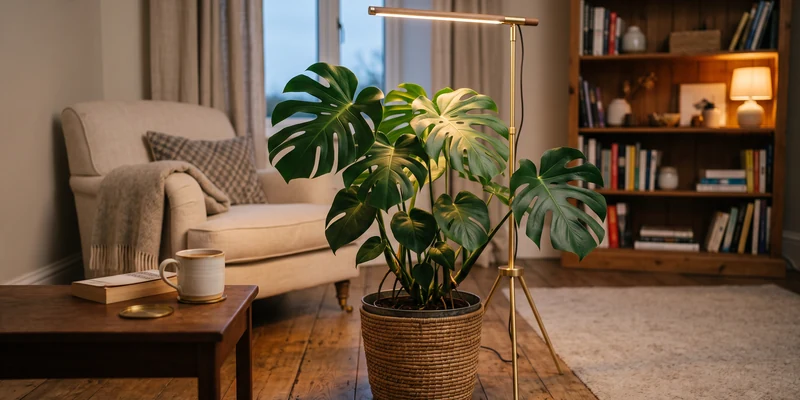
A full spectrum white LED bulb around 36 watts that screws into any standard E26 fixture, so a floor lamp aimed at the canopy becomes a grow light that does not look like one. Strong enough for a large monstera at 2 to 3 feet; our SANSI grow light review covers the range in detail.

💰 Best Budget Pick
A clip-on gooseneck LED with flexible arms and a built-in timer, ideal for a young monstera on a desk or shelf. It will not cover a mature plant, but for the first year or two it is an easy, inexpensive answer.

⬆️ Upgrade Pick
A compact dimmable LED panel that lights a whole corner: a big monstera, a moss pole, and the neighbors around it, all from one overhead source. The dimmer matters for variegated plants that want strong but not harsh light.

Placement: Lighting a Plant That Grows Sideways
Overhead light is best for a monstera, because the plant orients its leaves toward the source. A lamp positioned to the side will pull the whole plant into a lean within weeks. If a side angle is unavoidable, rotate the pot a quarter turn every week or so to keep growth balanced.
Distance depends on the light. Many growers keep a 30 to 40 watt bulb about 24 to 36 inches from the top leaves, and hang panels at whatever height the manufacturer’s coverage chart lists for vegetative growth, often 18 to 24 inches. The practical check beats any chart: new leaves that are large, dark green, and splitting mean the distance is right, while pale or crispy top leaves mean the light should move up a few inches. For the general rules, see our guide on how far grow lights should be from plants.
Do not forget the pole
A monstera climbing a moss pole grows vertically, which makes overhead lighting even more effective since each new leaf stacks below the light rather than sprawling away from it. If your plant is on a pole, position the light above the growing tip and raise it as the plant climbs.
A Schedule That Works Year Round
Run the light 10 to 12 hours a day, every day, on a timer. Monsteras do not need seasonal light changes to thrive indoors, and a consistent photoperiod avoids the stop-start growth that comes from remembering the lamp only some evenings. Plug-in timers are cheap and most clip lamps have one built in; our roundup of grow light timers covers the options.
If your monstera sits near a window, the grow light becomes a supplement rather than the whole diet. In summer you might only need it on gloomy days, while in winter it can carry the plant through the short, gray stretch when most monsteras stall. Leaving the schedule at 10 to 12 hours year round is simpler and does no harm. More on photoperiods in how many hours of grow light plants need.
Common Mistakes to Avoid
- Buying a light that only covers one leaf. Small clip lamps suit small plants. A five-foot monstera needs a strong bulb at height or a panel, not a reading light.
- Placing the light to the side and never rotating. The plant will lean hard toward the source and grow lopsided.
- Expecting old leaves to split. Fenestration only shows up on new leaves. Judge your light by the next two or three leaves, not the existing ones.
- Running the light around the clock. Monsteras do fine with a night period, and more than about 14 hours brings diminishing returns.
- Confusing purple blurple panels with better results. A natural white full spectrum LED grows a monstera just as well and lets you actually enjoy how the plant looks; more in our explainer on full spectrum grow lights.
Frequently Asked Questions
Can a monstera live with only a grow light and no window? Yes. A full spectrum LED running 10 to 12 hours a day can be the plant’s entire light source. Interior rooms, basements, and dim apartments are exactly where grow lights earn their keep.
How far should the grow light be from my monstera? For a typical 25 to 40 watt bulb, around 24 to 36 inches from the top leaves is a common starting range. Move closer if growth is slow and stretched, farther if top leaves look pale or scorched.
Will a grow light make my monstera leaves split? It helps, on new growth. Fenestration depends on maturity, light, and climbing support together, so a well-lit monstera on a moss pole gives you the best odds of big split leaves.
Do variegated monsteras need a special grow light? Not a special type, but somewhat more intensity, since the white leaf zones do not photosynthesize. A dimmable panel gives you room to tune brightness without moving the fixture.
Is a purple grow light better for monstera? No. Red and blue panels work, but a white full spectrum LED delivers the same usable light in a form that flatters the plant and the room, which is why most houseplant growers choose white.
The Bottom Line
A monstera needs moderate, consistent light across its whole canopy: a full spectrum white LED around 25 to 40 watts, positioned 24 to 36 inches overhead, running 10 to 12 hours a day on a timer. Start with a quality bulb in a fixture you already own, and step up to a dimmable panel when the plant, or your collection, outgrows it.