Last updated: August 15, 2026
Pothos has a reputation problem, and it works against the plant. Everyone knows it survives in the windowless office, the stairwell, the bathroom with a single frosted pane, so people assume light is a non-issue. Then the vine turns into a long bare stem with a leaf every eight inches, the golden marbling fades to plain green, and nobody connects the two. A pothos grow light is not about survival, it is about the difference between a plant that persists and one that looks good.
The reassuring part is how little it takes. Epipremnum aureum evolved under a rainforest canopy, so a modest full spectrum LED at a comfortable distance is plenty, and you will see the difference in leaf size and node spacing on the next stretch of new vine.
This article contains affiliate links. If you buy through them, we may earn a commission at no extra cost to you. Learn more.
Quick Answer
What grow light does a pothos need?
- A modest full spectrum white LED is enough: a screw-in bulb in a lamp, a clip-on above the pot, or strips under the shelf where the vines sit.
- Keep a small bulb roughly 18 to 30 inches from the foliage, or strips and clip lamps 8 to 14 inches away, and run it about 10 to 12 hours a day.
- Variegated types such as golden, marble queen, and neon need the most light, because their pale leaf zones cannot photosynthesize.
Pothos Light Needs at a Glance
Pothos tolerates a wide range of conditions, which is exactly why the useful question is not what it survives but what makes it look full and well marked. The table below covers the settings that matter, and the sections after it explain how each one shows up in the plant.
| Factor | What a pothos wants | Notes |
|---|---|---|
| Light type | Full spectrum white LED, bulb, clip lamp, or strips | Modest output is fine; this is not a high-light plant |
| Intensity | Moderate, roughly 75 to 200 PPFD at the leaves | The upper end suits variegated cultivars best |
| Distance | Around 18 to 30 inches for a small bulb; 8 to 14 inches for strips and clip lamps | Move up if leaves pale, closer if new growth stretches |
| Hours per day | Around 10 to 12 | Longer days add little for a shade-adapted vine |
| Coverage | Crown and the first few feet of vine | Leaves along the trail photosynthesize too, so light the run where you can |
| Too little light looks like | Long gaps between leaves, small leaves, variegation fading to green | The classic office pothos |
| Too much light looks like | Washed out yellowish leaves, crispy patches on the top surface | Uncommon indoors, but easy to cause with a strong lamp too close |
What Low Light Actually Costs You
A pothos in dim light does not die, it economizes. New leaves come out smaller, the vine leaves a long bare stretch between one leaf node and the next, and the plant looks stringy rather than full. That node spacing is the clearest single indicator of light level, and it is visible on the newest growth long before anything looks unhealthy.
Variegation is the second casualty. Golden pothos, marble queen, and n’joy carry cream or white leaf zones with little chlorophyll, so in low light the plant favors green tissue that can actually feed it, and the pattern fades. Give the same plant brighter light and new leaves generally come in better marked. Neon pothos behaves differently again, keeping its color best in decent light and turning duller and darker in a dim corner.
The trade-off nobody mentions
Variegated leaves are also more prone to browning under a harsh, close light, since the pale zones have no pigment protection. That is why the sensible approach for a marble queen is a moderate light at a comfortable distance rather than a strong one pushed close, and why a dimmable fixture is a genuine convenience.
Grow Light Picks for Pothos
How we chose: we compared widely available full spectrum LEDs on output, coverage, mounting flexibility, and how they look in a living room, based on manufacturer specifications and the patterns that recur across owner reviews. A pothos does not need power, so choose by where the plant hangs.
🏆 Best Overall
A full spectrum white LED bulb with a standard E26 base, screwed into a floor lamp or pendant and aimed down at the pot. Enough for a full pothos at two to three feet, with nothing in the room that looks like growing equipment; details in our SANSI grow light review.

💰 Best Budget Pick
A clip-on gooseneck LED with a dimmer and timer, clamped to a shelf edge above the crown of the plant. Easy to aim, easy to move, and the simplest way to find out whether light really is what your vine is missing.

📏 Best for Trailing Vines on a Shelf
Linkable LED strips mounted under the shelf above, lighting both the pot and the length of vine that trails past. This is the format that fixes the bookcase pothos with a bare top and leaves only at the bottom.

Lighting a Plant That Trails or Climbs
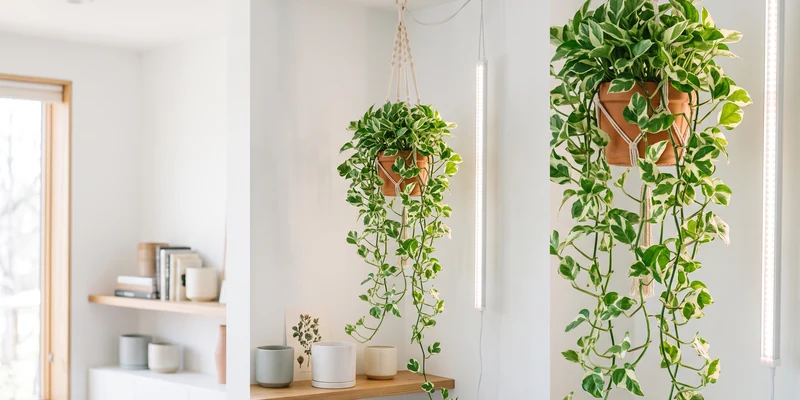
Pothos presents a coverage problem no other common houseplant has: the plant is several feet long and only the crown sits under your lamp. Every leaf photosynthesizes, so a vine trailing into a dark corner contributes nothing while still costing the plant water and energy. Where you can, light the run rather than only the pot.
On a shelf, strips under the shelf above do this naturally. For a hanging basket, position the light so the cone covers the crown and the first foot or two of vine, and turn the pot every couple of weeks so different sides take a turn in the bright zone. If the vine has grown far past the light, cutting it back just above a node encourages branching near the crown and puts new growth back where the light is; the cuttings root easily in water.
Climbing changes the answer
A pothos trained up a moss pole grows vertically instead of trailing, which stacks the leaves under an overhead light rather than away from it. Climbing plants also tend to produce larger leaves, and the effect compounds when the light is good. Raise the fixture as the plant climbs; the general ranges are in our guide to how far grow lights should be from plants.
Schedule, Water and the Rest of the Routine
Run the light around 10 to 12 hours a day on a timer, every day. Pothos is shade-adapted, so stretching the schedule to 16 hours adds very little, while a steady daily rhythm keeps growth even through winter. Background on photoperiods across plant groups is in how many hours of grow light plants need.
More light also means faster water use, so a pothos that grew slowly in a dark hallway will dry out sooner once it is properly lit. Keep checking the top inch or two of the mix rather than watering on a fixed day, since overwatering a slow plant in a dim corner is how most pothos actually die. And if the fixture sits above a shelf where you also water, keep plugs above pot level and let the cord hang in a drip loop.
Common Mistakes to Avoid
- Assuming tolerance means preference. Pothos survives low light and looks its best in moderate light. Those are different claims.
- Expecting old bare stems to fill in. They will not. Judge the light by new growth, and prune above a node to force fresh branching.
- Pushing a strong light close to a variegated plant. Pale leaf zones scorch first. Moderate light at a sensible distance is the better trade.
- Lighting only the pot. Several feet of vine in the dark do nothing for the plant. Light the run, or shorten it.
- Watering on the old schedule after upgrading the light. Growth speeds up and so does water use. Check the mix, not the calendar.
- Buying a purple panel for a living room. A white full spectrum LED grows a pothos just as well and lets you see the variegation; more in our explainer on full spectrum grow lights.
Frequently Asked Questions
Does a pothos really need a grow light? It does not need one to survive, but a windowless room gives you small leaves, long bare stems, and fading variegation. A modest LED is what keeps the plant looking full.
How far should a grow light be from a pothos? Roughly 18 to 30 inches for a typical screw-in grow bulb, and 8 to 14 inches for strips or clip lamps. Move it closer if new growth stretches, farther if leaves look washed out.
Will a grow light bring variegation back? On new leaves, often yes. Existing leaves keep the pattern they were born with, so judge the change on the next stretch of vine.
How many hours of light does a pothos need? Around 10 to 12 hours a day is plenty for a shade-adapted vine. Longer schedules do not add much and simply cost more to run.
Can I use the same light for my pothos and my monstera? Yes, they have similar needs, although a monstera is larger and wants wider coverage; see our guide to the best grow light for monstera.
The Bottom Line
A pothos survives almost anywhere and looks good only where the light is decent. A modest full spectrum white LED, 18 to 30 inches away for a bulb or 8 to 14 inches for strips, running 10 to 12 hours a day, gives you bigger leaves, tighter node spacing, and better variegation on new growth. Light the vine as well as the pot, and prune back what has outgrown the lit zone.