Last updated: August 15, 2026
An African violet that will not bloom is rarely sick. It is usually just under-lit. Healthy leaves, a tidy rosette, months of green and nothing else is the signature of a plant getting enough light to live on and not enough to flower, and it is the single most common complaint about the species. The right African violet grow light turns that around, often within a couple of months.
What makes violets interesting is that they are not asking for more, they are asking for steady. Saintpaulia comes from shaded, humid ground in East Africa, so it wants moderate light for a long, consistent day rather than the blast a tomato would enjoy. That is a schedule a modest LED delivers effortlessly, which is why violet growers have been raising these plants entirely under artificial light on multi-tier shelves for decades.
This article contains affiliate links. If you buy through them, we may earn a commission at no extra cost to you. Learn more.
Quick Answer
What grow light do African violets need?
- A modest full spectrum white LED, moderate rather than powerful: strip lights over a shelf or a low-wattage bulb in a lamp both work well.
- Keep it roughly 10 to 15 inches above the leaves for strips and small fixtures, farther for anything stronger, and run it 12 to 14 hours a day on a timer.
- Give a real dark period every night. Consistent moderate light plus darkness is what triggers blooming, not raw intensity.
African Violet Light Needs at a Glance
Violets want bright but gentle light, delivered on a dependable schedule. Too little and you get leaves only; too much and the rosette tightens up and bleaches. The table below is the working summary, and the sections after it explain the reasoning.
| Factor | What African violets want | Notes |
|---|---|---|
| Light type | Full spectrum white LED, strips or a low-wattage bulb | No special color mix needed; violets bloomed under plain fluorescent tubes for generations |
| Intensity | Moderate, roughly 100 to 200 PPFD at leaf level | Far less than vegetables; more is not better here |
| Distance | Commonly 10 to 15 inches for strips and small fixtures | Stronger bulbs and panels go higher, or use a dimmer |
| Hours per day | Around 12 to 14 | Very long days do not add blooms and can tire the plant |
| Dark period | Essential, at least 8 hours | Growers link a consistent night period to reliable flowering |
| Too little light looks like | Long upright leaf stalks, dark thin leaves, no buds | The classic non-blooming violet |
| Too much light looks like | Pale or yellowish leaves, tight crowded center, leaves curling down | Move the light up a few inches or dim it |
Why Light Decides Whether You Get Flowers
Blooming costs a plant energy it can only earn from light. A violet in a dim corner banks just enough to maintain its leaves, so it does the sensible thing and skips flowering entirely. Raise the light level to the moderate range and the same plant starts setting buds, usually within six to ten weeks, and then blooms in flushes for months.
The second half of the trick is consistency. Violets respond to a stable daily rhythm, so a light on a timer at 12 to 14 hours beats a brighter light switched on when you remember. Growers who keep collections on lit shelves report near continuous bloom precisely because the schedule never varies, no matter the season or the weather outside.
Leaf shape tells you the level
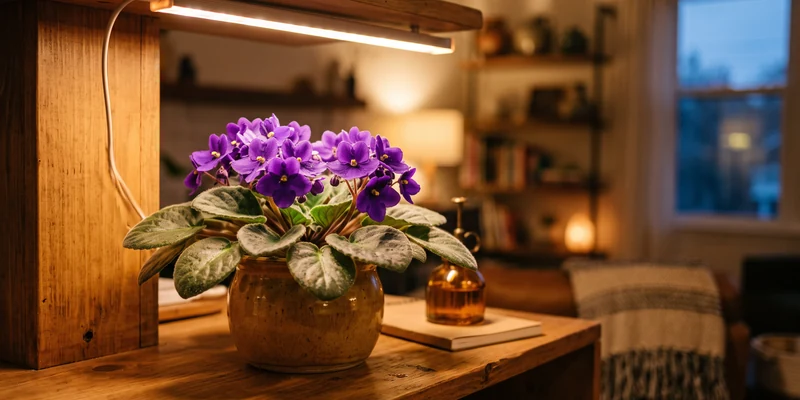
Read the rosette. Leaf stalks that stretch upward and a plant that looks like it is reaching mean not enough light. A crowded, tight center with leaves that curl downward over the pot rim usually means too much. A well-lit violet sits flat and symmetrical, which is exactly the look show growers aim for.
Grow Light Picks for African Violets
How we chose: we compared widely available full spectrum LEDs on output, coverage, and how easily they mount over a low-growing plant, using manufacturer specifications and the patterns that show up repeatedly in owner reviews. Violets need moderate light, so the deciding factor is how many plants you keep, not how powerful the fixture is.
🏆 Best Overall for a Violet Shelf
Linkable LED strips mounted under the shelf above, the modern version of the fluorescent tube setup violet growers have used for decades. Even, gentle light across a whole row of pots and easy to chain across a second tier.

💰 Best Budget Pick
A clip-on gooseneck LED with a dimmer and built-in timer, clamped above one or two plants. The dimmer matters here, since violets prefer moderate light and most clip lamps can easily overshoot at close range.

💡 Also Great for a Single Plant
A lower-wattage full spectrum bulb in a table lamp or pendant, aimed down at the rosette from a comfortable height. It keeps a windowsill violet blooming without any visible growing equipment; the range is covered in our SANSI grow light review.

Placement and Distance for a Flat Rosette
Light a violet from directly above. The plant grows as a flat rosette and orients every leaf toward the strongest source, so a lamp off to one side produces a lopsided plant within weeks. If the light has to sit at an angle, turn the pot a quarter turn each week and the rosette stays even.
For strips and small fixtures, growers commonly hang the light 10 to 15 inches above the leaves. Stronger bulbs and panels belong farther away or dimmed down, because violets reach their comfortable intensity long before a vegetable would. The general ranges per fixture type are in our guide to how far grow lights should be from plants.
Shelves are the classic solution
A wire rack with strips under each shelf lets you grow a whole collection in a small footprint, and because violets stay low, the tiers can sit close together. Leave enough clearance for airflow and for reaching in to water, and keep the fixture and its plug above the pots rather than behind them. A drip loop in the cord and a GFCI protected outlet are sensible where water and electricity share a shelf.
The Schedule That Keeps Them Blooming
Set a timer for 12 to 14 hours a day and leave it alone. That length is long enough to fund flowering and short enough to give the plant the dark period it needs, and holding it steady year round is what produces the repeat flushes violets are known for. Our guide to how many hours of grow light plants need covers photoperiods across other plant groups.
Light interacts with the rest of the care routine. A better lit violet uses more water and grows faster, so check moisture more often and feed lightly during active growth. Room temperature in a comfortable living range suits them, and violets dislike cold drafts more than they dislike a dim corner, so a lit shelf away from a winter window is often better than the windowsill it replaced.
Common Mistakes to Avoid
- Assuming more light means more flowers. Past the moderate range you get bleached leaves and a tight center, not extra blooms.
- Lighting from the side. A flat rosette leans hard toward the source. Light from above, or rotate the pot weekly.
- Running lights around the clock. Violets need their nights. A dark period is part of the blooming rhythm.
- Switching the lamp on and off by hand. Irregular days are the enemy of steady flowering. Use a timer.
- Giving up after a month. Buds take weeks to appear after a light upgrade. Judge the change at six to ten weeks, not at two.
- Choosing a purple fixture. Blooming violets are worth looking at, and a white full spectrum LED grows them just as well; more in our explainer on full spectrum grow lights.
Frequently Asked Questions
Can African violets grow under artificial light only? Yes, and many collections are grown that way. A modest full spectrum LED on a 12 to 14 hour schedule can supply everything the plant needs, with no window involved at all.
How many hours of light do African violets need to bloom? Commonly 12 to 14 hours a day, followed by a genuine dark period. Consistency across weeks matters more than pushing the hours higher.
How close should the grow light be to an African violet? Around 10 to 15 inches above the leaves for strip lights and small fixtures. Stronger bulbs and panels should sit farther back or run dimmed.
Why is my African violet not flowering under a grow light? The usual causes are too little intensity, too few hours, or not enough patience. Check that the light is close enough and on a timer, then give it six to ten weeks.
Do African violets need a special spectrum? No. A white full spectrum LED works well, which is why these plants bloomed happily under ordinary fluorescent tubes for decades before LEDs existed.
The Bottom Line
African violets bloom on moderate light delivered reliably, not on intensity. A full spectrum white LED about 10 to 15 inches above the leaves, running 12 to 14 hours a day on a timer with a proper dark period, is the whole recipe. Strips over a shelf suit a collection, a dimmable clip lamp or a low-wattage bulb suits a single plant, and patience covers the rest.
See our African violet light picks