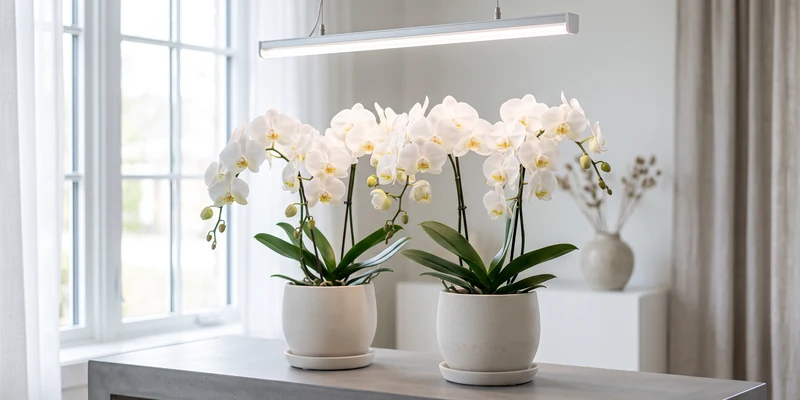
Last updated: August 13, 2026
Orchids are the rare houseplant where more light is not automatically better, which makes choosing a grow light for orchids a question of matching, not maximizing. A Phalaenopsis, the moth orchid from the supermarket, evolved clinging to shaded tree trunks and burns easily under intense light. A Cattleya or Vanda, by contrast, wants something close to full tropical sun. Same family, wildly different appetites.
That range is actually good news, because it means almost any orchid can thrive under lights once you know which group yours belongs to. It also means orchids come with a built-in light meter that most plants lack: their leaf color tells you, week by week, whether your lamp is dialed in. This guide covers the targets per orchid type, how to read the leaves, and which lights fit a windowsill, a shelf, or a dedicated orchid station.
This article contains affiliate links. If you buy through them, we may earn a commission at no extra cost to you. Learn more.
Quick Answer
What grow light do orchids need?
- Phalaenopsis and other low-light orchids do well under a modest full spectrum LED, roughly 12 to 20 inches away, 10 to 12 hours a day.
- High-light types like Cattleya, Dendrobium, and Vanda want a stronger lamp closer to the plant, more like a succulent than a moth orchid.
- Leaf color is your gauge: bright grass green means the light is right, dark forest green means too little, yellow or red-tinged means pushing the limit.
Light Targets by Orchid Type
Orchid light needs split into three broad tiers, and knowing your tier answers most equipment questions before they come up. Phalaenopsis sits at the shade end, Cattleya and Vanda at the sun end, with Dendrobium and Oncidium in between.
| Orchid group | Light level | Typical LED distance | Hours per day |
|---|---|---|---|
| Phalaenopsis, Paphiopedilum, Jewel orchids | Low to moderate, roughly 100 to 200 PPFD | About 12 to 20 inches from a modest LED | 10 to 12 |
| Oncidium, Dendrobium, Miltonia | Moderate to bright, roughly 200 to 400 PPFD | About 8 to 15 inches, or a stronger lamp higher up | 11 to 13 |
| Cattleya, Vanda, Cymbidium | Bright, roughly 400 PPFD and up | Strong bulb or panel per its coverage chart | 12 to 14 |
These figures are common hobbyist guidelines, not laboratory thresholds, and orchids tolerate a band around them. The practical approach is to start in the middle of your tier’s range and let the leaves vote over the following month.
Reading the Leaves: Your Built-In Light Meter
A well-lit orchid holds its leaves at a bright, slightly yellowish grass green. Leaves that turn deep, lush forest green look healthy to a houseplant eye, but on an orchid they usually signal too little light, and a plant that photosynthesizes too little will grow leaves but skip flowering. At the other end, yellowing across the whole leaf surface, or a reddish or purplish flush on species that show it, means the plant is near its upper limit, and pale scorched patches mean it went past it.
This feedback loop is why orchid growers obsess over leaf color more than any chart. Check the newest mature leaf monthly: if it is darker than grass green, move the light a few inches closer or add an hour; if it is bleaching, back off. Changes in either direction take weeks to show, so adjust in small steps.
Light and reblooming
The most common orchid disappointment, a Phalaenopsis that never flowers again, is usually a light problem first. Adequate light lets the plant bank the energy a flower spike costs, while a cool night period, a drop of roughly 10 degrees Fahrenheit for a few weeks, commonly provides the trigger. A grow light on a timer covers the energy half of that equation reliably, which windowsill light in winter often does not.
Our Grow Light Picks for Orchids
How we chose: we compared full spectrum LEDs on gentle-to-strong output range, mounting flexibility around humidity trays and bark pots, and the feedback that repeats across orchid owner reviews. Specifications come from manufacturers; adjust distance by leaf color, not by the box.
🏆 Best Overall
A mid-wattage full spectrum LED bulb in a desk or floor fixture, strong enough for any orchid tier depending on distance: 18 inches for a Phalaenopsis, closer or with more units for Cattleya types. Our SANSI grow light review compares the wattage options.

💰 Best Budget Pick
A clip-on gooseneck LED with a timer and dimmer, well suited to one or two Phalaenopsis on a desk or windowsill. The dimmer is genuinely useful here, since moth orchids sit at the shade end of the scale.

🪴 Best for a Collection
Linkable T5-style LED strips mounted above an orchid shelf, giving even coverage across many pots at once. Hang height sets the tier: closer for Oncidium and Dendrobium shelves, higher above the Phalaenopsis row.

Setup Notes Specific to Orchids
Orchids live with humidity trays, open bark pots, and regular soakings, so keep electrical connections above and away from the wet zone, plug the light into a GFCI-protected outlet, and let cords drop below the outlet in a loop so water cannot run along them into the socket. That is the one safety habit worth building into any plant shelf that gets watered in place.
Position lights overhead where possible. Phalaenopsis leaves grow in a flat fan that catches overhead light efficiently, and spikes will still arch toward the source, which is easy to guide with a stake. Under strip lights, group plants by tier so one shelf height suits everyone on it. General positioning rules are in our guide to grow light distance.
Schedule: Length, Consistency, and the Winter Question
Run orchid lights 10 to 14 hours depending on tier, on a timer, with a real dark period every night. Orchids use their nights, particularly for the temperature dip that helps trigger spiking, so around-the-clock light works against the bloom you are chasing.
In winter, a grow light quietly fixes the problem that stalls most windowsill orchids: day length and intensity both collapse just as many species want to set spikes. Keeping the same lit schedule year round smooths that dip. If your setup runs shorter days in winter for other reasons, 10 hours is a reasonable floor; the broader logic lives in how many hours of grow light plants need.
Common Mistakes to Avoid
- Treating all orchids as one plant. A lamp dialed in for a Vanda will cook a Phalaenopsis at the same distance. Know your tier first.
- Reading dark green leaves as health. On orchids that usually means underlighting, and it is the classic reason a plant grows leaves for years without a single spike.
- Making big adjustments fast. Orchids respond over weeks. Move the light a few inches at a time and give each change a month.
- Ignoring water and electricity. Misting and soaking around plugged-in fixtures deserves a GFCI outlet and drip loops, once, and then you never think about it again.
- Expecting light alone to force blooms. Light builds the energy budget, but many orchids also want a cool night stretch to trigger spiking. Both together is the recipe.
Frequently Asked Questions
Can orchids grow entirely under artificial light? Yes, and many serious collections do, especially Phalaenopsis and Oncidium. With tier-appropriate intensity and 10 to 14 hour days, orchids grow and rebloom without any window at all.
How far should a grow light be from a Phalaenopsis? Around 12 to 20 inches from a modest LED is a common range. Watch the leaves: grass green is right, forest green means come closer, bleaching means back away.
Will a grow light help my orchid rebloom? Usually, yes, because insufficient light is the most common reason a healthy orchid never spikes. Pair good light with a period of cooler nights and your odds improve considerably.
What color temperature is best for orchid lights? A white full spectrum LED, anywhere from roughly 3000K to 6500K, works well. Spectrum matters far less than getting intensity and duration right for your orchid’s tier.
Do orchids need darkness at night? Yes. A nightly dark period of 10 to 14 hours fits their rhythm, and the cool dark nights of fall are part of what triggers many species to set flower spikes.
The Bottom Line
Match the light to the orchid: modest LED at 12 to 20 inches for a Phalaenopsis, stronger and closer for Cattleya and friends, 10 to 14 hours on a timer with real darkness at night. Then let leaf color steer, grass green means hold, forest green means more, bleaching means less. Get that loop going and reblooming stops being a mystery.