Last updated: August 13, 2026
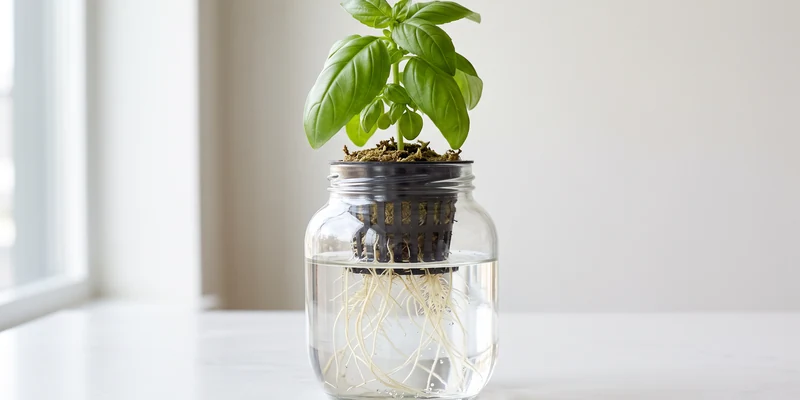
Hydroponics is growing plants in water instead of soil. The minerals a plant would normally pull out of the ground are dissolved in the water instead, so the roots sit in a nutrient solution and take up exactly what they need, when they need it. That is the whole idea, and everything else, the buckets, pumps, pebbles, and glowing pink lights, is just plumbing around it.
Once you see it that way, the hobby stops looking technical. A mason jar on a windowsill and a commercial greenhouse run on the same four ingredients. This guide explains what those are, how the main system types differ, what you actually need to start indoors, and which plants make the process feel easy the first time.
This article contains affiliate links. If you buy through them, we may earn a commission at no extra cost to you. Learn more.
Quick Answer
What is hydroponics, in plain English?
- It is soilless growing: roots sit in water carrying dissolved minerals, plus an inert medium like clay pebbles for support rather than for food.
- Because water, minerals, and oxygen reach the roots directly, plants generally grow faster than in soil, and indoors you supply the light yourself.
- The trade is control for attention: no weeding and no soil pests, but you manage the solution, and a pump or power failure matters more than it would in a pot.
The Four Things Every System Provides
Strip away the hardware and every hydroponic setup, from a jar to a warehouse, delivers the same four things to a root system. If a design fails, it is almost always because one of these slipped.
| Requirement | What it means | How systems deliver it |
|---|---|---|
| Water | Constant access, without drowning the whole root mass | A reservoir, a film of flowing solution, or a fine mist |
| Dissolved minerals | All fourteen elements a plant needs, since there is no soil bank to draw on | A complete hydroponic nutrient mixed to a target strength |
| Oxygen at the roots | Roots breathe; submerged, still water suffocates them | An air pump, an air gap above the water, or moving solution that picks up oxygen |
| Support and light | Something to hold the plant up, and enough light to run photosynthesis | Net pots with an inert medium, plus daylight or an LED grow light indoors |
Notice that soil provided three of those quietly and for free. Taking it away is what makes hydroponics fast and what makes it demand a little more of you. The medium question is covered in our guide to clay pebbles in hydroponics, and the mineral side in hydroponic nutrients explained.
How It Actually Works
A plant does not eat soil. It absorbs water and mineral ions through its roots and builds sugars from light and carbon dioxide in its leaves. Soil is a storage and delivery system for those minerals, and a fairly inefficient one, since the plant has to wait for organic matter to break down into forms it can use.
Hydroponics skips the waiting. The minerals are already dissolved in plant-available form, at a strength and a pH you choose, so uptake is immediate. That is the main reason hydroponic lettuce commonly reaches harvest in roughly four to six weeks from transplant while the same variety in a garden bed takes longer. Nothing magical is happening; the plant simply never spends a day hungry or thirsty.
Why pH keeps coming up
Minerals stay dissolved and reachable only within a certain pH window, usually cited as around 5.5 to 6.5 for most edible crops. Drift outside it and elements bond into forms roots cannot absorb, which looks exactly like a deficiency even though the solution is full. That is why a cheap pH meter earns its place faster than almost any other purchase.
The Main Types of Hydroponic System
There are six designs worth knowing, and they differ mostly in how they solve the oxygen problem. Everything else follows from that.
| System | How it works | Effort | Best for |
|---|---|---|---|
| Kratky (passive) | Fill once; as the plant drinks, the falling level leaves an air gap for the roots | Lowest, no power at all | Lettuce, greens, and herbs in jars or totes |
| Deep water culture | Roots hang in an aerated reservoir kept oxygenated by an air pump | Low, once running | Fast leafy greens and larger single plants |
| Nutrient film technique | A thin film of solution runs down sloped channels past bare roots | Medium, pump dependent | Rows of lettuce and herbs in a compact footprint |
| Ebb and flow | A tray of medium floods on a timer, then drains, pulling in fresh air | Medium | Mixed plantings and seedling trays |
| Drip systems | Emitters feed each plant in its own container of medium | Medium to high | Tomatoes, peppers, and other long-season crops |
| Aeroponics | Roots hang in air and are misted with solution on a cycle | Highest | Growers who want maximum oxygen and enjoy maintenance |
Countertop smart gardens are not a seventh category; most are small deep water culture or wick systems with a light and a timer built in. If you want the deeper mechanics, start with the Kratky method guide and the deep water culture guide, or see how channel systems compare in our NFT systems guide.
What You Need to Start Indoors
Five items cover almost any first setup, and two of them you may already own. Nothing here is exotic, and you can add the optional pieces once the first crop convinces you.
- A system or container. A jar and a net pot for a test run, a bucket for something bigger, or an all-in-one countertop unit if you would rather not assemble anything. Our roundup of the best indoor hydroponic gardens compares the plug-in options.
- Light. Indoors, a south-facing window rarely delivers enough for edible crops through winter. A modest LED panel or bar solves it; see the LED grow light guide for sizing.
- A complete nutrient. A hydroponic formula, not houseplant food, because it has to supply calcium, magnesium, and micronutrients too.
- An inert medium and net pots. Clay pebbles, rockwool cubes, or peat plugs to hold seedlings and support stems.
- A way to check pH. Strips work to start; a pocket meter is more accurate and quickly pays for itself in avoided guesswork.
Optional but useful later: an air pump for deep water culture, a timer for the light, and a meter for solution strength. None of those are day-one purchases.
What Grows Well, and What Fights You
Leafy greens and herbs are where hydroponics feels effortless. Lettuce, spinach, kale, basil, mint, and cilantro all thrive on modest light, mild nutrient strength, and short timelines, which is why nearly every beginner guide starts there.
Fruiting crops are absolutely possible and considerably more demanding. Tomatoes, peppers, and strawberries need stronger light, more support, more nutrient volume, and often pollination help indoors, so they suit a second or third project rather than a first. Root vegetables like carrots and potatoes are the awkward case: they can be grown in deep media beds, but the effort rarely rewards you compared with a pot of soil. A fuller list is in what you can grow in a hydroponic garden, and the herb side has its own complete guide at growing herbs indoors.
The Honest Pros and Cons
Hydroponics is genuinely good at several things and genuinely worse at others, and knowing which is which prevents disappointment.
On the plus side: faster growth for leafy crops, no weeding, no soil gnats, year-round harvests, small footprints, and complete control over what goes into the water. On the minus side: an upfront equipment purchase, a routine of mixing and checking, dependence on power for pumped systems, and a smaller margin for error, since a problem in a shared reservoir reaches every plant at once. Soil forgives a forgotten week; a small reservoir does not.
Common Beginner Mistakes
- Using houseplant fertilizer. It assumes soil supplies calcium and micronutrients. In water, that assumption fails within weeks.
- Relying on a windowsill. Most indoor light is far dimmer than it looks. Pale, stretched seedlings are a light problem, not a nutrient one.
- Drowning the roots. Submerging the entire root mass in still water starves it of oxygen. Every design leaves an air zone somewhere.
- Letting light hit the solution. Clear jars plus light equals algae. Wrap, paint, or use opaque containers.
- Starting with tomatoes. Ambitious, but they magnify every mistake. Start with lettuce or basil and graduate.
- Ignoring pH for weeks. It drifts as plants feed. A check every few days costs a minute.
Three Ways to Start This Week
Pick the entry point that matches how much building you want to do. All three grow the same salad.
The no-assembly route is a countertop smart garden: light, pump, and timer in one unit, running within ten minutes of unboxing. The cheapest route is a Kratky jar: a container, a net pot, a plug, nutrients, and patience, with no power at all. The middle route, and the one most people settle on, is a deep water culture bucket with an air pump, which teaches you the fundamentals cheaply. When you are ready for a first real crop, growing hydroponic lettuce walks the whole timeline from seed to harvest.
For the no-assembly route, a countertop starter kit bundles the light, pump, timer, and pods in one box, which is the lowest effort way to find out whether the hobby suits you. Plug it into a GFCI protected outlet and leave a drip loop in the cord.
Frequently Asked Questions
Is hydroponics hard for beginners? The first system is easier than most people expect, especially a Kratky jar or a countertop unit. The learning curve is about routine, checking water level and pH, rather than about technical skill.
Do hydroponic plants need special seeds? No. Ordinary seeds work. Compact and fast varieties simply suit indoor space better, which is why seed pod brands lean toward them.
Does hydroponics use a lot of water? Less than you would guess. Because the solution is contained and recirculated rather than draining into the ground, most of the water ends up in the plant or evaporates.
How much light do indoor plants need? Leafy greens and herbs commonly run around 12 to 16 hours a day under an LED, while fruiting crops want stronger light for a similar span. Distance and intensity matter as much as hours.
Can I grow hydroponically without electricity? Yes, with the Kratky method, which uses no pump at all. You still need light, so a bright window or a solar-lit space becomes the limiting factor.
Does hydroponic produce taste different? Flavor depends mostly on variety, light, and harvest timing rather than on the growing method. Many growers find home-grown herbs more aromatic simply because they are cut minutes before use.
The Bottom Line
Hydroponics is soilless growing: roots in a mineral solution, with oxygen and light supplied deliberately instead of by accident. Every system, from a jar to an aeroponic tower, is a different answer to the same oxygen problem. Start with leafy greens, a complete nutrient, a way to check pH, and enough light, and the rest of the hobby unfolds from there at whatever pace you like.