Last updated: August 15, 2026
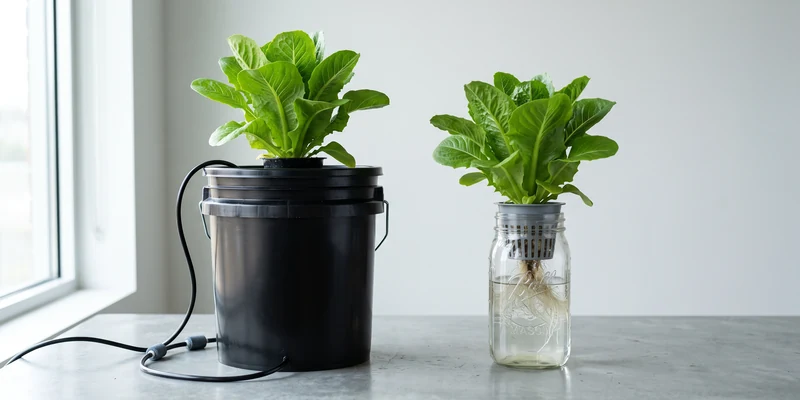
Deep water culture and the Kratky method are the two doors most people enter hydroponics through, and from the outside they look nearly identical: a container of nutrient solution, a net pot, roots hanging in the water. The DWC vs Kratky question really comes down to one component. DWC adds an air pump and air stone that bubble oxygen through the solution around the clock. Kratky adds nothing, and lets a growing air gap do the breathing instead.
That one difference cascades into everything: what you can grow, how fast it grows, what happens when you leave for a week, and what happens when the power goes out. This comparison walks through the trade-offs honestly, then gives a clear verdict on which passive-friendly system deserves your first bucket.
This article contains affiliate links. If you buy through them, we may earn a commission at no extra cost to you. Learn more.
Quick Answer
DWC or Kratky: which should you start with?
- Start with Kratky if you want to test hydroponics for a few dollars, grow leafy greens or herbs, or have no power outlet near your grow spot.
- Choose DWC if you want faster growth, fruiting crops like tomatoes and peppers, or a system you can run and refresh for months at a time.
- Many growers do both in sequence: a Kratky jar to learn the fundamentals, then a bubbling DWC bucket once they are hooked.
DWC vs Kratky at a Glance
Here is the whole comparison in one table. The short story: Kratky wins on simplicity and cost, DWC wins on performance and flexibility.
| Factor | Kratky | DWC |
|---|---|---|
| Oxygen supply | Passive air gap above the falling water line | Air pump and air stone bubbling constantly |
| Electricity | None needed | Required, day and night |
| Startup cost | Lowest in hydroponics: jar, net pot, nutrients | Modest: adds pump, air line, air stone |
| Growth speed | Good for greens, slows for big plants | Generally faster, especially past seedling stage |
| Best crops | Lettuce, herbs, Asian greens | Everything Kratky grows, plus fruiting crops |
| Maintenance | Nearly zero for short crops | Regular level checks and solution changes |
| Refilling | Avoided or minimal by design | Routine top-ups and full reservoir swaps |
| Power outage risk | None, nothing to fail | Real: still water can starve roots of oxygen within a day or two in warm conditions |
| Noise | Silent | Quiet hum and bubbling |
| Scale ceiling | Single containers, short cycles | Multi-bucket systems, long cycles |
How Each System Actually Breathes
Roots need oxygen as much as they need water, and the two systems solve that problem in opposite ways. In Kratky, the plant drinks the reservoir down, and the exposed upper roots become air roots in the humid gap left behind. The system self-regulates as long as you never refill over those roots. Our full Kratky method guide covers the setup in detail.
DWC keeps the water level high and constant, and delivers oxygen mechanically instead: an air pump pushes air through a stone that breaks it into streams of fine bubbles. Dissolved oxygen stays high everywhere in the reservoir, which is why roots in a healthy DWC bucket look like white cotton and grow with startling speed. The mechanics, and what pump size fits what bucket, are covered in our complete DWC guide.
Why oxygen decides the crop list
A lettuce finishing in a month never outgrows a passive air gap. A tomato running four months at full canopy will, because its oxygen demand keeps climbing while the Kratky gap strategy assumes a short, tidy life cycle. Constant aeration is what lets DWC carry heavy feeders from seedling to final harvest without the improvisation Kratky needs for the same crops.
Speed, Effort, and Cost Compared
On growth speed, DWC generally wins, and growers who run both side by side report the gap widening as plants get bigger. More dissolved oxygen supports more root activity, and more root activity supports a bigger, faster canopy. For a quick salad crop the difference is modest; for anything long-lived it compounds.
On effort, the ranking flips. A Kratky lettuce needs attention twice: setup day and harvest day. A DWC bucket asks for weekly level checks, periodic full solution changes, and an occasional look at the pump and stone. None of it is hard, but it is a routine, and it continues for the life of the crop. Water changes are also where beginners meet questions of drift and balance; our guide on where the DWC water level should sit covers the most common one.
The failure modes are different, not equal
Kratky fails slowly and visibly: the water runs out, or heat cooks a small reservoir, and you can see both coming. DWC fails fast and quietly: a dead pump or tripped outlet turns an oxygen-rich reservoir into still water, and warm still water around a big root mass is the express lane to root rot. It is worth reading our DWC root rot guide before your first long grow, and putting the pump on an outlet you trust. One practical safety note applies to any pump near water: plug it into a GFCI-protected outlet and leave a drip loop in the cord.
Which System Fits Which Grower?
Choose Kratky if any of these sound like you: you want to try hydroponics before spending real money, your grow spot has no outlet, you mostly want salads and herbs, or you travel often and need a system that genuinely runs itself for weeks. A mason jar of basil on a windowsill is still the cheapest convincing demo in home growing.
The passive side of this comparison needs almost nothing: a wide mouth jar and a net pot lid that turns it into a growing container.

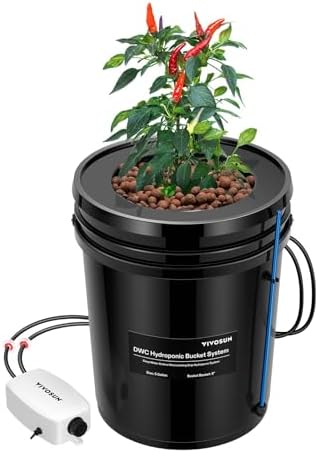
Choose DWC if you already know you are in for a season or more, want tomatoes, peppers, or cucumbers, or simply want the fastest growth a simple system can give. A single 5-gallon bubbling bucket is the classic build, and ready-made kits take the guesswork out of hole saws and grommets; see our roundup of the best DWC hydroponic systems for both routes, and our guide to air pumps for hydroponics for sizing the one component Kratky proudly lacks.
On the powered side, a complete 5 gallon bucket kit is the equivalent starting point: bucket, lid, net pot, air pump, stone, and tubing arrive matched, so the only decision left is what to plant.
Common Mistakes to Avoid
- Judging Kratky by a fruiting crop. Tomatoes make Kratky look bad and DWC look essential. Compare the systems on greens first; that is the fair fight.
- Refilling a Kratky container to the top. That erases the air gap, and with it the entire oxygen plan. Top up below the upper roots or not at all.
- Running DWC without a backup plan. A spare air pump costs little and turns a dead-pump emergency into a five-minute swap.
- Clear containers in either system. Light in the reservoir means algae, and algae means competition for nutrients and oxygen. Opaque wins every time.
- Mixing one solution strength for every crop. Greens want a mild mix, fruiting crops a stronger one, in both systems alike.
Frequently Asked Questions
Is Kratky just DWC without an air pump? Functionally close, but the design logic differs. DWC holds the water level high and aerates it; Kratky deliberately lets the level fall so an air gap forms. Removing the pump from a DWC bucket without managing that gap gives you the worst of both.
Which is better for beginners? Kratky is the gentler on-ramp: cheaper, silent, and nearly maintenance-free for greens. DWC is a better first system if you already know you want fruiting crops or months-long grows.
Does DWC really grow plants faster? Growers running both side by side generally report faster growth in DWC, with the gap widening as plants mature. Constant dissolved oxygen is the usual explanation.
Can I convert a Kratky bucket to DWC later? Yes, easily. Add an air pump, air line, and air stone, raise the solution level, and you have a DWC bucket. Many growers upgrade exactly this way.
What happens to DWC in a power outage? Dissolved oxygen falls once bubbling stops, and in warm conditions roots can begin to suffer within a day or two. Short outages are usually survivable; for long ones, a battery-powered air pump is cheap insurance.
The Bottom Line
Kratky is the better first step: for the cost of a jar and a packet of nutrients it teaches you everything passive hydroponics can do, and for greens and herbs it barely concedes anything to powered systems. DWC is the better system to grow into, with faster growth and a crop list that includes the fruiting plants Kratky struggles to finish. Start passive, upgrade to bubbles when your ambitions outgrow the air gap.