Last updated: August 15, 2026
In a deep water culture system the roots live underwater full time, which means your plants are only ever as healthy as the oxygen supply. A deep water culture air pump is the machine behind that supply: a small diaphragm pump, borrowed straight from the aquarium world, pushing air through a stone that shatters it into thousands of tiny bubbles. Cheap, simple, and absolutely load-bearing.
The category is confusing out of proportion to its price, because pumps are sold on flow numbers nobody explains and every listing claims to be quiet. This guide covers how much air a system actually needs, which specs matter, the accessories that are not optional, and our picks from a single bucket to a whole row of them.
This article contains affiliate links. If you buy through them, we may earn a commission at no extra cost to you. Learn more.
Quick Answer
Which air pump do you need for hydroponics?
- For one 5-gallon DWC bucket, a small dual-outlet aquarium-style pump is plenty; a commonly used rule of thumb is around 1 liter per minute of air per gallon of solution.
- Running several buckets? Step up to a commercial-style pump with a multi-outlet manifold instead of stacking small pumps.
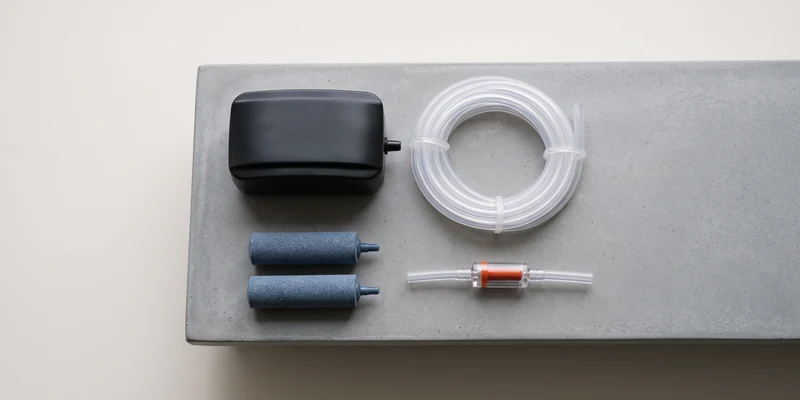
- Budget for the trio, not just the pump: air stones, airline tubing, and a check valve per line are part of the deal.
What to Check Before You Buy
Five specs decide whether a pump fits your system, and flow rate is only the first. Work down this list and the field narrows fast.
| What to check | Why it matters | What to look for |
|---|---|---|
| Flow rate | Sets how much oxygen reaches the roots | Roughly 1 L/min per gallon of solution is a common guideline; more is fine, roots are hard to over-aerate |
| Outlets | Each bucket wants its own line and stone | Dual outlets for one or two buckets, a manifold for more |
| Adjustability | Lets you trade bubbles against noise | A dial beats an on-off switch in a bedroom or office grow |
| Noise | The pump runs 24/7 in your living space | Rubber feet, adjustable output, and owner reports of hum rather than rattle |
| Serviceability | Diaphragms wear out long before motors | Brands that sell replacement diaphragm kits earn the long game |
Where the air ends up matters too: the geometry of stone, net pot, and water line is covered in our deep water culture guide and the practical build in the 5-gallon DWC bucket setup.
How Much Air Does DWC Actually Need?
Less than the marketing suggests, and more than silence. The guideline many growers use is about 1 liter per minute of airflow per gallon of nutrient solution, so a 5-gallon bucket holding around 3 to 4 gallons of solution is well served by a small pump rated in the 4 to 8 L/min range. Practically, you want a steady, rolling boil of fine bubbles across the stone, not a violent churn.
Oversizing within reason costs little and buys margin, because dissolved oxygen falls as water warms. That link between warm, still water and trouble is the entire root rot story; if your pump is marginal on a hot day, the first symptom shows up in the roots, as explained in our guide to DWC root rot. One nuchter safety note, since this is electricity living next to a full bucket of water: plug the pump into a GFCI outlet, leave a drip loop in the cord, and keep the pump itself above the waterline or protected by a check valve.
Our Air Pump Picks
How we chose: we compared widely available pumps on rated flow, outlet count, adjustability, noise as reported by owners, and the availability of spare diaphragms, using manufacturer specifications and recurring themes in reviews rather than any testing of our own.
🏆 Best Overall
A dual-outlet, adjustable-flow air pump in the aquarium style, with enough output for two buckets and a dial to tune bubbles against noise. The default choice for a first or second DWC bucket.

💰 Best Budget Pick
A small single-outlet aquarium air pump for one bucket or a Kratky-to-DWC upgrade. Owners consistently describe this class as quiet enough for a bedroom, and it sips electricity.

🔗 Best for Multiple Buckets
A commercial-style pump with a chrome multi-outlet manifold, built to feed four or more buckets from one plug. One strong pump beats a power strip full of small ones.

Air Stones, Tubing, and Check Valves
The pump gets the attention, but the stone does the actual work: it breaks the airflow into fine bubbles, and finer bubbles mean more surface area transferring oxygen into the water. Cylinder stones distribute bubbles more evenly across a bucket than the small blue discs, and stones clog slowly over months, so buy spares and swap them at reservoir changes.
Standard airline tubing connects everything; keep runs short and kink-free, since every foot of tubing and every splitter costs a little pressure. The check valve is the unglamorous essential: a one-way valve in the line that stops water from siphoning backward into the pump when the power goes out. One per line, always, unless the pump sits well above the waterline.
Two More Buys That Round Out the Setup
Neither of these is strictly a pump, and skipping them is the most common way a good pump ends up performing badly.
🪨 The Workhorse Air Stones
A multi-pack of cylinder air stones sized for buckets. Even bubble columns, cheap to replace, and having spares on the shelf means a clogged stone never tempts you to run without one.

⭐ Also Great: the All-in-One Kit
An aeration kit that bundles pump, stones, tubing, and check valves in one order. The simplest route for a first build, and the parts double as spares once you upgrade the pump later.

Keeping It Quiet and Keeping It Alive
Diaphragm pumps hum by nature, and most of the noise you hear is vibration reaching a hard surface. Set the pump on a folded towel or foam pad, keep it off the lid and off hollow shelves, and use the output dial to find the quietest setting that still rolls the water.
Maintenance is minimal but real: rinse or replace clogged stones, check that tubing has not hardened, and expect the rubber diaphragm inside the pump to wear over time, which shows up as weakening output. Brands that sell rebuild kits let you fix that for pocket change instead of replacing the pump.
Common Mistakes to Avoid
- Skipping the check valve. A power cut can siphon reservoir water backward into the pump and onto the floor. One valve per line prevents it.
- One stone for two buckets. Splitting a single line unevenly starves one bucket. Give every bucket its own stone and line.
- Buying on wattage alone. Watts measure consumption, not delivered air. Compare rated flow and outlet count instead.
- Letting a clogged stone limp along. Output drops slowly enough that you stop noticing. Swap stones at reservoir changes.
- Putting the pump on the bucket lid. It turns the bucket into a soundboard and vibrates the water all night. Floor plus foam pad is quieter.
Frequently Asked Questions
How big should an air pump be for a 5-gallon bucket? Using the common guideline of about 1 L/min per gallon of solution, a pump rated around 4 to 8 L/min covers a 5-gallon bucket comfortably, with margin for warm days.
Can an air pump be too strong for DWC? Rarely. Roots tolerate vigorous aeration well; the practical limits are noise, splashing that wets the stem, and bouncing seedlings in very small containers. A dial solves all three.
Should the air pump run 24/7? Yes. Dissolved oxygen depletes quickly in a stocked reservoir, and there is no benefit to cycling the pump. Continuous operation is the standard, as covered in our DWC guide.
Do I need an air pump for Kratky? No. The Kratky method deliberately uses a growing air gap instead of aeration. The pump is what separates DWC from Kratky in the first place.
Why did my air pump get weaker? Usually a clogged stone, a kinked line, or a worn diaphragm, in that order. Test the pump with a bare tube; strong flow there points at the stone.
The Bottom Line
Size the pump to the water with the 1 L/min per gallon guideline, give every bucket its own stone and check-valved line, and favor adjustable pumps from brands that sell spare diaphragms. Aeration is the cheapest insurance in all of hydroponics: the whole setup costs less than one lost tomato plant.