Last updated: August 15, 2026
The Kratky method has one honest limitation, and it is the one most beginner guides skip: the container you fill on day one has to carry the plant to harvest. That single fact decides the best plants for the Kratky method better than any top-ten list. Crops that finish fast on modest water are effortless. Crops that live for months and drink by the quart demand workarounds.
So instead of a flat list, this guide sorts common crops into three tiers: plants that thrive with zero intervention, plants that work if you top up, and plants that fight the method the whole way. Pick from the first tier for your first jar or bucket, and passive hydroponics will feel almost unfairly easy.
This article contains affiliate links. If you buy through them, we may earn a commission at no extra cost to you. Learn more.
Quick Answer
Which plants grow best with the Kratky method?
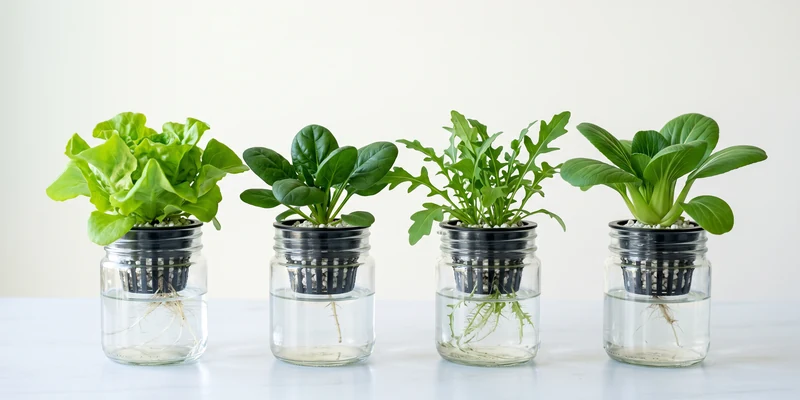
- Leafy greens are the sweet spot: lettuce, bok choy, arugula, kale, and spinach typically finish in around 30 to 60 days on a single fill.
- Herbs like basil, mint, and cilantro come a close second, happily living in mason jars on a bright windowsill or under a small grow light.
- Fruiting crops such as tomatoes, peppers, and cucumbers work only in large containers with regular top-ups; root crops and heavy long-season plants are better grown another way.
The Kratky Crop Tier List
Here is the whole answer in one table: what to grow, how it behaves in a passive container, and what size vessel it realistically needs.
| Crop | Kratky fit | Typical time to harvest | Container that works |
|---|---|---|---|
| Lettuce | Excellent, the signature Kratky crop | Around 30 to 45 days from transplant | Quart jar to 1-gallon container |
| Bok choy | Excellent, fast and compact | Around 30 to 50 days | Half-gallon to 1-gallon container |
| Arugula | Excellent, quick cut-and-come-again | Around 30 to 40 days | Quart jar and up |
| Kale and chard | Very good, harvest leaf by leaf | First picks around 40 to 60 days | 1-gallon and up |
| Spinach | Good, but bolts in heat | Around 35 to 50 days | Quart to 1-gallon, kept cool |
| Basil | Excellent, regrows after pinching | First picks around 3 to 4 weeks after transplant | Quart or half-gallon jar |
| Mint | Excellent, almost too vigorous | Continuous once established | Half-gallon and up |
| Cilantro and parsley | Good, prefers cooler spots | Around 3 to 5 weeks to first picks | Quart jar and up |
| Green beans (bush) | Decent, short season helps | Around 50 to 60 days | 2 to 5 gallons |
| Tomatoes | Workable with top-ups only | Around 60 to 80 days from transplant | 5 gallons minimum |
| Peppers | Workable with top-ups only | Around 60 to 90 days | 3 to 5 gallons |
| Cucumbers | Demanding, very thirsty | Around 50 to 70 days | 5 gallons plus frequent refills |
| Root crops, corn, squash | Poor fit, skip | Not practical | Not recommended |
Timelines are typical ranges, not promises; light, temperature, and variety all move the numbers. If the method itself is new to you, our complete Kratky method guide explains the air gap and setup behind every crop on this list.
Why Leafy Greens Dominate
Leafy greens win because their whole life fits inside one reservoir. A head of lettuce transpires modestly, feeds lightly, and is done in about a month, which means the water level falls at almost exactly the pace the roots grow down to chase it. That self-regulating balance is what Kratky’s design assumes, and greens are the crop that matches it best.
They are also forgiving on chemistry. One mild, balanced solution mixed on day one carries a green from transplant to harvest, with no need to shift formulas mid-grow. Most leafy greens do well with pH around 5.5 to 6.5 and a modest EC, commonly in the 0.8 to 1.5 range. Lettuce in particular is so reliable that we gave it its own walkthrough: Kratky lettuce from seed to harvest.
The cheapest way to work through this tier is a greens seed variety pack, which usually bundles lettuce, spinach, kale, and arugula in one box so you can start a different crop in every container.

Herbs: the windowsill tier
Basil, mint, and their cousins behave like slower, woodier greens. They drink modestly, regrow after every pinch, and fit in mason jars, which makes them the cheapest possible entry into hydroponics. A jar, a net pot, and a sunny window will genuinely do it; our guide to Kratky in mason jars shows the full setup for a few dollars in parts.
Herb seed variety packs cover the same ground for the windowsill tier, with basil, mint, cilantro, and parsley in one set and enough seed in each packet to keep restarting jars all year.

The Conditional Tier: Fruiting Crops
Tomatoes, peppers, and cucumbers all grow in passive containers, and all of them break the fill-once promise. A fruiting plant lives two to four times longer than a lettuce, builds far more canopy, and hits a thirsty stage right when fruit sets. In a fixed reservoir that means the water runs out mid-crop, so growers top up with fresh solution every week or two and treat the system as pump-free rather than hands-free.
They also feed harder. Fruiting crops generally want a stronger solution than greens, with EC commonly run around 2.0 or higher, which makes a purpose-mixed formula worth having. Our roundup of the best nutrients for the Kratky method flags which formulas suit still-water systems, and our dedicated guide to Kratky tomatoes walks through the highest-value conditional crop in detail.
What Not to Grow, and Why
Some crops fail in Kratky for structural reasons, not skill reasons. Knowing them saves a season of frustration.
- Root vegetables. Carrots, beets, and potatoes form their harvest below the crown, exactly where Kratky has water and air instead of a growing medium. The roots you eat never develop properly.
- Corn and large squash. Sheer size and water demand outrun any container you can lift. These are field crops pretending otherwise.
- Long-season perennials. A plant that lives for years needs a system you can clean, refresh, and rebalance, which passive containers resist. Strawberries can limp along, but they are far happier in an actively fed setup.
- Anything in a hot, translucent container. Whatever the crop, sunlight on the solution grows algae and cooks oxygen out of still water. Opaque containers are non-negotiable.
Matching the Crop to Your Setup
A quart jar on a kitchen windowsill grows herbs and single lettuce heads. A tote or bucket on a balcony grows greens by the batch and one fruiting plant if you commit to top-ups. If you find yourself topping up constantly and eyeing an air pump, you have outgrown the method, and that is a fine outcome: our DWC vs Kratky comparison covers when the upgrade actually pays.
Indoors, light becomes the deciding factor before water does. Greens and herbs are content under modest LED fixtures run 12 to 16 hours a day, while fruiting crops need considerably more output to set fruit. Match the crop tier to the light you actually have, not the light you plan to buy.
Common Mistakes to Avoid
- Starting with a tomato. It is the most requested crop and the least representative of the method. Grow one round of lettuce first and let the air gap teach you.
- Undersizing the container. When in doubt, size up. More solution means more buffer against heat, drift, and forgetfulness.
- One solution strength for everything. Greens want a mild mix, fruiting crops a stronger one. Splitting the difference serves neither.
- Clear jars in full sun. Green water within a week. Paint, wrap, or sleeve any translucent vessel.
- Chasing exotic crops early. The boring tier one crops are the ones that build the skills, and the salads, fastest.
Frequently Asked Questions
What is the single easiest plant for the Kratky method? Lettuce. It finishes in around a month on one fill, tolerates a wide range of conditions, and shows problems early and visibly. Butterhead and loose-leaf types are especially reliable.
Can you grow strawberries with the Kratky method? They survive, but they rarely thrive. Strawberries are long-lived, sensitive to water quality, and happier in actively aerated or circulating systems, so most growers skip them in passive containers.
Do herbs regrow after cutting in Kratky? Yes. Basil, mint, and similar herbs regrow for months if you pinch above a leaf pair rather than stripping the stem, and top up the jar as the level falls.
Can you do Kratky outdoors? Absolutely, and sunlight makes fruiting crops far more realistic. The trade-offs are heat in the reservoir, algae pressure, and faster evaporation, so opaque containers and afternoon shade help.
How many plants per container? One plant per hole, sized to the crop: a quart for one herb or lettuce, a gallon for kale or chard, five gallons for one tomato or pepper. Crowding a reservoir shortens everyone’s water supply.
The Bottom Line
Kratky rewards crops that finish fast on modest water: lettuce, Asian greens, arugula, kale, and kitchen herbs are the tier that makes the method feel effortless. Fruiting crops work as a second project in big containers with regular top-ups, and root crops simply do not belong. Start in tier one, and let a jar of basil convince you before a bucket of tomatoes tests you.