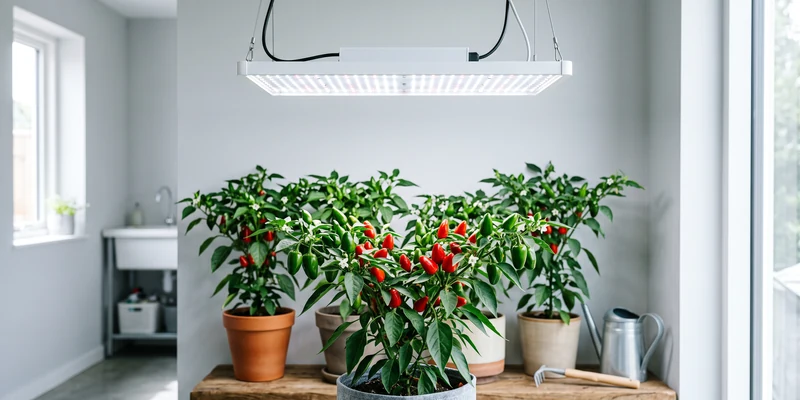
Last updated: August 15, 2026
Peppers are the crop that exposes a weak grow light. Lettuce forgives a dim shelf, basil complains politely, but a pepper plant under too little light does something unmistakable: it grows tall and green, sets a few flowers, drops them, and then just stands there looking healthy and producing nothing. If you have ever overwintered a chili plant indoors and harvested a grand total of two pods, the grow light for peppers was almost certainly the bottleneck.
This guide covers how much light peppers want, how that translates into fixture size and hours, and the non-light factors that decide whether flowers turn into fruit. Peppers are a vegetable-garden crop pretending to be a houseplant, and they need to be lit like one.
This article contains affiliate links. If you buy through them, we may earn a commission at no extra cost to you. Learn more.
Quick Answer
What is the best grow light for peppers indoors?
- A dimmable full spectrum white LED panel sized to your growing area, not a small clip-on lamp; fruiting crops need real intensity across the whole canopy.
- Run it 14 to 16 hours a day on a timer, and keep panels commonly 12 to 24 inches above the plants, dimmed while they are young.
- Plan coverage, not just wattage: one mature pepper plant wants roughly a square foot or two of well-lit floor space to itself.
What Peppers Ask From a Grow Light
Peppers are a full-sun fruiting crop, in the same light bracket as tomatoes and well above herbs and greens. Flowers and fruit are expensive for a plant to build, and the energy for them comes from light. Here is what that means in practice.
| Factor | What peppers want | Practical translation |
|---|---|---|
| Light appetite | Very high; a full-sun crop outdoors | Light them like tomatoes, not like a pothos |
| Hours per day | Commonly 14 to 16 under LEDs | Put it on a timer and leave a real dark period |
| Fixture class | A panel or bar light, not a bulb | Small clip-ons keep a seedling alive but rarely ripen fruit |
| Coverage | Even light across the full canopy | Match the fixture footprint to your shelf or tent floor |
| Distance | Close enough for intensity, far enough for spread | Commonly 12 to 24 inches for panels, higher and dimmed for seedlings |
| Spectrum | Full spectrum white with red in the mix | Roughly 3000K to 4000K white LEDs are the common choice |
| Signs it is working | Short internodes, thick stems, flowers that hold | Stretching and blossom drop point at light or temperature first |
Growers often talk about daily light integral, the total light a plant receives over a day. Fruiting crops sit in a noticeably higher bracket than leafy greens, which is the technical way of saying what most indoor gardeners learn by accident: the lettuce did fine, the peppers sulked.
Why Peppers Need More Light Than Herbs
A pepper plant runs a longer production line than basil. It builds a woody frame, holds flowers, pollinates them, then fills and ripens fruit over weeks. Every stage is powered by photosynthesis, and under a weak fixture the plant makes a rational decision and skips the expensive parts.
Blossom drop is usually a light or temperature message
Peppers commonly abort flowers when conditions are not good enough to finish the job. Insufficient light is one trigger, temperature extremes are another, and growers frequently report drop when a room runs very hot or dips cold at night. If your plant flowers and sets nothing, check intensity and the thermometer before nutrients.
Compact varieties are far easier indoors
Small-fruited chilis, ornamental types, and dwarf sweet peppers fit an indoor light footprint far better than a full-size bell pepper. Less plant means more light per leaf from the same fixture, which is the cheapest upgrade available.
Which Type of Light Fits Your Pepper Setup?
Choose by growing area rather than by plant count. Peppers need intensity spread evenly over a footprint, so the question is how much floor you are lighting.
One or two plants on a shelf
A compact full spectrum LED panel or a set of bar lights above the shelf is the standard answer. Look for a fixture rated for roughly a two foot by two foot footprint and a dimmer, since you will want to dial it back for seedlings and up for fruiting. Bulbs and clip-on goosenecks are fine for starting seeds, but they concentrate light in a narrow cone and leave outer branches in shadow, a trade covered in our guide to grow light bulbs versus fixtures.
A dimmable panel in that footprint class is the fixture most indoor pepper growers end up with:

A grow tent or dedicated rack
If peppers are a serious project rather than a windowsill experiment, a small tent gives you reflective walls, a controlled climate, and somewhere to hang a proper panel. Reflective sides genuinely help a fruiting crop, because the leaves at the edges of the canopy get a second chance at the light that would otherwise hit a wall. Our roundup of grow tent kits for vegetables and seedlings covers the complete-kit route, and small grow tents suit one or two pepper plants nicely.
Supplementing a bright window
A south-facing window plus a panel is a legitimate hybrid, especially from fall through spring when day length collapses. Treat the window as a bonus rather than the main source and run the fixture on its normal schedule. For model-level comparisons across these formats, see our roundup of the best LED grow lights for indoor plants.
Hours, Distance, and Dimming
Peppers under LEDs commonly run 14 to 16 hours a day. They are day-neutral, so long days do not disrupt flowering, but the plant still needs a nightly dark period. A basic outlet timer removes the question from your life; the background lives in our guide to how many hours of grow light plants need.
Distance is where most setups go wrong. Mid-power panels commonly hang 12 to 24 inches above the canopy, and the right number depends on wattage, dimming, and how the manufacturer rates the fixture. Start higher and dimmer than you think for seedlings and young transplants, then bring the light down or turn it up as the plant fills out. Bleached, curling, or crispy top leaves mean back off; long gaps between leaf pairs and a leaning plant mean come closer or extend the schedule. Our grow light distance guide lays out the ranges per fixture type.
Raise the light as the plant grows
A well-fed pepper adds height for months, so a fixture set perfectly in February is inside the canopy by May. Hang panels on adjustable ratchet hangers rather than fixed hooks and check the gap every few weeks. Keep the cord in a drip loop and use a GFCI outlet if you water directly under the fixture, since watering cans and electricity share a lot of shelf space in indoor growing.
Light Is Not the Only Variable
Once intensity is right, three other factors decide your harvest. Temperature comes first: peppers generally like warm days and mildly cooler nights, and both extreme heat and cold nights are commonly linked to flower drop. A room that swings hard between a hot afternoon under lights and a cold night by a window is working against you.
Pollination comes second. Peppers are self-fertile, but outdoors the wind shakes the flowers for them. Indoors that job is yours: a small oscillating fan, a gentle flick of each open flower, or a soft brush moved between blossoms. The fan pays double, since moving air also strengthens stems. If you grow in a tent, our guide to fans for grow tents covers the airflow side.
Feed for fruit, not just for leaves
A pepper under strong light burns through nutrients faster than the same plant on a windowsill, and heavy nitrogen encourages leaves at the expense of pods. Growers commonly shift toward a more balanced or bloom-oriented feed once flowering starts, and keep calcium steady, since blossom end rot usually traces back to uneven watering. If you grow in water rather than soil, our guide to the best hydroponic systems for tomatoes applies almost unchanged to peppers.
Common Mistakes to Avoid
- Using a herb light for a fruiting crop. A small clip-on that keeps basil happy is rarely enough to ripen pods. Peppers need panel-class intensity over the whole plant.
- Buying wattage without checking coverage. A powerful fixture with a narrow footprint lights the center and starves the branches. Match the rated footprint to your shelf.
- Running lights 24 hours. Long days help, endless days do not. Peppers need a nightly dark period.
- Blaming the light for blossom drop. Heat, cold nights, and missing pollination cause it too. Check the thermometer and shake the flowers before you buy a bigger lamp.
- Growing full-size bells in a tiny footprint. Compact chili and dwarf sweet varieties give far better results per square foot of light.
Where to Go From Here
Peppers and tomatoes are close cousins under lights, and almost everything about intensity, hours, and pollination transfers between them; our guide to the best grow light for tomatoes indoors is worth reading alongside this one. If fixture boxes are starting to blur together, our explainer on what full spectrum actually means clears up the spectrum claims.
And if this is your first fruiting crop indoors, start peppers from seed under the same fixture rather than buying a stretched nursery plant. A pepper that has never known weak light grows compact from day one.
Frequently Asked Questions
How many hours of light do indoor peppers need? Commonly 14 to 16 hours a day under LEDs, with a dark period every night. Peppers are day-neutral, so the long schedule supports growth without disrupting flowering.
How far should a grow light be from pepper plants? Mid-power panels commonly sit 12 to 24 inches above the canopy, higher and dimmed for seedlings. Watch the plant: stretching means closer, bleached top leaves mean farther.
Can peppers grow indoors with only a grow light? Yes. With enough intensity, a long schedule, warm temperatures, and hand pollination, peppers fruit indoors with no sunlight at all.
Why do my indoor pepper flowers fall off? Blossom drop is commonly linked to insufficient light, temperature extremes, or flowers that were never pollinated. Add intensity, stabilize the room, and shake the flowers or run a small fan.
Is one grow light enough for several pepper plants? That depends on footprint rather than plant count. A mature pepper wants roughly a square foot or two of well-lit space, so check the fixture’s rated coverage area.
The Bottom Line
Peppers fruit indoors when they get vegetable-garden light, which means a dimmable full spectrum panel covering the whole canopy, running 14 to 16 hours a day at a sensible distance. Add warmth, moving air, and a little hand pollination, and the flowers stop dropping and start turning into pods. Choose the fixture by coverage first and wattage second, and the rest of the setup gets easy.
See what peppers need from a light