Last updated: August 13, 2026
Here is the honest opening truth about choosing a grow light for tomatoes: this is not a houseplant purchase. A tomato plant is a sun-drenched field crop that you are asking to flower and set fruit inside your home, and fruit is the most light-expensive thing a plant can make. The clip lamps and small bulbs that keep a monstera happy will grow you a lovely tomato plant with exactly zero tomatoes on it.
The equipment answer is a real LED panel with enough wattage for your growing area, run long hours through the whole season. That sounds demanding, but modern panels have made indoor tomatoes genuinely practical: growers routinely take cherry varieties from seed to harvest under a single mid-range panel. This guide covers the light targets per growth stage, the panels worth considering, and the setup details that decide whether you get trusses of fruit or just foliage.
This article contains affiliate links. If you buy through them, we may earn a commission at no extra cost to you. Learn more.
Quick Answer
What grow light do tomatoes need indoors?
- A full spectrum LED panel in roughly the 100 to 150 true-watt class per plant or two, such as a Spider Farmer SF-1000 or MARS HYDRO TS 1000.
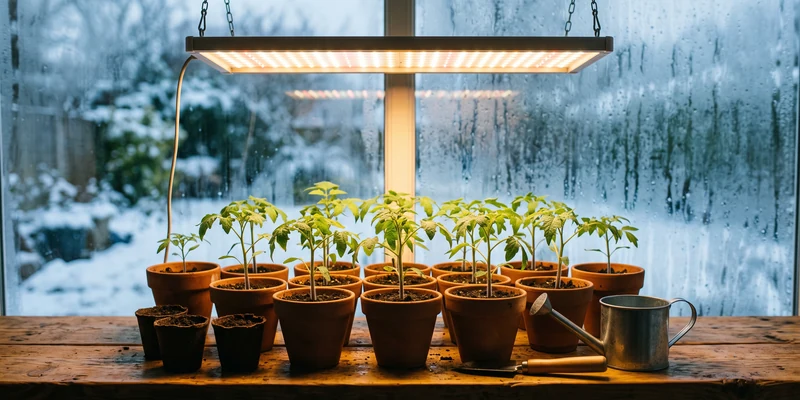
- Hang it about 12 to 24 inches above the canopy depending on power and dimmer setting, and raise it as plants grow.
- Run 14 to 16 hours a day through vegetative growth, and around 12 to 14 once flowering starts.
Tomato Light Targets by Growth Stage
Tomatoes want more light at every stage than a foliage plant wants at its hungriest, and the requirement climbs as the plant moves from seedling to fruiting. The table gives commonly used hobby targets; treat them as ranges to aim inside, not laws.
| Stage | Intensity guideline | Hours per day | Panel distance |
|---|---|---|---|
| Seedling | Modest, roughly 100 to 300 PPFD | 14 to 16 | Higher or dimmed, commonly 18 to 24 inches |
| Vegetative | Roughly 300 to 600 PPFD | 14 to 16 | Commonly 15 to 24 inches at moderate power |
| Flowering and fruiting | Roughly 500 to 800 PPFD | 12 to 14 | Commonly 12 to 18 inches at higher power |
Growers who think in daily totals aim for a DLI, the light delivered over a whole day, somewhere around 20 to 30 moles for productive tomatoes. You do not need to calculate it: hitting the intensity and hour ranges above lands you in that zone automatically.
Why Fruit Changes the Math
Leaves are cheap for a plant to run; fruit is expensive. Every tomato on the vine is sugar the leaves had to manufacture from light, which is why underlit tomato plants behave in a very specific way: they grow tall and green, produce a few flowers, then drop them without setting fruit. Flower drop under lights is the plant auditing its energy budget and canceling the project.
This is also why panel wattage matters here in a way it does not for houseplants. A panel drawing 100 to 150 real watts can deliver fruiting-level intensity across a couple of square feet; a 20 watt bulb physically cannot, no matter how close you hang it. If you want more than one or two plants, scale the wattage and coverage area up accordingly, or grow in a reflective tent that keeps every photon on the canopy, as covered in our grow tent kit guide.
Variety choice is half the battle
Compact determinate and dwarf varieties, the patio and cherry types, fruit well indoors under a single panel. Sprawling indeterminate beefsteaks want more light, more height, and more patience than most indoor setups can offer. Starting with a cherry or dwarf variety is the single easiest way to stack the odds in your favor.
Our Grow Light Picks for Indoor Tomatoes
How we chose: we compared popular hobby LED panels on true wattage, coverage at fruiting intensity, dimmer control, and the experiences that repeat across grower reviews. Specifications are the manufacturers’; the distances below assume the maker’s own hanging charts as the starting point.
🏆 Best Overall
A dimmable quantum-board style panel in the 100 watt class with efficient diodes and a coverage footprint that suits one or two tomato plants from seedling through fruit. The dimmer lets one light serve every growth stage.

💪 Best Value Alternative
A comparable 150 watt class panel with a slightly larger footprint, a common pick for a 2 by 2 or 2 by 4 foot growing area. Owners frequently pair it with a small tent for a self-contained tomato corner.

🌱 Best for a Compact Start
A smaller panel around the 60 to 100 watt class for a single dwarf or micro tomato on a countertop or in a mini tent. Enough for one productive compact plant, and a low-commitment way to try indoor fruiting.

Hanging Height, Heat, and the Dimmer
Start at the manufacturer’s recommended height for each stage, typically 18 to 24 inches dimmed for seedlings and 12 to 18 inches at fuller power for mature plants, then let the plant fine-tune it. Leaves curling up and bleaching near the top mean too much light; long internodes and a plant visibly reaching mean too little. Raise the panel weekly as the plant grows, keeping the distance roughly constant.
Modern LED panels run far cooler than old high-pressure sodium lamps, but a fruiting setup still adds warmth to a small room, and tomatoes prefer roughly 65 to 85 degrees Fahrenheit. If you water and mix nutrients around the light, plug it into a GFCI outlet and keep a drip loop in the cord, the same quiet safety habit as any electrical gear near water. Distance rules for every light type are in how far grow lights should be from plants.
The Indoor Jobs Sunlight Used to Do
Outdoors, wind and bees handle pollination; indoors that job is yours. Tomatoes are self-fertile, so a gentle shake of each flower truss every day or two, or a few seconds with an electric toothbrush against the stem, releases pollen and sets fruit. Skipping this step is the most common reason well-lit indoor tomatoes still fail to produce.
Feeding also shifts with stage under lights, from nitrogen-forward growth feeding to a bloom-oriented mix once flowers appear; our guide to hydroponic nutrients for tomatoes covers the schedule. And if you are still choosing how to grow the plants themselves, tomatoes are a flagship crop for home hydroponics; see the best hydroponic systems for tomatoes for setups that pair naturally with a panel.
Common Mistakes to Avoid
- Using a houseplant bulb and expecting fruit. Foliage is easy, fruit is expensive. Fruiting tomatoes need panel-class light.
- Keeping seedlings under full power. Young plants scorch. Dim the panel or hang it high, then ramp up with the plant.
- Never raising the light. Tomatoes grow fast, and a panel that was 18 inches away last week can be 6 inches away today.
- Forgetting pollination. No wind, no bees, no fruit. Shake the trusses every day or two once flowers open.
- Running 24-hour light. Tomatoes want a dark period; commonly cited practice keeps light at or under about 18 hours, and 14 to 16 is plenty.
Frequently Asked Questions
Can you really grow tomatoes indoors year round? Yes, with a panel-class LED and a compact variety. Cherry and dwarf tomatoes are the reliable indoor performers, fruiting on a windowless shelf or in a small tent through any season.
How many watts of LED do tomatoes need? A common hobby guideline is a panel drawing roughly 100 to 150 true watts for one or two plants in about a 2 by 2 foot area, with more area needing proportionally more.
How many hours of light do indoor tomatoes need? Around 14 to 16 hours during vegetative growth and 12 to 14 during flowering and fruiting, always with a nightly dark period. Details in our guide to grow light hours.
Why do my indoor tomato flowers fall off without fruiting? Usually not enough light energy, missed pollination, or temperatures outside the comfortable range. Check light intensity first, then start hand-pollinating open flowers.
Do tomatoes need special red spectrum light to fruit? No. Full spectrum white panels carry plenty of red and grow tomatoes through fruiting without any special bloom mode, though some panels offer boostable red as a refinement.
The Bottom Line
Indoor tomatoes are a light-first project: a dimmable full spectrum panel in the 100 to 150 watt class per plant or two, hung 12 to 24 inches up and adjusted by stage, running 14 to 16 hours through growth and a bit less in fruit. Add a compact variety, a weekly light raise, and a daily flower shake, and homegrown winter tomatoes stop being a novelty and start being a routine.