Last updated: August 13, 2026
If you have ever watched a tight little echeveria turn into a pale, stretched-out spiral on a windowsill, you already know why a succulent grow light is worth considering. Succulents come from some of the brightest habitats on earth, and the light inside even a sunny home is a fraction of what they evolved for. The result is etiolation: stems elongate, rosettes flatten and gap open, and colors fade to plain green as the plant strains toward the glass.
The fix is not a warmer window, it is more photons for more hours, and that is exactly what a decent LED provides. Succulents are actually one of the most rewarding plant groups to put under lights, because the response is visible: compact growth, tight rosettes, and the reds, purples, and oranges that only show up when light is abundant. Here is what they need and which lights deliver it.
This article contains affiliate links. If you buy through them, we may earn a commission at no extra cost to you. Learn more.
Quick Answer
What grow light do succulents need?
- Succulents want strong light: a bright full spectrum LED positioned close, often 6 to 12 inches for strip lights and 12 to 18 inches for a powerful bulb.
- Run it 12 to 14 hours a day; long days are what keep rosettes compact and colors saturated.
- For a shelf collection, linkable LED strip lights such as Barrina T5s are the standard answer; for a few pots, one strong bulb works.
How Much Light Succulents Actually Need
Succulents sit near the top of the houseplant light scale. Where a fern is happy in shade and a monstera in bright indirect light, most succulents want something closer to direct sun for a good part of the day. Under LEDs, that means higher intensity and longer hours than almost any other plant on your shelf.
| Factor | Guideline for succulents | Notes |
|---|---|---|
| Light type | Full spectrum white LED, strips or a strong bulb | Strips excel at shelves; bulbs suit a single cluster of pots |
| Intensity | High, commonly cited around 300 to 800 PPFD | More than most houseplants; weak lamps produce weak results |
| Distance | Strips about 6 to 12 inches; strong bulbs about 12 to 18 inches | Closer than tropical foliage plants, but watch for bleaching |
| Hours per day | Around 12 to 14 | Long days partly compensate for indoor intensity limits |
| Signs of too little | Stretching, gaps between leaves, fading to plain green | Etiolated growth never tightens back up |
| Signs of too much | Bleached, tan or scorched patches on the sun-facing side | Raise the light a few inches; damage appears within days |
One nuance worth knowing: those coveted stress colors, the pinks and deep purples, are the plant’s response to abundant light. A succulent that stays plain green under your lamp is not unhappy, but it is telling you there is room to push intensity or hours higher.
Etiolation: The Damage a Grow Light Prevents
Etiolation is stretched, pale growth caused by insufficient light, and it is the single most common problem with indoor succulents. The plant elongates its stem to hunt for sun, spacing its leaves out along the way. Once that happens, the stretched section is permanent: succulents do not shrink back, so the only cosmetic fix is beheading and re-rooting the compact top.
That permanence is the argument for getting light right from day one rather than treating a lamp as a rescue tool. Under adequate light, new growth comes in tight and the plant slowly rebuilds its shape from the center outward. Growers who move a stretched collection under strips consistently report that the difference between old and new growth becomes visible within a few weeks.
Our Grow Light Picks for Succulents
How we chose: we compared popular full spectrum LEDs on intensity at close range, coverage shape, and mounting options, using manufacturer specifications and recurring themes in owner feedback. Succulent collections tend to live on shelves and trays, so coverage shape matters as much as raw power.
🏆 Best for Shelves
Linkable full spectrum T5-style LED strips that mount under each shelf and daisy-chain to one plug. Even coverage across an entire tray of pots, which is exactly what a rosette collection needs to grow symmetrically.

💡 Best Single-Light Option
A high-output full spectrum LED bulb around 36 watts in any standard fixture, aimed down at a cluster of pots from about a foot away. Simple, powerful, and easy to reposition; see our SANSI grow light review for how the wattages compare.

⬆️ Upgrade Pick
A compact dimmable LED panel for a large tray or a dedicated succulent station. It delivers the intensity that brings out stress colors across a wide area, and the dimmer lets you acclimate plants gradually.

Setting Up a Succulent Shelf That Works
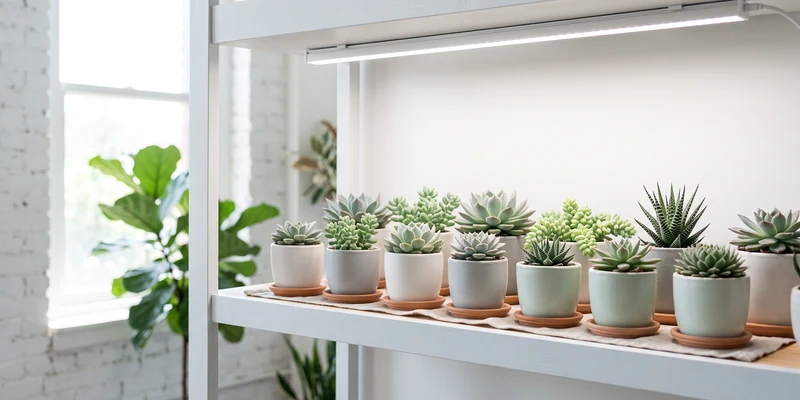
The classic setup is a wire or bookcase shelf with strips mounted under each level, 6 to 12 inches above the plants. Keep pots of similar height together, since a tall cactus under the same strip as a flat lithops means one of them is at the wrong distance. Reflective or white shelf surfaces noticeably improve how much light reaches lower leaves.
Acclimate gradually. A succulent moved from a dim window straight under strong LEDs can bleach, so start with the light a bit higher or the hours a bit shorter for the first week or two, then increase. This mirrors how you would harden plants off to outdoor sun. For the underlying rules on positioning any light, our guide to grow light distance goes deeper.
Rotation and watering under lights
Even under an overhead strip, rosettes drift toward the brightest point, so give pots a quarter turn every week or two. And remember that succulents under 13 hours of daily light grow faster and drink slightly more than they did in a dim corner, though the soak-and-dry rule stays the same: water only when the mix is fully dry.
Hours and Seasons: Long Days Do the Heavy Lifting
Run succulent lights 12 to 14 hours a day. Indoor lamps rarely match midday desert sun in intensity, but photosynthesis is cumulative, so a longer day at moderate intensity gets the plant most of the way there. A timer makes the schedule automatic, which matters more here than with low-light plants because succulents show neglect faster.
In winter, many succulents rest and some, like certain echeverias and sedums, tolerate shorter days without stretching, but there is no need to simulate seasons. Keeping the same 12 to 14 hour schedule year round is the simplest reliable approach; the full reasoning is in how many hours of grow light plants need.
Common Mistakes to Avoid
- Using a weak decorative lamp and expecting compact growth. Succulents need real intensity; a 5 watt clip light is a night light to them.
- Hanging the light too far away. Intensity falls off fast with distance. Strips a foot or less above the plants beat a bright panel across the room.
- Skipping acclimation. Sudden strong light bleaches leaves. Ramp up over a week or two.
- Judging by old growth. Stretched sections never recover their shape. Watch the newest center leaves to evaluate your light.
- Short, irregular days. Six hours here, ten there, and the collection slowly stretches anyway. Put the light on a timer at 12 to 14 hours.
Frequently Asked Questions
Can succulents survive on grow lights alone? Yes, and many collectors grow entire shelves this way in basements and offices. With 12 to 14 hours of adequate LED light daily, succulents grow as compact and colorful as they would on a bright porch.
How close should the grow light be to succulents? Strip lights commonly sit 6 to 12 inches above the plants, and strong bulbs around 12 to 18 inches. Closer is generally better for succulents as long as leaves show no bleaching and heat stays modest.
Why are my succulents still stretching under a grow light? The light is too weak, too far, or on for too few hours. Move it closer, extend the day toward 14 hours, and remember that already-stretched growth will not tighten back up.
Will a grow light bring out red and purple colors? Often, yes. Those pigments are a response to abundant light, so intensity close to the plant plus long days is what triggers them. Plain green under lights usually means there is room to push brighter.
Do succulents need a dark period? They should get one. Around 10 to 12 hours of darkness fits their natural rhythm, and running lights 24 hours brings no benefit worth the electricity.
The Bottom Line
Succulents are high-light plants, so give them a strong full spectrum LED close up, strips at 6 to 12 inches or a powerful bulb at 12 to 18 inches, running 12 to 14 hours on a timer. Get that right and you prevent the one problem that cannot be undone, etiolation, while unlocking the compact shapes and stress colors these plants are grown for.