Last updated: August 13, 2026
Cacti have a cruel trick they play on indoor growers: they die slowly enough that the cause is long forgotten by the time it shows. A desert cactus can sit in a dim corner for a year looking perfectly fine, quietly starving, and then produce one season of thin, pale, stretched growth that disfigures it for good. If you are looking for a grow light for cactus plants, you are solving the single biggest gap between what these plants get indoors and what they are built for.
Because that gap is enormous. A saguaro or golden barrel bakes under some of the most intense sunlight on the planet, and even the brightest window in an American home delivers a modest slice of that. The encouraging part: cacti grow slowly and ask for little else, so light is close to the whole job. Get a strong lamp close enough for long enough, and a cactus collection becomes one of the lowest-maintenance setups under lights.
This article contains affiliate links. If you buy through them, we may earn a commission at no extra cost to you. Learn more.
Quick Answer
What grow light does a cactus need?
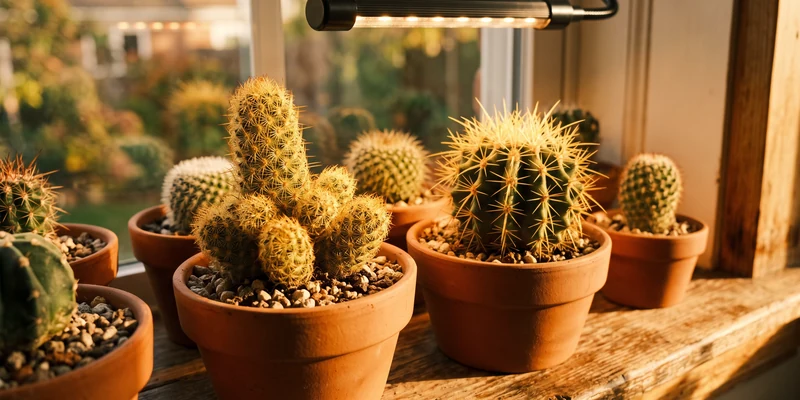
- Desert cacti are the highest-light houseplants there are: give them a strong full spectrum LED, a 36 to 40 watt bulb at about 12 to 18 inches or strips at 6 to 12 inches.
- Run the light 12 to 14 hours a day on a timer.
- Jungle cacti like Christmas cactus and Rhipsalis are the exception: they want moderate light at greater distance, more like an orchid than a barrel cactus.
Cactus Light Needs at a Glance
Desert cacti top the houseplant light scale, wanting intensity and day lengths that would stress most foliage plants. The table covers both cactus families, because the jungle types play by different rules.
| Factor | Desert cacti | Jungle cacti |
|---|---|---|
| Examples | Barrel, Mammillaria, Opuntia, Astrophytum, columnar types | Christmas cactus, Easter cactus, Rhipsalis, orchid cactus |
| Light level | Very high, commonly cited around 400 to 800 PPFD and beyond | Moderate, roughly 100 to 300 PPFD |
| Typical LED distance | Strong bulb 12 to 18 inches; strips 6 to 12 inches | Modest light at 18 to 24 inches, no direct beam |
| Hours per day | 12 to 14 | 10 to 12 |
| Too little light | Thin pale new growth at the tip, leaning, no flowers | Few blooms, weak segments |
| Too much light | Yellow or tan bleaching on the lit side | Red-tinged, scorched segments |
Etiolation in Cacti Is Forever
Every plant stretches in dim light, but a cactus wears the damage permanently. When a globular or columnar cactus etiolates, the new growth at the crown comes in narrower than the body below it, producing a pale, tapered tip on a formerly fat plant. Unlike a stretched houseplant that fills in over time, a cactus never regrows that section: the constriction stays in the plant’s silhouette for the rest of its life, like a bad year in tree rings.
That is the real argument for lighting a cactus properly from the start rather than waiting for symptoms. By the time stretching is visible at the crown, the record of the dark months is already written into the body. Under a strong lamp, new growth returns to full width, and the plant carries a visible before-and-after waistline as a reminder.
Do not confuse corking with light damage
One reassurance: many aging cacti develop corking, a woody brown hardening that starts at the base and creeps upward. It is a normal part of maturing, not scorch and not rot. Light damage shows up on the side facing the lamp as yellow or tan bleaching; corking wraps the base evenly. Knowing the difference saves a lot of unnecessary lamp shuffling.
Our Grow Light Picks for Cactus
How we chose: we compared readily available full spectrum LEDs on raw intensity at close range, heat behavior, and suitability for the shelf and sill setups where cactus collections actually live, drawing on manufacturer specifications and recurring owner feedback.
🏆 Best Overall
A 36 to 40 watt full spectrum LED bulb in a gooseneck or track fixture, aimed at a cluster of pots from about a foot away. The most output per dollar for a small desert collection; our SANSI grow light review compares the sizes.

📚 Best for Shelf Collections
Linkable T5-style LED strips mounted a hand’s width above each shelf row. Even side-to-side coverage keeps a lineup of small cacti growing straight instead of leaning toward a single bright point.

⬆️ Upgrade Pick
A dimmable LED panel over a dedicated cactus table or large tray, delivering desert-tier intensity across many plants at once. The dimmer earns its keep for acclimating new arrivals and dialing back over jungle types.

Placement: Close, Overhead, and Acclimated
Hang or aim the light directly overhead and keep it close: 12 to 18 inches for a strong bulb, 6 to 12 inches for strips. Cacti lean toward light slowly but relentlessly, and a columnar cactus that has curved toward a side window will not straighten, so overhead placement matters more here than with plants that can be pruned back into shape. Rotate pots a quarter turn every few weeks for insurance.
Acclimate new plants and newly upgraded lights over a week or two, starting with more distance or fewer hours. A cactus from a dim garden center shelf can bleach under sudden desert-tier LED light, exactly as it would if moved straight into summer sun. The general height rules across light types are in how far grow lights should be from plants.
Schedule and the Winter Rest Question
Through the growing season, run 12 to 14 hours a day on a timer. Cacti pair long bright days with cool nights in habitat, so a normal home’s nighttime temperature drop alongside a dark period suits them fine; details on day length across plant types are in how many hours of grow light plants need.
Winter is where cactus culture diverges from other houseplants. Many desert cacti flower best after a cool, dry winter rest, and growers handle lighting during rest in two reasonable ways: keep the same long days and simply accept slower growth, or shorten the schedule to 10 hours or so alongside cooler temperatures and near-zero watering. Both work; what matters is that light does not drop to dim-corner levels while the plant sits warm and watered, which is exactly the etiolation recipe. A rested, well-lit cactus often rewards the effort with spring flowers.
Common Mistakes to Avoid
- Assuming a cactus is fine because it looks fine. Cacti run on stored reserves and show light starvation a season late. Judge the setup, not the snapshot.
- Buying a decorative 10 watt lamp for a desert plant. Cacti need the strongest light in the houseplant aisle, close up and for long hours.
- Skipping acclimation. Sudden desert-tier light bleaches shade-grown plants. Ramp up over a week or two.
- Lighting a Christmas cactus like a barrel cactus. Jungle cacti scorch under desert intensity; give them moderate light at more distance.
- Panicking over corking. Even brown hardening from the base up is normal aging, not light damage. Bleaching on the lamp-facing side is the thing to fix.
Frequently Asked Questions
Can a cactus live indoors with only a grow light? Yes, provided the light is genuinely strong. A 36 to 40 watt full spectrum bulb or equivalent strips, run 12 to 14 hours daily at close range, supports healthy desert cacti with no window at all.
How close should a grow light be to a cactus? Commonly 12 to 18 inches for a high-wattage bulb and 6 to 12 inches for LED strips, after a week or two of acclimation. Watch the lit side for bleaching and back off if it appears.
Why is my cactus growing thin at the top? That is etiolation, new growth stretched by insufficient light, and the narrowed section is permanent. A stronger, closer light returns future growth to full width.
Will a grow light make my cactus flower? It is a major part of the recipe. Many desert cacti flower after a bright growing season plus a cool winter rest, and jungle types like Christmas cactus respond to shortening days, so light management drives blooming in both groups.
Do cacti and succulents need the same grow light? Largely, yes, desert cacti simply sit at the top of the same high-light range. If you grow both, one strong setup serves them together, as covered in our succulent grow light guide.
The Bottom Line
A desert cactus wants the strongest light you can reasonably give it: a 36 to 40 watt full spectrum LED at 12 to 18 inches, or strips at 6 to 12 inches, running 12 to 14 hours a day, with jungle cacti dialed back to moderate. Because etiolation scars a cactus permanently, the light is not an accessory here, it is the difference between a plant that keeps its shape for decades and one that records every dark winter in its silhouette.