Last updated: August 13, 2026
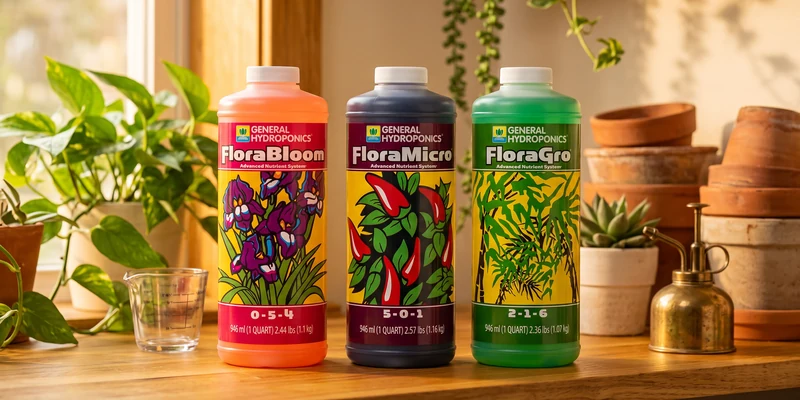
Three bottles, a long feed chart, and a warning about mixing order: the General Hydroponics Flora Series is the nutrient line most new growers meet first, and the one that confuses them fastest. FloraGro, FloraMicro, and FloraBloom have been on shelves for decades, and they will grow excellent lettuce, basil, and tomatoes indoors. The three bottle format is also the reason people give up and buy a single powder instead.
This guide takes the mystery out of it: what each bottle does, the mixing order that prevents a cloudy reservoir, the ratios that cover most indoor crops, and where a three part liquid beats a one part powder. Everything below reflects published label guidance and the patterns that repeat across grower feedback rather than any trial of our own.
This article contains affiliate links. If you buy through them, we may earn a commission at no extra cost to you. Learn more.
Quick Answer
How do you use the General Hydroponics Flora Series?
- Add the bottles to water one at a time, always FloraMicro first, then FloraGro, then FloraBloom, stirring between each. Never pour concentrates into each other.
- Lean on FloraGro while plants are leafy and shift toward FloraBloom once flowers set. Leafy greens and herbs rarely need much FloraBloom at all.
- Mix to a modest strength for greens, typically around 1.0 to 1.4 EC, then check pH last and land it around 5.5 to 6.5.
Flora Series at a Glance
The Flora Series splits a complete hydroponic fertilizer across three bottles so you can change the ratio as a plant moves from leaf growth to fruit. That flexibility is the entire reason it exists, and also the entire reason it feels complicated.
| Category | What to know |
|---|---|
| Format | Three liquid concentrates: FloraGro, FloraMicro, FloraBloom, mixed into water at every reservoir change |
| FloraMicro | The base of every mix, carrying nitrogen, calcium, and the micronutrients. It goes into the water first, always |
| FloraGro | The leaf and stem bottle, weighted toward nitrogen and potassium for vegetative growth |
| FloraBloom | The flower and fruit bottle, weighted toward phosphorus, potassium, magnesium, and sulfur |
| Completeness | The three together form a complete formula. FloraMicro on its own, or FloraGro on its own, is not |
| Best suited to | Recirculating systems, deep water culture, drip and NFT setups, and anyone growing several crop types |
| Less suited to | Growers who want one scoop and no decisions, and very small passive containers where liquids get costly |
| Storage | Sealed bottles in a cool dark spot. Liquids have a shorter practical life than dry powders |
If the underlying chemistry is still fuzzy, the difference between an A/B system, a three part line, and a single powder is unpacked in our hydroponic nutrients explainer.
What the Flora Series Gets Right
Its biggest strength is control. Because nitrogen, phosphorus, and potassium sit in separate bottles, you can push a basil plant hard on FloraGro and dial a tomato toward FloraBloom in the same week from the same shelf. A one part powder cannot do that, which is why growers running mixed crops tend to stay with a three part line.
Availability and small volume dosing
The second advantage is boring and genuinely useful: you can buy it almost anywhere, and the ratios stay the same as you scale. Measuring a few milliliters of liquid is far easier than weighing a fraction of a gram of powder, which matters if you feed a countertop system or a handful of jars. That is why it shows up as the liquid option in our roundup of nutrients for the Kratky method.
Where It Falls Short
Economy per mixed gallon is the honest weak point. You are paying to ship and store water, and a dry three part kit like MasterBlend mixes far more solution from the same shelf space. For a single countertop garden that difference is irrelevant; for several buckets changing weekly, it adds up.
The feed chart problem
The published feeding charts are the other stumbling block. They cover many crop types and growth stages across a long table, and beginners read that as a set of rules they must follow exactly. In practice most indoor growers use a handful of simple ratios and adjust based on how the plants look.
One smaller note: liquids freeze, separate, and eventually degrade, so a garage shelf in winter is a poor storage spot.
The Mixing Order That Prevents Cloudy Water
Always add FloraMicro to the water first, stir until it is fully dispersed, then FloraGro, stir again, then FloraBloom. The reason is chemistry, not tradition: FloraMicro carries the calcium, and concentrated calcium meeting concentrated sulfates or phosphates forms a white precipitate your plants cannot use. Diluting each bottle into the full volume of water keeps those ions far enough apart that nothing binds, which is the same rule that keeps calcium nitrate separate in dry kits. The full routine is in our guide to mixing hydroponic nutrients.
Ratios most indoor growers actually use
A common starting point for leafy growth is a Gro heavy mix, roughly three parts FloraGro to two parts FloraMicro to one part FloraBloom, and a common flowering mix flips that toward Bloom. Many growers simplify further and run a Micro plus Bloom mix for fruiting crops, a shortcut widely known as the Lucas approach. Treat all of these as starting points, let leaf color and your EC reading guide the adjustment, and set pH last, aiming somewhere around 5.5 to 6.5.
Check It Out
How we chose: the standard three bottle trio in its widely stocked bottle sizes is what nearly all grower feedback describes, and the configuration that makes the ratio flexibility worth having in the first place.
🏆 The Reference Three Part Liquid
FloraGro, FloraMicro, and FloraBloom together form a complete hydroponic feed that adapts from seedling to fruit by ratio alone. Easy to measure at small volumes, stocked almost everywhere, and flexible enough to cover a countertop garden and a bucket system from the same three bottles.

Who It Is For, and Who Should Skip It
The Flora Series suits growers who run more than one kind of plant and mix modest volumes at a time. If you are feeding a smart garden, a few net pots, or a single deep water culture bucket, liquid measuring is more convenient than weighing powder, and the crop range you can cover is wide.
Skip it if your goal is the lowest possible effort or the lowest cost per gallon. A one part dry formula turns feeding into one scoop, and a dry three part kit mixes hundreds of gallons from one purchase. Growers running a rack of buckets or a full NFT system usually land on powder for that reason.
Alternatives Worth Considering
Three directions, depending on which Flora Series limitation bothers you most.
🧴 The One Bottle Version
FloraNova compresses the line into a single concentrated bottle per stage, Grow or Bloom, so you keep most of the flexibility with one measuring step. Shake it well, since the concentrate is thick and settles between uses.

🥄 The Simplest Routine
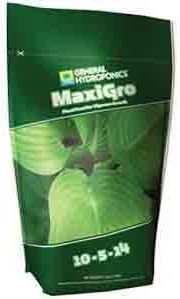
MaxiGro is a complete dry nutrient in one container: a scoop per gallon, stir, done. It covers calcium and magnesium, stores for years, and suits windowsill jars and first crops.
💰 The Best Cost Per Gallon
The MasterBlend 4-18-38 combo kit, base powder plus calcium nitrate plus Epsom salt, is what growers switch to once volume matters. It mixes an enormous number of gallons per bag; details and ratios are in our MasterBlend mixing guide.

Frequently Asked Questions
Do I need all three Flora bottles? For a complete feed, yes. FloraMicro is the base of every mix and the other two shift the balance toward leaves or fruit. Running FloraGro or FloraMicro alone leaves gaps that show up as deficiency symptoms later in the crop.
Which bottle goes in the water first? FloraMicro, every time, into the full volume of water. Then FloraGro, then FloraBloom, stirring between each. Pouring concentrates together is what creates the white sediment growers occasionally find in the bottom of a reservoir.
What ratio should I use for lettuce and herbs? A Gro heavy mix at a modest overall strength, typically around 1.0 to 1.4 EC, suits leafy crops. FloraBloom is not wasted on greens, but it stays the smallest part of the mix until something flowers.
Do I adjust pH before or after adding nutrients? After. Nutrient concentrate moves the pH on its own, so mix everything first, stir, then measure and correct toward roughly 5.5 to 6.5. Our pH meter guide covers the tools that make that reading trustworthy.
Can I use the Flora Series in a smart garden? Generally yes, at a reduced strength, though branded pod gardens are designed around their own dosing. Measure small volumes carefully, since countertop reservoirs are far less forgiving of a heavy hand than a five gallon bucket.
The Bottom Line
The Flora Series earned its shelf space honestly: complete, flexible across crops and stages, and easy to measure at small volumes. The trade is three bottles to manage, a mixing order you cannot ignore, and less economy per mixed gallon than dry powder. For a mix of greens and fruiting plants in modest volumes, it is still one of the easiest lines to live with.