Last updated: August 13, 2026
The fiddle leaf fig has a reputation for drama, and most of that drama traces back to light. Before you blame watering or drafts for dropped leaves, it is worth asking whether the plant is simply underlit, because in most homes it is. A fiddle leaf fig grow light solves the problem at the source: Ficus lyrata is a full-sun tree in its native West Africa, and the corner of the living room where it photographs so beautifully usually offers a small fraction of the light it wants.
Unlike a pothos that merely slows down in dim light, an underlit fiddle drops leaves, grows sparse, and sulks its way toward the compost bin. The flip side is that few plants respond to supplemental light as visibly: steadier leaf retention, bigger new leaves, and a fuller silhouette. Here is what this particular tree needs and how to light it without turning your living room into a grow tent.
This article contains affiliate links. If you buy through them, we may earn a commission at no extra cost to you. Learn more.
Quick Answer
What grow light does a fiddle leaf fig need?
- A strong full spectrum white LED bulb, in the 36 to 40 watt class, mounted overhead in a floor lamp or ceiling fixture, works for most single trees.
- Keep it roughly 2 to 3 feet above the canopy and run it 8 to 12 hours a day, every day, on a timer.
- Consistency is the whole game with this plant: pick a position and schedule, then leave both alone.
Fiddle Leaf Fig Light Needs at a Glance
A fiddle leaf fig wants more light than almost any other popular foliage plant, delivered from above and on a schedule that never changes. The table sums up the targets; the sections below explain why this tree is stricter about them than its neighbors.
| Factor | Guideline for Ficus lyrata | Notes |
|---|---|---|
| Light type | Full spectrum white LED, high-wattage bulb or panel | Overhead placement strongly preferred; this is a tree, not a trailing plant |
| Intensity | Bright, roughly 300 to 500 PPFD at the top leaves for strong growth | Tolerates less but grows slowly and sheds lower leaves |
| Distance | Commonly 24 to 36 inches above the canopy for a 36 to 40 watt bulb | Panels per the maker’s hanging chart, usually 18 to 24 inches |
| Hours per day | Around 8 to 12 | Same window every day; erratic schedules stress the plant |
| Signs of too little | Leaf drop, small new leaves, long gaps between leaves, leaning | Lower leaves go first |
| Signs of too much | Bleached or brown scorch patches on top leaves | Usually from a hot lamp far too close, not from LEDs at proper height |
Why This Tree Punishes Low Light Harder Than Most
A fiddle leaf fig maintains its big, violin-shaped leaves at a real energy cost, and it ruthlessly sheds any leaf that no longer pays its way. When light drops below what a leaf needs to break even, the tree cuts it loose, which is why underlit fiddles go bare from the bottom up while the top keeps growing toward the window. That pattern, a tuft of leaves on a bare trunk, is the plant’s light history written in wood.
The tree also dislikes change. Growers report leaf drop after moves, rotations, and even big seasonal light swings, because the plant fine-tunes each leaf to its light environment. A grow light on a timer removes exactly that variability: same intensity, same direction, same hours, every day of the year. That stability is arguably as valuable as the extra photons.
The window plus lamp combination
Most fiddles do best near a bright window with a grow light filling the gap, especially through winter. If your plant already gets good morning sun, a lamp running through the afternoon keeps the total light high without moving anything. In a dim room, the lamp carries the whole load, which a 36 to 40 watt full spectrum bulb can genuinely do for a single tree.
Our Grow Light Picks for a Fiddle Leaf Fig
How we chose: we looked for lights that deliver high output from overhead, fit into normal living room fixtures, and have a track record in owner feedback for large floor plants. Specifications come from the manufacturers; we lean on patterns across reviews rather than any testing of our own.
🏆 Best Overall
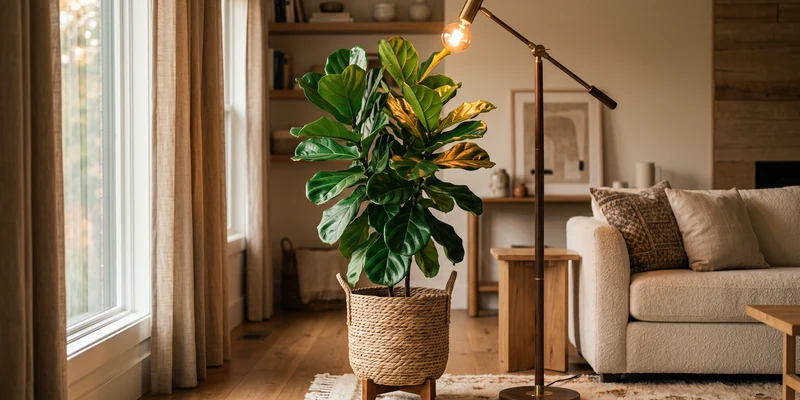
A 36 to 40 watt full spectrum LED bulb in a sturdy floor lamp aimed down into the canopy. It is the least intrusive way to put serious light on a tree in a decorated room; our SANSI grow light review covers which wattage fits which plant size.

💰 Best for Young Plants
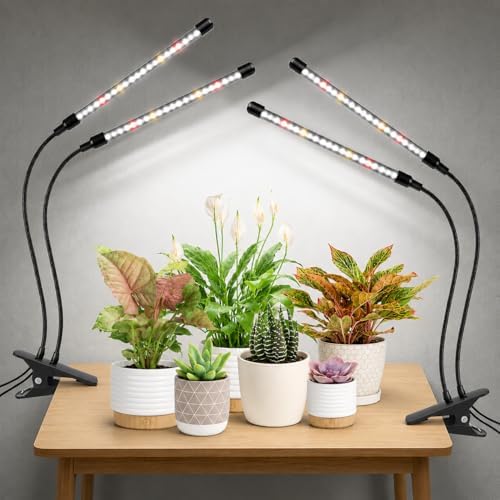
A clip-on gooseneck LED with a timer for fiddles still at shelf or tabletop size. It will not light a six-foot tree, but it keeps a young plant compact and evenly leafed until it earns a bigger lamp.
⬆️ Upgrade Pick
A dimmable full spectrum LED panel hung or mounted above a large specimen, or a pair of trees. Panels spread light across the whole canopy instead of a bright center spot, which shows in more even leaf size.

Placement: Light the Canopy, Not the Trunk
Aim the light down onto the top of the tree from 2 to 3 feet above. Fiddle leaf figs grow strongly toward their light source, so a lamp positioned to the side produces a lean that hardens into the trunk over months. Overhead light keeps the tree vertical and encourages the upper branching that gives a fiddle its lollipop shape.
Resist the urge to rotate frequently. A quarter turn every month or two is enough to keep growth even under a mostly overhead lamp, and it is gentler than the weekly rotations that suit smaller plants. If the tree is also using a window, place the lamp on the room side so both sources roughly agree on direction. For the numbers behind hanging heights, see how far grow lights should be from plants.
Schedule and Seasons
Run the light 8 to 12 hours a day on a timer, ideally overlapping daylight hours so the plant experiences one long day rather than two short ones. Through summer, a window-adjacent fiddle may need the lamp only as a top-up; through a northern winter, those 10 lamp hours may be most of the light the tree gets. The schedule itself should not change, only the share of work the lamp does. Our guide to grow light hours covers the reasoning across plant types.
Expect results on the tree’s timeline, not yours. A fiddle that stops shedding is responding within weeks, but new leaves, which emerge in flushes of two to four from the branch tips, may take a month or two to show the difference. Bigger, closer-spaced new leaves are your confirmation the light is working.
Common Mistakes to Avoid
- Rescuing with light and changing everything else too. New spot, new watering, new lamp all at once and the plant drops leaves from the upheaval. Add the light, change nothing else, wait.
- Using a small clip light on a full-sized tree. A six-foot fiddle needs 30-plus watts of real output overhead, not a 10 watt gooseneck aimed at one branch.
- Side lighting a straight trunk. The lean it causes is permanent wood. Get the light above the canopy.
- Judging success by old leaves. Damaged leaves never heal and dropped ones never return on the same spot. Watch what the branch tips do next.
- Buying a purple panel for a living room tree. A white full spectrum LED grows the plant equally well without the nightclub glow; our full spectrum explainer covers why.
Frequently Asked Questions
Can a grow light keep a fiddle leaf fig alive in a dark room? Yes, if the light is strong enough. A 36 to 40 watt full spectrum bulb or a small panel running 10 to 12 hours daily can be the tree’s primary light source in a dim room.
How far should a grow light be from a fiddle leaf fig? Around 24 to 36 inches above the canopy is a common range for a high-wattage bulb. Move up if top leaves bleach, down if growth stays slow and sparse.
Will a grow light stop my fiddle leaf fig from dropping leaves? If low light is the cause, which it often is, leaf drop typically slows within a few weeks of consistent supplemental light. Drops caused by overwatering or cold drafts need their own fixes.
How many hours a day should the light run? Around 8 to 12 hours, at the same time every day on a timer. Consistency matters more to this species than squeezing in extra hours.
Do fiddle leaf figs need direct sun or is a grow light enough? The species enjoys sun but does not require it indoors. Bright consistent light is the requirement, and a good LED meets it, alone or alongside a window.
The Bottom Line
A fiddle leaf fig is a full-sun tree living indoors, so give it a strong full spectrum LED from above, roughly 2 to 3 feet over the canopy, 8 to 12 hours a day on a timer, and then stop moving things around. Most fiddle drama is a light deficit wearing a disguise, and a good bulb in a floor lamp is the quiet, permanent fix.
See our fiddle leaf fig light picks