Last updated: August 13, 2026
Choosing nutrients for a hydroponic system is the easy half. The harder half is dosing them, because a bottle that grows beautiful lettuce at one strength will scorch the same lettuce at another, and the tomato in the next bucket wants roughly twice as much as either. Feeding charts rarely explain that, so growers either follow the label to the letter or guess, and both routes produce the same complaint: healthy looking solution, unhappy plants.
This guide gives you the numbers most indoor growers work to, crop by crop, along with the reasoning behind them. Treat every range here as a well established starting point rather than a law, because water source, light intensity, room temperature, and system type all shift the right answer a little.
This article contains affiliate links. If you buy through them, we may earn a commission at no extra cost to you. Learn more.
Quick Answer
How much nutrient does a hydroponic system need?
- Leafy crops run light, typically around 0.8 to 1.4 EC. Fruiting crops run roughly twice that once they are established.
- Seedlings start at around a quarter to a half of the mature rate, then step up as real leaves appear.
- Keep pH somewhere around 5.5 to 6.5 whatever you are growing, since nutrients that are present but unavailable look exactly like nutrients that are missing.
Dosing by Crop: The Numbers Growers Work To
These are the ranges commonly used for indoor crops in water culture. EC is in millisiemens per centimeter, and the PPM column uses the 500 scale, so check which scale your meter reports before comparing.
| Crop | Typical EC | PPM (500 scale) | Typical pH |
|---|---|---|---|
| Seedlings and cuttings | Around 0.4 to 0.8 | Around 200 to 400 | 5.5 to 6.0 |
| Lettuce and salad greens | Around 0.8 to 1.2 | Around 400 to 600 | 5.5 to 6.0 |
| Basil and soft herbs | Around 1.0 to 1.6 | Around 500 to 800 | 5.5 to 6.5 |
| Kale, chard, spinach | Around 1.2 to 1.8 | Around 600 to 900 | 6.0 to 6.5 |
| Strawberries | Around 1.4 to 2.0 | Around 700 to 1000 | 5.5 to 6.2 |
| Peppers | Around 1.8 to 2.8 | Around 900 to 1400 | 5.5 to 6.5 |
| Cucumbers | Around 1.7 to 2.5 | Around 850 to 1250 | 5.5 to 6.0 |
| Tomatoes | Around 2.0 to 3.5 | Around 1000 to 1750 | 5.5 to 6.5 |
| Microgreens | Plain water up to around 0.8 | Up to around 400 | 5.5 to 6.5 |
Two habits make these numbers useful. Subtract your tap water’s own EC before dosing, since hard water already contributes, and always land in the lower half of a range when you are unsure. A printable version of this table lives in our hydroponic nutrient chart.
Reading EC and PPM Without Confusion
EC measures how well the solution conducts electricity, which correlates with how much dissolved mineral is in the water. PPM is the same measurement multiplied by a conversion factor, and two factors are in common use, usually 500 and 700. A solution at 1.0 EC reads 500 PPM on one scale and 700 on the other while nothing about the water has changed.
That is why forum advice about PPM numbers so often contradicts itself. Talking in EC removes the ambiguity entirely, and every meter that reports PPM also reports EC. If you inherited a chart in PPM, find out which scale it assumes before you follow it.
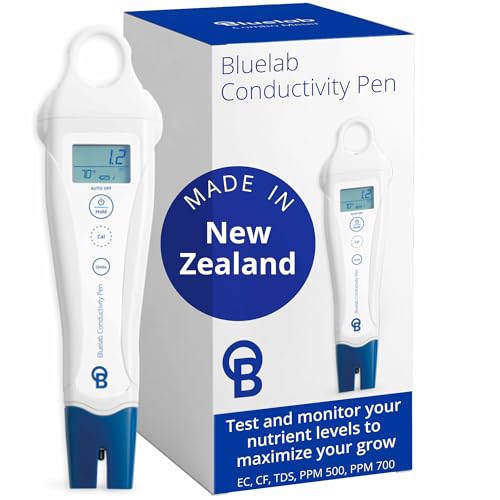
None of these numbers mean anything without a meter to read them, and a pocket EC and TDS pen with temperature compensation is enough for a home reservoir:
What EC does not tell you
EC measures total dissolved minerals, not which minerals. A reservoir can read a perfect 1.2 while being short of calcium and heavy on something else, which happens naturally as plants take up nutrients selectively over a week or two. That is the real argument for changing solution on a schedule rather than topping it up indefinitely.
Why Leafy and Fruiting Crops Differ So Much
Leafy crops are built almost entirely of soft tissue grown quickly, and they are harvested young. They need a steady supply weighted toward nitrogen, and they burn easily because tender leaves cannot cope with a strong solution pulling water out of them. Lettuce showing brown, crisp leaf margins is the classic sign of a mix that is too strong.
Fruiting crops carry a much bigger structure and then load it with fruit, which takes far more potassium, phosphorus, calcium, and magnesium. A tomato plant at full production is working harder than a head of lettuce ever does, so it tolerates and needs a stronger solution, ramped up gradually rather than applied on day one.
Ramping through the crop cycle
A practical pattern: start seedlings at roughly a quarter to a half of the mature target, step up when the first true leaves are established, then hold at the vegetative range. For fruiting crops, increase again as flowers set and shift the balance toward the bloom side of your nutrient line. Our guide to the General Hydroponics Flora Series shows how a three part line handles that shift by ratio.
System Type Changes the Dosing
The same crop asks for slightly different handling depending on how water reaches its roots. In a recirculating system such as NFT or a pumped drip setup, solution passes the roots constantly, so growers often run at the lower end of a range and rely on frequent contact rather than strength.
In deep water culture, roots sit in aerated solution around the clock, which suits steady mid range dosing with weekly changes. Passive Kratky containers are the strictest case: the mix you make on day one is the whole crop, so start at or slightly below label strength, since the reservoir concentrates as the plant drinks water faster than minerals. That logic is unpacked in our Kratky method guide.
Smart gardens are a special case
Countertop pod gardens hold a small volume and are engineered around their own dosing schedule, usually a measured amount of liquid nutrient every couple of weeks. If you substitute a general hydroponic formula, mix it weaker than you would for a bucket, because a quart of solution is far less forgiving of a heavy hand than five gallons.
Reading the Plant Instead of the Chart
Numbers get you close; the plant tells you the rest. Underfed plants grow slowly and pale, often starting with the oldest leaves as the plant moves nitrogen to new growth. Overfed plants show burned leaf tips and margins, wilt in bright light despite a full reservoir, and sometimes stall entirely.
Before adjusting strength, check pH. Nutrients outside roughly 5.5 to 6.5 are chemically unavailable no matter how much is in the water, and the resulting symptoms mimic deficiency almost perfectly. A calibrated meter settles that question in seconds; our pH meter guide covers the tools worth owning.
Warm rooms need weaker solution
Plants transpire faster in warm, bright, dry conditions, drinking more water relative to the minerals they take up. In a hot room a reservoir concentrates noticeably within days, so many growers reduce strength slightly in summer and top up with plain water more often. Warm water also holds less oxygen, which matters most in deep water culture, as explained in our DWC guide.
Common Mistakes to Avoid
- Feeding seedlings at mature strength. Young roots burn easily. Start low and step up as true leaves appear.
- Comparing PPM numbers across scales. Always confirm whether a chart uses the 500 or 700 scale, or convert everything to EC.
- Topping up with nutrient instead of water. Plants drink faster than they feed, so the reservoir concentrates on its own. Plain water is the correct top up.
- Ignoring the water you started with. Hard tap water can contribute a meaningful share of your target EC before you open a bottle.
- Adjusting strength when the real problem is pH. Check pH first. Unavailable nutrients look exactly like absent ones.
- Never changing the solution. EC can look correct while the balance behind it has drifted. Fresh solution every one to two weeks resets it.
Where to Go From Here
If the labels themselves are still confusing, start with our hydroponic nutrients explainer, then follow the mixing routine in how to mix hydroponic nutrients, which covers the order that prevents a cloudy reservoir.
And if you have not settled on a formula yet, the practical differences between complete dry kits, three part liquids, and one part powders are laid out in our roundup of the best hydroponic nutrients. Pick one, learn its behavior in your water, and change one variable at a time.
Frequently Asked Questions
What EC should hydroponic lettuce run at? Commonly around 0.8 to 1.2, at a pH of roughly 5.5 to 6.0. Lettuce is one of the lightest feeders in the garden, and brown leaf edges usually mean the solution is stronger than it needs to be.
How often should I change the nutrient solution? Every one to two weeks is the common rhythm for most home systems, with plain water top ups in between. Warm rooms, small reservoirs, and fast growing crops all shorten that interval.
Can I just follow the bottle instructions? As a starting point, yes. Label rates are usually set for average conditions, so growers commonly begin slightly under and adjust based on how the plants respond and what the meter shows.
Why does my EC keep rising between changes? Plants take up water faster than minerals, so the remaining solution concentrates. Top up with plain water rather than nutrient, and reset the reservoir at the next change.
Do herbs and lettuce need different nutrients? Not different products, just slightly different strengths. Basil and other soft herbs generally take a little more than lettuce, and both stay well below what a tomato requires.
Is more nutrient ever better? No. Beyond a crop’s range, extra minerals make it harder for roots to take up water, which is why overfed plants wilt in a full reservoir. Underfeeding is the safer error to make.
The Bottom Line
Dose by crop and by stage: leafy greens around 0.8 to 1.2 EC, herbs a little higher, fruiting crops roughly twice that once established, and seedlings at a fraction of the mature rate. Keep pH somewhere around 5.5 to 6.5, subtract what your tap water already contributes, top up with plain water, and replace the solution every week or two. Then let the plants fine tune the numbers.