Last updated: August 15, 2026
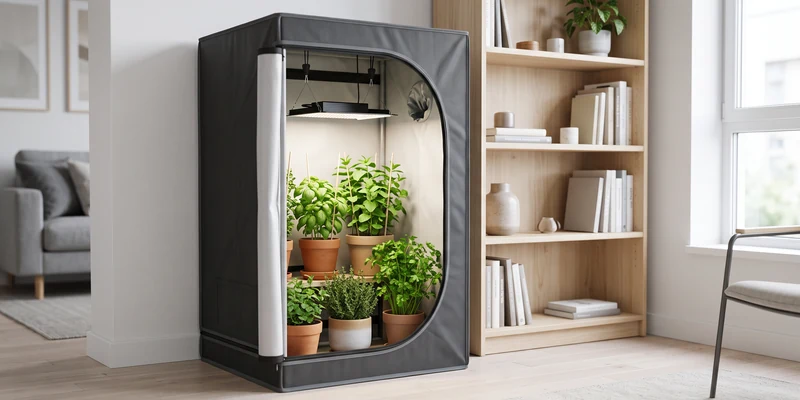
A 2 by 2 grow tent is the most underrated piece of equipment in indoor gardening. It takes up about the same floor space as a laundry basket, fits in a closet, a spare corner, or beside a desk, and gives you something a windowsill never will: a controlled climate with its own light, its own airflow, and walls that keep all of it in one place.
Small tents suit exactly the projects most people actually want, which is fresh herbs through winter, a tray of seedlings for the spring garden, and one compact pepper or tomato plant grown properly rather than hopefully. This guide covers which small footprints exist, what changes when a tent gets small, and which kits and components fit that scale.
This article contains affiliate links. If you buy through them, we may earn a commission at no extra cost to you. Learn more.
Quick Answer
Which small grow tent should you start with?
- A 2 by 2 foot tent is the sweet spot: closet-friendly, cheap to light, and big enough for herbs, seedlings, or one fruiting plant.
- Buy a complete kit if this is your first tent, since a matched light and 4 inch inline fan removes every compatibility question.
- Watch height and heat rather than floor space. Small volumes warm up quickly, so plan ventilation from day one.
Small Grow Tent Sizes Compared
Small tents come in a narrow band of footprints, and the differences matter more than the numbers suggest. Pick by what you intend to grow and where the tent has to physically fit.
| Size | Holds | Best for | Light class | Trade-off |
|---|---|---|---|---|
| Mini, roughly 16 x 16 in | A few small pots or one tray | Propagation, cuttings, herbs | Small panel or strip lights | Too short for anything that grows upward |
| 2 x 2 ft | 1 tray or 1 to 2 large pots | Herbs, seedlings, one pepper or tomato | Compact dimmable panel | Heats up fast; ventilation is not optional |
| 2 x 3 ft | 2 to 3 medium pots | A slightly wider herb and greens mix | Compact to mid panel | Fewer accessories made for this footprint |
| 2 x 4 ft | 2 standard 10 x 20 trays | Seed starting at scale, salad greens | Bar lights or a mid panel | Needs a full wall rather than a corner |
Height is the specification people forget. Small tents commonly run from roughly four to six and a half feet tall, and you lose the top several inches to hangers, the light, and the fan. If a tomato or pepper is in your plans, buy the tallest small tent you can fit, because floor space is not what runs out first.
What Changes When a Tent Gets Small
Everything you read about big tents still applies, but two factors get sharper. Heat is the first: a compact panel in a 2 by 2 foot volume raises the temperature quickly, and there is very little air mass to buffer it. A 4 inch inline fan running continuously is the standard answer, and our guide to grow tent fans covers sizing and how to keep it quiet.
Light distance gets tight
In a short tent, the gap between fixture and canopy is a scarce resource. Dimmable lights matter more here than in a big tent, because dimming buys you the flexibility that hanging height cannot. Start dimmed and higher for seedlings, then increase output as plants fill out rather than dropping the light onto them.
Fewer plants, better plants
The most common small-tent mistake is treating the footprint as a challenge. Two well-spaced plants in a 2 by 2 tent outproduce four crowded ones, because crowded canopies block light, trap humidity, and make every problem harder to spot. Resist the urge to fill every inch.
Our Top Picks at a Glance
How we chose: we compared small tents and small-tent kits on build quality, whether the bundled light is dimmable and correctly sized for a compact footprint, ventilation included or missing, and the complaints that repeat across owner feedback. This is based on published specifications and user reports rather than any testing of our own, and each pick is a product that stays reliably in stock.
🏆 Best Overall
A Spider Farmer 2 by 2 foot complete kit: tent, a dimmable full spectrum panel sized for the footprint, and ventilation in one box. The least intimidating way into tent growing, and the light is the part owners most often single out as better than the class average.

💰 Best Budget Pick
A VIVOSUN 2 by 2 foot Mylar tent on its own, for anyone who already owns a light or wants to choose one separately. Reflective interior, sealed ports, viewing window, removable tray, and nothing you are paying for twice.

⚙️ Upgrade Pick
An AC Infinity Advance Grow Tent System in the 2 by 2 size pairs a heavier tent with a dimmable LED, a CLOUDLINE fan, and the controller that ties fan speed to temperature and humidity. In a small volume, that automation is worth more than it is in a big one.

What a Tent-Only Purchase Still Needs
If you bought the tent alone, three components turn it into a growing space. Buying them together saves a second round of shipping and a week of waiting.
💡 The Light
A compact dimmable full spectrum LED panel rated for a 2 by 2 foot footprint, commonly in the 100 watt class. Dimming is the feature that matters in a short tent, since you cannot always raise the fixture. Our LED grow light roundup compares the options.

🌬️ The Inline Fan
A 4 inch inline duct fan with speed control handles a small tent comfortably and quietly. Run it low and continuously rather than high and intermittently; small volumes heat up faster than they cool down.

🌀 The Clip Fan
One small clip fan aimed just under the canopy strengthens stems, breaks up humid pockets, and shakes flowers loose on peppers and tomatoes. In a small tent, one is enough.

Setting Up a Small Tent
Placement first: somewhere with a stable base temperature, near an outlet, with a little clearance behind for ducting. Closets work well, provided the door can stay ajar or the room itself has some air exchange. Uninsulated garages and attics swing too much in most climates, and a small tent has no thermal mass to ride out those swings.
Then the standard airflow layout: intake vents open at the bottom, inline fan pulling air out of the top, light hung on ratchet hangers so it can rise with the plants. Keep a drip loop in every cord and use a GFCI outlet, since a small tent puts watering cans, reservoirs, and electronics within inches of each other. Add a timer for the light, because a schedule you have to remember is a schedule you will eventually forget; our guide to grow light timers covers the simple options.
What to grow first
Herbs and salad greens are the fastest reward and the most forgiving of a beginner’s climate. Seedlings for the outdoor garden are the most practical use, turning the tent into a spring workhorse; our guide to the best grow light for seedlings covers that job specifically. Compact peppers and dwarf tomatoes are the ambitious option, and they want the tallest tent you can manage.
Common Mistakes to Avoid
- Choosing on floor size alone. Height runs out before floor space does. Measure vertically and subtract for hangers, light, and fan.
- Skipping ventilation because the tent is small. Small volumes heat up fastest. The fan is more important here, not less.
- Overcrowding the footprint. Two healthy plants beat four struggling ones. Crowded canopies trap humidity and hide problems.
- Buying a fixed-output light. Without dimming and without hanging height, you have no way to soften the light for seedlings.
- Putting the tent in a garage or attic. Temperature swings hit a small tent hardest. Pick a room that stays reasonably stable.
- Forgetting the timer. Manual switching gives plants an inconsistent day length, which shows up as uneven, stretched growth.
Where to Go From Here
If a 2 by 2 already feels too small for your plans, our roundup of grow tent kits for vegetables and seedlings covers the larger footprints and what changes at 4 by 4. For brand-level detail on the two names you will see most, read our AC Infinity grow tent review and VIVOSUN grow tent review.
And if the goal is simply fresh basil and parsley within arm’s reach of the stove, a tent may be more machinery than the job needs; our guide to growing herbs indoors covers the simpler routes before you commit a closet to the cause.
Frequently Asked Questions
What can you grow in a 2 by 2 grow tent? Herbs, salad greens, microgreens, a full tray of seedlings, or one compact pepper or dwarf tomato plant. It is a real growing space, just a focused one.
How many plants fit in a 2 by 2 tent? One or two larger plants, or a single standard tray of seedlings or greens. Crowding beyond that costs you light penetration and airflow.
What size fan does a small grow tent need? A 4 inch inline fan with speed control is the standard choice, plus one small clip fan inside for circulation. Run the inline fan low and continuously.
Do small grow tents get too hot? They can, because there is little air volume to absorb the heat from the light. Continuous ventilation and a dimmable fixture keep temperatures in a workable range.
Can a grow tent go in a closet? Yes, and it is the classic placement. Leave clearance for the duct run, keep the closet door ajar or the room ventilated, and check that the tent height clears any shelf you are not removing.
Is a complete kit better than buying parts? For a first small tent, usually yes. The light, fan, and ducting are matched to the footprint, which is exactly the sizing question beginners find hardest.
The Bottom Line
A 2 by 2 foot tent is the right starter size for almost everyone: closet-friendly, cheap to light, and capable of herbs, greens, seedlings, or one properly grown fruiting plant. Buy a complete kit if this is your first, prioritize height and a dimmable light over floor area, and treat the 4 inch inline fan as mandatory rather than optional. Small tents fail from heat, not from lack of space.