Last updated: August 13, 2026
Almost every disappointing grow tent has the same story behind it. The light was chosen carefully, the plants went in on schedule, and then the tent turned into a warm, still, humid box where leaves drooped and the thermometer crept upward all afternoon. Getting grow tent fans right fixes more problems than any other upgrade, and it is the part most first-time buyers underestimate.
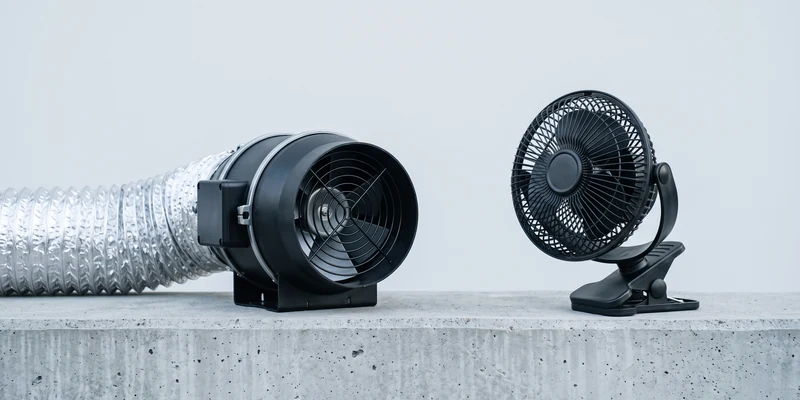
There are two jobs to fill, and they need two different fans. An inline fan pulls hot, stale air out of the tent and pulls fresh air in behind it. A circulation fan stirs the air inside so no leaf sits in a still, humid pocket. This guide covers how to size both for a vegetable or seedling tent, how much noise you can avoid by spending sensibly, and which models keep coming up.
This article contains affiliate links. If you buy through them, we may earn a commission at no extra cost to you. Learn more.
Quick Answer
Which fan does a grow tent need?
- You need two: an inline exhaust fan mounted at the top of the tent, and a small clip or oscillating fan moving air around the plants.
- Size the inline fan to the tent, roughly a 4 inch fan for footprints up to 2 by 4 feet and a 6 inch fan for a 4 by 4, then run it below full speed.
- Buy the fan with the speed controller. A fan you can turn down is quiet, and a fan stuck on high is the thing people replace first.
Fan Sizing by Tent Size
Inline fans are sold by duct diameter, and duct diameter is the first thing to match to your tent. Bigger than you need is usually better than smaller, because a large fan running slowly is quieter than a small one screaming at full speed.
| Tent size | Inline fan | Circulation fan | Typical use | Notes |
|---|---|---|---|---|
| 2 x 2 ft | 4 inch | One small clip fan | Herbs, one plant, a tray of seedlings | Small volume heats up fast; run the fan continuously |
| 2 x 4 ft | 4 inch | One or two clip fans | Seed starting, greens, microgreens | A 6 inch fan run low is quieter if you have the space |
| 3 x 3 ft | 4 or 6 inch | Two clip fans | Mixed edible garden | Go 6 inch if you also run a carbon filter |
| 4 x 4 ft | 6 inch | Two fans, one above and one below canopy | Tomatoes, peppers, cucumbers | Filters and long duct runs cost airflow; size up |
The principle behind the table is air exchange. Growers commonly aim to replace the tent’s entire air volume every couple of minutes, and then buy a fan with headroom on top of that, because carbon filters, long ducting, and every bend in the run reduce real-world airflow well below the number printed on the box.
What the Inline Fan Actually Does
Three things at once, which is why it matters so much. It removes heat that the light pours into a small space, it carries humidity out before it settles on leaves, and it draws in fresh air carrying the carbon dioxide plants need to photosynthesize. A sealed tent with a strong light and no exhaust runs out of all three within an hour.
Passive intake, active exhaust
The standard setup is simple: open the lower intake vents, mount the fan at the top pulling air out, and let atmospheric pressure do the rest. Warm air rises, so pulling from the top removes the hottest air first. That slight negative pressure also keeps the tent walls gently drawn inward, which is the visual sign that your intake and exhaust are roughly in balance. If the tent bulges outward, something is pushing air in and the setup needs rethinking.
Noise is a spec, not bad luck
Fan noise comes from motor type, blade design, and how hard the fan is working. Modern EC-motor inline fans with electronic speed control are dramatically quieter at reduced speed than older fixed-speed units, and a slightly oversized fan running at half speed is the standard trick for a quiet tent. Insulated ducting and short, straight duct runs help too, since every sharp bend adds turbulence and noise.
Our Top Picks at a Glance
How we chose: we compared widely available inline fans on duct size options, whether speed control is built in or an added part, motor type, and the noise complaints that repeat across owner feedback. This reflects published specifications and user reports rather than testing of our own, and every pick is a model that stays in stock and has replaceable ducting in standard sizes.
🏆 Best Overall
An AC Infinity CLOUDLINE inline fan in the 6 inch size, with its speed controller included. Owners consistently point at the same two things: it is quiet at the settings most home tents actually need, and the controller lets you tie fan speed to temperature and humidity instead of guessing.

🌱 Best for Small Tents
The 4 inch version of the same family, sized for 2 by 2 and 2 by 4 foot tents. Small tents heat up faster than big ones, so quiet continuous running matters more here than peak airflow does.

💰 Best Budget Pick
A VIVOSUN inline duct fan with a variable speed controller covers the same job for less. It is louder at comparable settings and has no automation, but it moves air reliably, which is the part that keeps plants healthy.

Moving Air Inside the Tent
The inline fan exhausts, but it barely stirs. Circulation fans are the cheap half of the job and they earn their place several times over: stronger stems, fewer humid pockets around dense leaves, more even temperature top to bottom, and better pollination on tomatoes and peppers, which rely on movement to shake pollen loose indoors.
🌀 Best Circulation Fan
A clip-on oscillating fan designed for tents, with a bracket that grips the frame poles and enough sweep to move air across the whole canopy. Aim it just under the leaves rather than straight at them; you want the plants to sway gently, not to fight a gale.

💨 The Budget Second Fan
A basic 6 inch clip fan is enough for the second position, above the canopy, in a 4 by 4 tent. Two modest fans placed well beat one powerful fan pointed at a single spot.
🧵 The Ducting You Forgot
Kit ducting is often thin, short, and noisy. Four-layer or insulated ducting in your fan’s diameter, cut to a short straight run, quiets the whole system and preserves the airflow you paid for.

Setting Up Airflow That Works
Mount the inline fan inside the tent hanging from the top bars, or outside on a bracket if you want the noise further from the room. Run the duct out through a sealed port, keep it as short and straight as the space allows, and point the exhaust somewhere the warm air can actually go: a window, a vent, or at least a different part of the room.
Open the lower intake vents fully. An exhaust fan with closed intakes strains against a sealed bag, which is loud, ineffective, and hard on the motor. Then set the speed low and work upward until temperature and humidity stay where you want them. One practical safety note, since fans, lights, and watering cans share the same small space: keep cords in a drip loop below the outlet and use a GFCI outlet in any tent with a reservoir or regular watering.
Aim for stable, not perfect
Most edible crops are comfortable in the range of roughly 65 to 80 degrees Fahrenheit with lights on, with humidity often around 50 to 70 percent for seedlings and lower as plants mature. Chase stability rather than an exact number. If airflow alone cannot hold the range, our guides to a dehumidifier for a grow tent and a humidifier for a grow tent cover the next step.
Common Mistakes to Avoid
- Buying one fan. Exhaust and circulation are separate jobs. An inline fan alone leaves still pockets around the leaves.
- Undersizing to save money. A small fan at full speed is louder and less effective than a bigger fan running low.
- Forgetting filter and duct losses. A carbon filter and a long bendy duct run can cut real airflow substantially below the rated figure.
- Closing the intake vents. Nothing comes out if nothing can go in. Open the lower vents and let the tent breathe.
- Pointing the clip fan straight at the plants. Constant direct blast dries and stresses leaves. Aim just under or across the canopy for a gentle sway.
- Running a carbon filter you do not need. For vegetables and herbs there is no odor to control, and the filter simply costs you airflow.
Where to Go From Here
If you are still assembling the space, our roundup of grow tent kits for vegetables and seedlings shows which kits include a decent fan and which leave you upgrading immediately. The brand-level detail lives in our AC Infinity grow tent review and VIVOSUN grow tent review.
And if the tent is small, airflow gets easier and heat gets harder, which is a trade worth understanding before you buy; our guide to the best small grow tent for starters covers the 2 by 2 class and the ventilation it needs.
Frequently Asked Questions
What size inline fan do I need for a 4 by 4 grow tent? A 6 inch fan is the common choice, and it should be run below full speed. Step up if you also run a carbon filter or a long duct run, since both reduce real airflow.
Do I need an intake fan as well? Usually not. Passive intake vents at the bottom of the tent supply plenty of air for a home-sized setup, and a passive intake keeps the tent under slight negative pressure.
Should the inline fan run all the time? In most setups yes, at least while the light is on, and often continuously at a low speed. Controllers that adjust speed by temperature and humidity handle this automatically.
How many circulation fans does a tent need? One is enough for a 2 by 2 or 2 by 4 tent. A 4 by 4 with taller plants benefits from two, one below the canopy and one above it.
How do I make my grow tent quieter? Oversize the inline fan and run it slow, use insulated ducting, keep the duct run short and straight, and mount the fan so it is not touching the tent frame directly.
Do I need a carbon filter for vegetables? No. Odor control is not a factor with edible crops, and skipping the filter gives you back airflow the fan would otherwise spend pushing air through it.
The Bottom Line
Every tent needs two fans: an inline exhaust sized to the footprint, roughly 4 inch up to a 2 by 4 and 6 inch for a 4 by 4, plus a clip fan stirring the air around the plants. Buy the version with speed control, run it below full tilt, keep the ducting short, and open the intake vents. That combination fixes heat, humidity, weak stems, and poor pollination in one purchase.