Last updated: August 13, 2026
Once the light is hung and plugged in, the next question arrives immediately: how long do you leave it on? It sounds like a detail, but the daily schedule decides how much light a plant actually receives, and it is the easiest setting to get wrong in both directions. Some growers run lamps four hours after work and wonder why nothing happens; others leave them on permanently and assume more must be better.
The answer to how many hours grow light a plant needs depends on what you are growing and how strong the fixture is. This guide gives working ranges per plant group, explains why total daily light matters more than either number alone, and covers why a dark period is part of the job.
This article contains affiliate links. If you buy through them, we may earn a commission at no extra cost to you. Learn more.
Quick Answer
How many hours of grow light do plants need?
- Most indoor edibles do well on 12 to 16 hours a day, seedlings often on 14 to 18, and typical houseplants on 10 to 12.
- Total daily light is intensity multiplied by hours, so a weaker light hung farther away needs a longer day to deliver the same result.
- Leave a dark period every night. Running lights 24 hours a day brings little extra growth and can stress some plants.
Daily Hours by Plant Type
Different plants evolved under very different day lengths and light levels, so a single schedule cannot suit a tray of lettuce seedlings and a snake plant in the hallway. The table below gives the ranges growers commonly use as a starting point, assuming a reasonable full spectrum LED at a sensible distance.
| Plant group | Typical hours per day | Notes |
|---|---|---|
| Seedlings and cuttings | 14 to 18 | Long days keep them compact; intensity still matters more than length |
| Microgreens | 12 to 16 | Short crop cycle; consistency for the whole run matters most |
| Lettuce and leafy greens | 12 to 16 | Long warm days can encourage bolting in some varieties |
| Culinary herbs | 12 to 16 | Basil, rosemary, and dill toward the top; mint and parsley are content lower |
| Tomatoes and peppers | 14 to 18 | Fruiting crops are the hungriest indoors and still want a night period |
| Strawberries | 12 to 16 | Everbearing types suit indoor lighting better than June-bearing ones |
| Tropical houseplants | 10 to 12 | Monstera, pothos, and friends; longer is not better here |
| Succulents and cacti | 10 to 14 | Bright but not endless; they also need the temperature to make sense |
| Flowering houseplants | 12 to 14 | African violets and orchids bloom on steady, moderate photoperiods |
Treat these as conventional starting ranges, not rules. Growers adjust them for fixture strength, distance, and how much daylight the room already gets.
Hours Are Only Half of the Equation
What a plant responds to is the total amount of usable light it collects in a day, not the number of hours the switch was on. That total is intensity multiplied by time, which is why two setups can produce identical growth with very different schedules: a strong panel close to the canopy for 12 hours can equal a modest strip light at 16 hours.
This is the practical reason schedules and distance have to be decided together. If your fixture is weak or has to hang high because of the shelf you own, adding hours is the cheapest way to compensate. If your light is genuinely strong, stretching the day past 16 hours mostly adds to the electricity bill. Our companion guide on how far grow lights should be from plants covers the other half of the calculation.
Where extra hours stop helping
Growth response flattens out. Once a plant is receiving enough light for its species, additional hours produce steadily smaller gains, and for shade-adapted houseplants that ceiling arrives early. This is why a pothos on 16 hours does not grow noticeably better than the same pothos on 11 hours, while a tomato absolutely notices the difference.
Why Plants Need the Dark
Darkness is not wasted time. Plants keep working through the night, moving sugars made during the day, growing roots, and repairing tissue, and many of those processes run best when photosynthesis pauses. Continuous light removes that rhythm.
In practice, tomatoes are the classic example of a crop that responds badly to nonstop light, with growers reporting mottled or damaged foliage under continuous lighting. Some crops tolerate 24 hour light without obvious harm, but few benefit enough to justify it, and every hour of unnecessary running costs money and fixture life. A night period of at least six to eight hours is the sensible default.
Day length as a signal
Some plants use day length to decide when to flower. Everbearing and day-neutral varieties largely ignore it, which is precisely why they are recommended for indoor growing, while others need a specific pattern to set buds. For food crops indoors, choosing day-neutral varieties saves you from managing photoperiods at all.
Setting a Schedule You Do Not Have to Think About
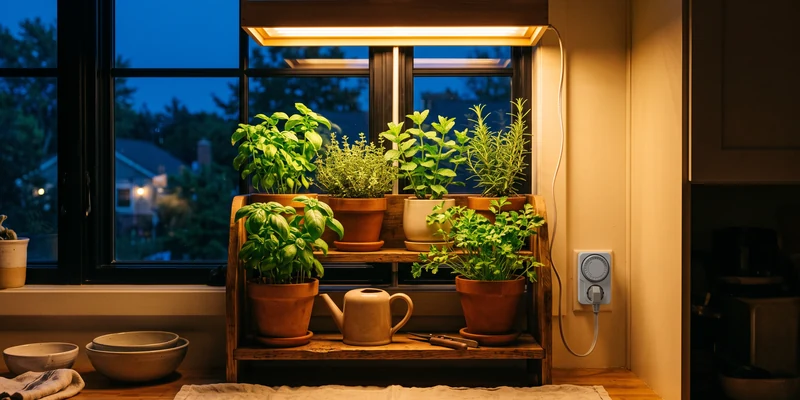
Consistency beats intensity of effort. A plant on the same 14 hour cycle every day grows more predictably than one that gets 18 hours on weekends and four hours on busy weekdays, so the single best upgrade for most setups is an inexpensive outlet timer. Many clip-on lamps and smart gardens have one built in; for everything else a plug-in timer solves it permanently, and our roundup of grow light timers covers the options.
If you just want the schedule handled tonight, a programmable digital outlet timer is the whole solution:

Align the schedule with your own day where you can. Running lights from early morning to early evening means the plants are lit when you see them, the room is dark at night, and a light near a bedroom does not become a problem. If your plants also get daylight, the grow light is a supplement: you can run a shorter schedule in summer and extend it through the gray months without changing anything else.
Adjusting by season
Plants that share a window benefit from more artificial hours in winter, when both day length and light intensity drop. Many growers simply leave the timer at a year round setting for simplicity, which works fine for herbs and houseplants; seed starting is where the seasonal boost really pays off, as covered in our guide to grow lights for seedlings.
Common Mistakes to Avoid
- Running lights 24 hours a day. Little extra growth, a real risk of stress for some crops, and a bigger bill.
- Two or three hours in the evening. A short burst does almost nothing. Under lights, the day has to be long enough to matter.
- Switching manually. Human memory is the least reliable timer available. Automate it once and forget it.
- Using one schedule for every plant. A tray of seedlings and a fiddle leaf fig on the same timer means one of them is getting the wrong treatment.
- Adding hours to fix a weak light. It helps up to a point, but a fixture that is too dim or hung too high cannot be rescued by time alone.
- Changing the schedule every few days. Pick a setting, hold it for two weeks, and judge by the new growth.
Frequently Asked Questions
Can you leave a grow light on 24 hours a day? You can, but most growers do not. Extra hours beyond a full day bring diminishing returns, and crops such as tomatoes commonly show leaf problems under continuous light. A night period of six to eight hours or more is the safer default.
How many hours of light do seedlings need? Commonly 14 to 18 hours a day. Long days keep seedlings compact, though a light that is too far away will still produce stretched stems no matter how long it runs.
Do houseplants need as many hours as vegetables? No. Tropical foliage plants generally do well on 10 to 12 hours, while herbs and vegetables want 12 to 18. Overlong days are wasted on shade-adapted species.
Does the grow light replace the window completely? It can. A full spectrum LED running an appropriate schedule is enough to grow herbs, greens, and houseplants in a room with no daylight at all.
Should the schedule change in winter? If your plants also get daylight, yes, extending the schedule through the darker months helps. Plants grown entirely under lights can stay on the same setting year round; see our roundup of the best LED grow lights for indoor plants for fixtures that suit each situation.
The Bottom Line
Most indoor edibles want 12 to 16 hours of grow light a day, seedlings 14 to 18, and ordinary houseplants 10 to 12, always with a real dark period at night. Because total light is intensity multiplied by time, a weaker or higher-hung fixture needs a longer day to deliver the same result. Set the schedule on a timer, hold it for a couple of weeks, and let new growth tell you whether to stretch it.