Last updated: August 13, 2026
Plenty of kitchens get no usable sun. A north-facing apartment, a basement, an interior wall, a winter that swallows the daylight for months: growing herbs indoors without sunlight is the normal situation for a lot of people, not an edge case. The good news is that it is a solved problem, and the solution is smaller and cheaper than it was even a few years ago.
What it is not is a matter of moving the pot to the brightest corner and hoping. Room lighting and plant lighting are different categories of thing, and understanding why is what separates a windowless herb shelf that works from one that produces three pale stems and a shrug. Here is how to set one up properly.
This article contains affiliate links. If you buy through them, we may earn a commission at no extra cost to you. Learn more.
Quick Answer
Can you grow herbs indoors without any sunlight?
- Yes, with a grow light. Herbs do not care whether photons come from the sun or an LED, only how many arrive and for how long.
- Normal room and ceiling lighting will not do it. Household bulbs are built for eyes, and their output at plant distance is a small fraction of what a leaf needs.
- Plan on roughly 12 to 16 hours a day on a timer, and start with herbs that cope with moderate light: mint, chives, parsley, and cilantro.
What Can Replace Sunlight, and What Cannot
Every light source in your home falls somewhere on this scale. The difference between the bottom and the top rows is not subtle, which is why swapping a desk lamp for a grow bulb changes results so dramatically.
| Light source | Works for herbs? | What to know |
|---|---|---|
| Ceiling and room lighting | No | Designed for human vision, mounted far away, and off at night when you are not in the room |
| Ordinary desk lamp with a standard bulb | Barely | Only within a few inches, and household bulbs are not built to run 14 hours a day |
| LED grow bulb in a normal socket | Yes, for one or two pots | The simplest upgrade: screws into a lamp you already own, brands like SANSI and GooingTop are common |
| Clip-on or gooseneck grow light | Yes, for a small cluster | Flexible positioning, usually with a built-in timer; coverage is narrow, so aim carefully |
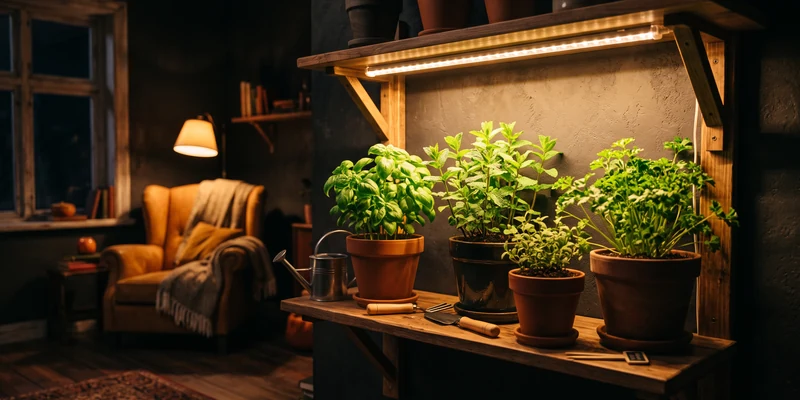
| LED bar or strip under a shelf | Yes, and evenly | Barrina style strips light a whole shelf with no hot spots; the tidiest kitchen solution |
| LED panel | Yes, with room to spare | More output than herbs need; useful if you also grow seedlings or fruiting plants |
| All-in-one smart garden | Yes, light included | Light, pump, and timer in one unit, sized for a counter |
Any of the middle rows will grow good herbs in a windowless room. Which you pick depends on how many plants you want and whether you would rather clip something to a shelf or plug in a finished unit; our grow light guide for herbs compares those formats side by side.
For a windowless corner with one or two pots, these are the two entry points: a grow bulb for a lamp you already own, or a clip-on lamp that brings its own timer.


Why Room Light Does Not Count
Two things work against household lighting, and they compound. First, light intensity falls off sharply with distance, so a bulb on the ceiling delivers a small fraction of its output to a counter. Second, human vision adapts constantly, which means a room that feels perfectly bright to you can be closer to deep shade from a plant’s point of view.
There is also a measurement mismatch. Household bulbs are rated in lumens, a measure weighted for how bright light looks to us, while plants respond to the number of usable photons landing on a leaf. A lamp can look dazzling and still deliver very little of what a leaf can photosynthesize with, which is exactly why “I put it under a bright lamp” so often ends in a stretched, pale plant.
How Long and How Close
Without any daylight, the grow light supplies everything, so hours matter more than in a sunny kitchen. Most growers run herbs roughly 12 to 16 hours a day, with basil and other high-light herbs at the upper end, and leave the rest of the day dark. A cheap outlet timer removes the whole question from your life.
Distance depends on the fixture. As common starting points, growers keep grow bulbs around 6 to 12 inches from the canopy, LED strips a similar distance under a shelf, and larger panels roughly 12 to 24 inches above leafy plants. Then adjust by watching the plant, which is more reliable than any chart: long bare stems reaching upward mean too little light, while pale, bleached, or curling top leaves mean too close. Our guide on how far a grow light should be from plants goes deeper, and how many hours of grow light plants need covers the schedule side.
Do not skip the dark period
Running a light 24 hours a day sounds efficient and is generally a poor trade. Plants use the dark period for respiration and internal transport, and continuous light stresses many species while doubling your electricity use for no gain.
Which Herbs Cope Best With Artificial Light Only
All herbs will grow under a good light, but they differ in how much they need, and starting with the tolerant ones builds confidence quickly.
The reliable group under moderate artificial light is mint, chives, parsley, cilantro, and lemon balm. They tolerate an imperfect setup and still produce usefully. Basil, oregano, and thyme want your strongest position and the longer end of the light schedule; basil in particular tells you immediately when it is short, with long gaps between leaf pairs. Rosemary is the hardest of the common herbs indoors, since it wants intense light and dislikes damp air, so give it the brightest spot in the setup or accept slow progress. The wider indoor herb picture, including watering and harvesting, is covered in our complete guide to growing herbs indoors.
A Windowless Setup That Actually Works
Here is the arrangement that comes up again and again among growers in dark apartments, because it is compact, quiet, and hard to get wrong.
- A shelf or a counter run. Any surface roughly two to four feet wide, ideally with a shelf above it to mount a light under.
- An LED strip or bar mounted overhead. Even coverage beats a single bright point, since a spotlight leaves half your pots in shade.
- A timer. Set it once for your 12 to 16 hour window and stop thinking about it.
- Pots with drainage, or a small water-based system. Both work under lights; a countertop unit bundles the light and is covered in our herb garden kit guide.
- A little air movement. Windowless rooms are often still, and stagnant air invites mildew on basil and mint. A small fan on low, not pointed directly at the plants, is enough.
One practical safety note: lights, timers, and pumps sit near water in every one of these setups. Use a GFCI protected outlet where you can, leave a drip loop in each cord so water runs down and away rather than into the plug, and keep fixtures rated for the humidity of the room.
Full Spectrum, Color, and What Actually Matters
You will see two looks on the shelf: white light fixtures labeled full spectrum, and the purple ones that mix red and blue diodes. Both grow herbs. The practical difference for a kitchen is that white light lets you see the true color of your plants and does not tint the whole room, while purple fixtures can be slightly more efficient per watt.
What matters more than color is coverage and real output over the area you are lighting, rather than marketing numbers like an “equivalent” wattage. A modest fixture close to the plants beats a powerful one mounted too far away every time. Our explainer on what full spectrum really means unpacks the label, and the SANSI grow light review looks at one of the common bulb-style options in detail.
Common Mistakes to Avoid
- Counting on the kitchen ceiling light. It is not a plant light at any distance, and it is off at night.
- Mounting the light too far away. Intensity drops fast with distance. Closer, within the safe range for the fixture, is nearly always better.
- Running lights around the clock. Herbs need darkness. Use a timer and give them a night.
- Lighting one bright spot. Plants at the edge of the beam stretch sideways. Choose a fixture that covers the whole shelf.
- Starting with rosemary. It is the most light-hungry common herb. Prove the setup with mint or chives first.
- Forgetting airflow. Still, warm, windowless rooms are where powdery mildew appears on basil.
Frequently Asked Questions
Can herbs grow under a regular LED bulb? Only marginally, and only very close to the plant. Household bulbs are optimized for how light looks rather than for photosynthesis, and a grow bulb in the same socket transforms the result.
How many hours of artificial light do herbs need? Roughly 12 to 16 hours a day when the light is the only source, followed by darkness. Basil and other high-light herbs sit at the upper end of that range.
Which herb tolerates the least light? Mint and chives are the most forgiving of the common kitchen herbs, followed by parsley and cilantro. Rosemary is the least tolerant.
Do I need a special fixture, or will a desk lamp do? A desk lamp with a grow bulb screwed into it works fine for one or two pots. For a shelf, a bar or strip light gives far more even coverage.
Is purple light better than white? Not meaningfully for herbs. White full spectrum fixtures are easier to live with in a kitchen; purple ones can be marginally more efficient. Coverage and distance matter more than color.
Will herbs grown under lights taste the same? Flavor comes down to variety, light levels, and when you cut. Herbs given enough light and harvested regularly are aromatic whether the light came from a window or a fixture.
The Bottom Line
No window is not a dealbreaker, it is a shopping list. Add a grow bulb, strip, or panel close enough to matter, put it on a timer for roughly 12 to 16 hours, keep a little air moving, and start with mint, chives, parsley, or cilantro. Room lighting is the one thing that will not work, and once you replace it, a windowless corner grows herbs as happily as a sunny sill.