Last updated: August 15, 2026
The light on a smart garden runs for most of the day, every day, and that makes a lot of new owners nervous about the next utility bill. It is a fair question: smart garden electricity usage is the one running cost these devices have, since the seed pods are occasional purchases and the water comes from your tap.
The reassuring news is that the numbers are small. Countertop smart gardens are built around efficient LED panels, and even the larger vertical systems draw less than many appliances you never think twice about. This guide walks through what the popular systems typically draw, how to turn watts into a monthly dollar figure, and where the real savings hide.
This article contains affiliate links. If you buy through them, we may earn a commission at no extra cost to you. Learn more.
Quick Answer
How much electricity does a smart garden use?
- A typical countertop smart garden draws around 10 to 40 watts and runs its light 12 to 16 hours a day, which works out to roughly 5 to 20 kWh per month.
- At an electricity rate of about 17 cents per kWh, that is somewhere around one to three dollars a month for most countertop units.
- Larger vertical systems with bigger LED arrays use more, often in the range of a few dollars to under ten dollars a month, still modest for the amount of growing space.
Typical Wattage and Monthly Cost by System Type
Most countertop smart gardens draw between 10 and 40 watts with the light on, and the light is by far the biggest consumer. Multiply the wattage by the daily light hours, divide by 1,000, and you have kWh per day. The table below shows illustrative numbers at a rate of 17 cents per kWh.
| System type | Typical draw | Light hours/day | Approx. kWh/month | Approx. cost/month |
|---|---|---|---|---|
| Small pod garden (3 pods, Click & Grow style) | Around 8 to 15 watts | About 16 | 4 to 7 kWh | Under $1.50 |
| Standard countertop (6 pods, AeroGarden Harvest class) | Around 20 watts | About 15 | Around 9 kWh | Around $1.50 |
| Large countertop (9 to 12 pods, iDOO or LetPot class) | Around 20 to 40 watts | 12 to 16 | 8 to 19 kWh | $1.50 to $3.50 |
| Premium countertop (AeroGarden Bounty class) | Around 30 to 50 watts | About 15 | 14 to 23 kWh | $2.50 to $4 |
| Vertical tower system (Gardyn or Rise Gardens class) | Around 60 to 100 watts | 12 to 16 | 25 to 48 kWh | $4 to $8 |
These figures are illustrative, not billed guarantees. Your actual cost depends on your local rate, the light schedule you choose, and the brightness setting if your model has one. Electricity rates in the United States commonly range from around 11 cents per kWh in cheaper states to over 30 cents in the most expensive ones, so check your own bill for the number that applies to you.
Where the Electricity Actually Goes
Almost all of a smart garden’s power draw is the LED grow light. The water pump, where a model has one, typically draws only a few watts and runs intermittently, often a few minutes per hour. The control electronics and display use a trickle. In practice, you can estimate the whole device by its light alone.
Why LED changed the math
Older fluorescent grow setups pushed a lot of their energy out as heat. The LED panels in modern smart gardens convert far more of their draw into usable light for the plants, which is why a 20 watt panel can grow a full canopy of basil. If you are curious how light schedules affect growth, our guide on how many hours of grow light plants need goes deeper into the daily timing question.
Pumps, sensors, and standby draw
Circulation pumps in countertop gardens are tiny, comparable to a small aquarium pump, and most run on a cycle rather than continuously. Standby draw overnight, when the light is off, is usually negligible, in the region of a watt or so. Unplugging the unit at night is not worth it, and it would interrupt the automatic light schedule that makes these gardens convenient in the first place.
How to Calculate the Cost for Your Own Garden
The formula is simple: watts times hours per day, divided by 1,000, gives kWh per day. Multiply by 30 for the month, then by your electricity rate for the dollar figure. A 20 watt garden running 15 hours a day uses 0.3 kWh per day, so about 9 kWh per month.
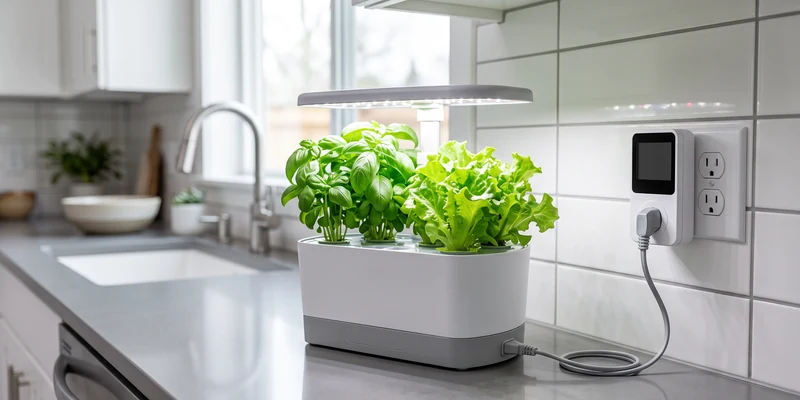
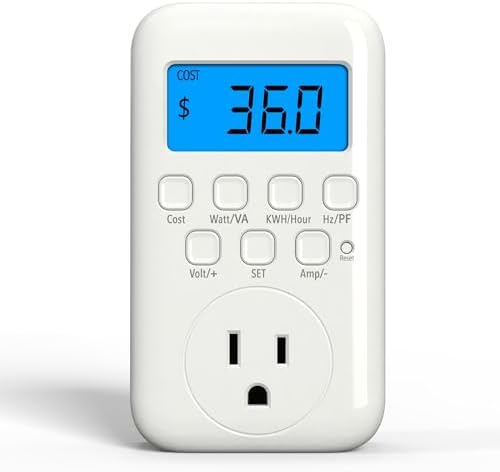
Two places to find your inputs. The wattage is printed on the power adapter or listed in the manual, and it is usually the maximum draw, so your real usage sits at or below it. Your electricity rate is on your utility bill, listed per kWh. If you want a measured number instead of an estimate, an inexpensive plug-in power meter between the outlet and the garden logs the real consumption over a week, and smart plug brands like Govee report it in an app.
A plug-in power meter is the simplest version: it sits between the outlet and the garden and totals kWh, so after a week you can multiply by your own rate instead of estimating from the adapter label.
What Actually Moves the Number
Three settings matter far more than which brand you bought: how many hours the light runs, how bright it runs, and whether you dial either one down as plants mature. Everything else is rounding error at this scale.
- Light hours. Most systems default to somewhere between 12 and 16 hours. Leafy greens and herbs generally do well toward the middle of that range, so trimming a 16 hour default back can shave usage without hurting growth.
- Brightness or height settings. Some models let you dim the panel or raise it as plants grow. Dimming reduces draw roughly in proportion.
- Season and placement. A garden near a bright window may need less supplemental runtime than one in a dark corner, though most people leave the automatic schedule alone.
- Heat side effects. A smart garden adds only a gentle amount of warmth to a room, so unlike big grow tents, there is no meaningful knock-on cooling cost.
Common Mistakes to Avoid
- Judging cost by the scary phrase “grow light.” High-wattage horticultural fixtures exist, but a countertop garden is not one. Check the actual adapter rating before worrying.
- Turning the light off to save money. Cutting light hours below what the crop needs saves cents and costs you the harvest. Weak, leggy seedlings are the usual result.
- Comparing the light to a window. Winter daylight through glass is far weaker than it looks, which is why the light schedule exists. The garden’s draw is the price of consistent growth year round.
- Forgetting the schedule after moving the unit. Some models reset their light timing after being unplugged, and a light stuck on 24 hours a day doubles usage and stresses many plants.
Electricity Is the Small Cost, Pods Are the Bigger One
Once you see the monthly figure, it becomes clear that power is not where smart garden money goes. The recurring cost that owners actually notice is seed pods and nutrients, which is worth understanding before you buy into any ecosystem. Our guide on how long smart garden seed pods last breaks down replacement cycles per crop.
If you are still choosing a system, efficiency differences between models are real but small in dollar terms. Pick on growing space, pod ecosystem, and reliability first, then let wattage be a tiebreaker. Our roundup of the best indoor hydroponic gardens compares the popular options on exactly those points, and the AeroGarden review covers the best known name in the category.
Frequently Asked Questions
Does a smart garden use a lot of electricity? No. Most countertop models draw around 10 to 40 watts and cost roughly one to a few dollars per month at typical US rates, comparable to a Wi-Fi router or a couple of LED bulbs running on a timer.
How much does an AeroGarden cost to run per month? A Harvest class unit at around 20 watts and 15 light hours a day uses roughly 9 kWh a month, which is around a dollar and a half at an average rate. Larger Bounty class models run somewhat higher.
Do smart gardens use power at night? Only a trickle. When the light is off, the remaining draw from electronics and the occasional pump cycle is typically a watt or two, which barely registers on a bill.
Is it cheaper to grow herbs in a smart garden than to buy them? Electricity is rarely the deciding factor, since it is so small. The comparison hinges on pod and nutrient costs versus store prices for fresh herbs, and frequent herb users generally come out ahead.
Can I put my smart garden on a smart plug to track usage? Yes, an energy-monitoring smart plug is the easiest way to measure real consumption. Just make sure the plug stays on so the garden’s own light schedule keeps running.
The Bottom Line
A smart garden’s electricity cost is genuinely minor: figure roughly one to four dollars a month for countertop units and a bit more for large vertical towers, driven almost entirely by the LED light. Calculate your own number with watts times hours divided by 1,000, and spend your attention on pod costs instead, because that is where the real money in this hobby lives.