Last updated: August 15, 2026
Two growers can stand over the same bucket, hold up two meters, and read 800 and 1120. Neither is broken. That single fact explains most of the confusion around EC for hydroponics, and it is the reason forum advice about parts per million so often leads people astray.
EC is a direct measurement. PPM is a conversion of that measurement, and manufacturers use different conversion factors. Once you understand which scale your meter uses, every nutrient chart on the internet suddenly becomes readable, and your own reservoir starts telling you something useful about what your plants are doing.
This article contains affiliate links. If you buy through them, we may earn a commission at no extra cost to you. Learn more.
Quick Answer
What is the difference between EC and PPM in hydroponics?
- EC measures how well your solution conducts electricity, which tracks how much dissolved mineral is in it. It is reported in millisiemens per centimeter.
- PPM is EC converted using a factor. On the 500 scale, EC 1.0 reads 500 ppm; on the 700 scale, the same solution reads 700 ppm.
- Work in EC wherever possible, and when you use ppm, always state which scale you mean.
EC to PPM Conversion Table
Here is the same solution expressed three ways. The EC column is the measurement; the two ppm columns are what different meters will display for it. The last column gives a rough sense of which crops sit where.
| EC (mS/cm) | PPM (500 scale) | PPM (700 scale) | Roughly suits |
|---|---|---|---|
| 0.4 | 200 | 280 | Seedlings and fresh cuttings |
| 0.8 | 400 | 560 | Young transplants, light-feeding greens |
| 1.0 | 500 | 700 | Lettuce and most leafy greens |
| 1.2 | 600 | 840 | Mature lettuce, mild herbs |
| 1.6 | 800 | 1120 | Basil and similar herbs, strawberries |
| 2.0 | 1000 | 1400 | Tomato vegetative growth, peppers |
| 2.5 | 1250 | 1750 | Fruiting tomatoes, cucumbers |
| 3.0 | 1500 | 2100 | Heavy fruiting, brassicas |
| 3.5 | 1750 | 2450 | Upper end of most home growing |
Full crop-by-crop targets, including pH, are in our hydroponic nutrient chart. If a chart or forum post lists ppm without naming a scale, convert it back to EC by dividing by 500 and by 700, and see which result makes sense for the crop.
What EC Actually Measures
Pure water is a poor conductor of electricity. Dissolve mineral salts in it and they split into charged ions, which carry current, so conductivity rises in step with how much dissolved mineral is present. An EC meter passes a small current between two contacts and reports how easily it flows.
That is the whole mechanism, and it has an important consequence: EC is blind to composition. It cannot tell nitrogen from calcium, and it cannot tell nutrient from contaminant. A reservoir at 1.2 EC might be perfectly balanced or badly skewed after a week of selective uptake. This is exactly why growers change reservoirs on a schedule rather than simply topping up to a target number forever.
The units you will encounter
Millisiemens per centimeter, written mS/cm, is the standard hydroponic unit and the one nearly every chart uses. Microsiemens per centimeter, µS/cm, is a thousand times smaller, so 1.0 mS/cm equals 1000 µS/cm; some meters display it this way and the reading looks alarmingly large until you spot the unit. CF, or conductivity factor, is simply EC multiplied by ten, so 1.0 EC is CF 10. All three describe the same thing.
The 500 Scale, the 700 Scale, and Why They Differ
PPM means milligrams of dissolved solids per liter, and the honest problem is that conductivity does not translate to weight in one fixed way. Different salts conduct differently at the same concentration, so meter makers picked a reference salt and calibrated the conversion against it. Different reference salts produced different factors, and the industry never agreed on one.
The 500 scale, also called the NaCl scale
This one references sodium chloride and multiplies EC by 500. It is the most common scale on meters sold in the United States, and Hanna Instruments meters are frequently associated with it. EC 1.0 becomes 500 ppm, EC 2.0 becomes 1000 ppm. If you bought a budget TDS pen from a US retailer, this is most likely what you have.
The 700 scale, also called the KCl scale
This one references potassium chloride and multiplies EC by 700. It is common on Australian and some European equipment, and the Bluelab Truncheon is the meter most often named in connection with it. EC 1.0 becomes 700 ppm. The same reservoir therefore reads forty percent higher than it would on the 500 scale, which is precisely how people end up dramatically overfeeding after following advice written for the other scale.
The 640 scale, the third one nobody mentions
A 640 factor also exists, sometimes labeled the 442 or European scale, sitting between the other two. It appears less often in hobby hydroponics but it does turn up, which is a further argument for working in EC and treating ppm as a display preference. Some meters let you choose the scale in a settings menu, and it is worth checking which one yours is set to before trusting any number.
Reading a Changing EC
The most useful thing about EC is not the absolute number but the direction it moves between checks. Your plants are constantly removing both water and minerals, rarely at the same rate, and the gap between those rates is what your meter reports.
- EC rising, water level dropping fast. The plants are drinking water faster than they are taking up minerals, so the solution is concentrating. Top up with plain water.
- EC falling, water level fairly steady. Minerals are being taken up faster than water. Add nutrient solution or refresh the reservoir.
- EC steady, level dropping. Uptake is roughly balanced, which is what you want. Top up with a weak solution to hold the level.
- EC rising sharply with no growth. Something is wrong at the roots. Check for root rot, water temperature, and pump function before adjusting anything.
- EC will not hold anywhere. The reservoir is likely exhausted and out of balance. Change it rather than chasing the number.
None of this works without knowing your starting point, so measure your plain source water first and treat that as the baseline. Hard tap water can carry meaningful dissolved mineral before you add anything, which means your true nutrient strength is lower than the meter suggests. Our guide to how often to change hydroponic water covers the schedule side.
Measuring Accurately
Two details separate a meter you can trust from one that quietly misleads you. The first is temperature compensation. Conductivity changes with temperature, so a meter with automatic temperature compensation, usually labeled ATC, corrects readings back to a standard reference. Without it, a cold reservoir reads low and a warm one reads high on identical solutions.
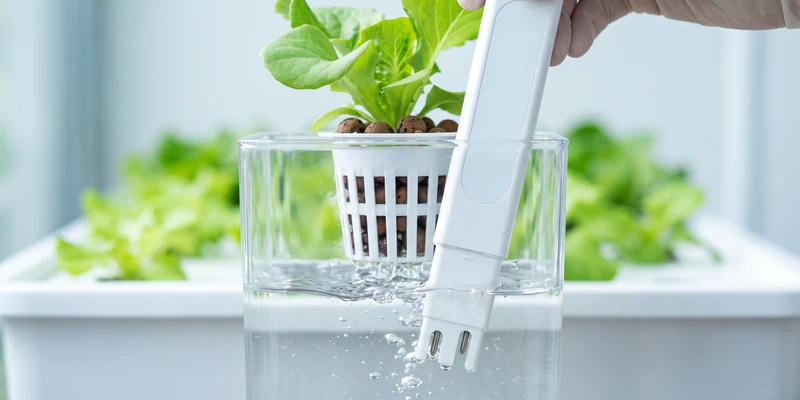
An ATC pocket meter that reports EC and ppm together is the baseline tool for a reservoir you check weekly:

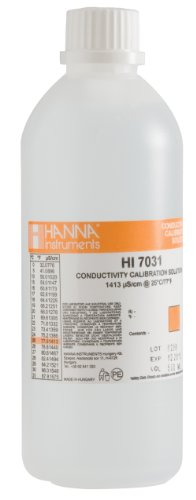
The second is calibration. EC meters drift, and the standard calibration solution for hydroponic use is 1413 µS/cm, which is EC 1.413. Calibrate on a regular schedule, rinse the probe in clean water rather than wiping it, and keep the sensor free of mineral film. Combination meters that read pH and EC together are convenient but hold two sets of calibration to maintain; our roundup of the best pH meters for hydroponics covers the reliable options, including combination units. Since meters and pumps live around open water, keep everything on a GFCI outlet with a drip loop in the cord.
Calibration needs its own bottle, and 1413 microsiemens is the standard reference solution for hydroponic EC meters:
Common Mistakes to Avoid
- Copying ppm numbers without checking the scale. A 700 ppm target on the wrong meter is a forty percent error in either direction.
- Assuming EC tells you what is in the water. It reports total dissolved mineral, not balance. Only a reservoir change resets the ratios.
- Ignoring your source water baseline. Hard water starts well above zero, so your effective nutrient strength is lower than the display suggests.
- Never calibrating. A drifted meter gives confident wrong numbers, which is worse than no meter at all.
- Topping up with nutrient solution. Water leaves, minerals stay. Plain water is the correct top-up when EC is climbing.
Where to Go From Here
EC and pH are the pair worth tracking together, because a solution at the right strength and the wrong pH still leaves nutrients unavailable to the roots. If lettuce is your main crop, our guide to pH for hydroponic lettuce covers the second half of that picture.
And if you are still working out what goes into the water in the first place, start with our hydroponic nutrients explainer and then the practical routine in how to mix hydroponic nutrients the right way. A meter is far more useful once you know what you are measuring.
Frequently Asked Questions
Is EC or PPM better for hydroponics? EC, because it is a direct measurement with one unit. PPM depends on which conversion factor a meter uses, so the same solution can read 500 or 700 ppm depending on the device.
How do I convert EC to PPM? Multiply EC in mS/cm by 500 for the 500 scale or by 700 for the 700 scale. EC 1.2 is therefore 600 ppm on one and 840 ppm on the other.
Which ppm scale does my meter use? Check the manual or the settings menu, since many meters let you switch. As a rough guide, meters sold in the United States commonly use the 500 scale, while Australian equipment often uses 700.
What EC should a beginner start at? Around 0.8 to 1.2 suits lettuce and most leafy greens, which is where most people start. Seedlings run lower and fruiting crops considerably higher.
Does temperature affect EC readings? Yes. Conductivity rises with temperature, so a meter with automatic temperature compensation is worth having. Without it, the same solution reads differently warm and cold.
The Bottom Line
EC is the measurement and ppm is a conversion of it, so the number on a chart means nothing until you know the scale behind it: the 500 scale multiplies EC by 500, the 700 scale by 700, and the same reservoir reads forty percent apart on the two. Work in EC, note your source water baseline, and watch the direction the number moves rather than the number itself.